Very thankful for…

Making copies in the office

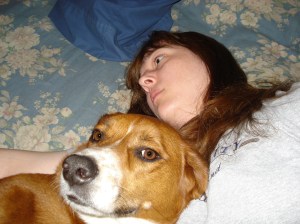
… copiers who “spit out” the copies high up instead of down low. See the look of disappointment on Chloe’s face? One of her favorite things to do is to “collect” the copies if they come out low.

School is starting! “Back to School Night” is tomorrow night and classes officially start 9/10! I only filled two classes this year so will only be teaching in the afternoon. As I’m in school myself, this will actually be a welcome break.

(pssst… hey Chloe? Ready to be my school bell again?)

Denise Portis

© 2009 Hearing Loss Journal

Get My Attention First

Denise and Chloe at the Aquarium in Baltimore Aug. 23, 2009

Dog Training 101

When I first began training at Fidos For Freedom in Laurel, Maryland, I learned from trainer Tracy B. that it is very important to use your dog’s name. This was especially important on the training floor where there were numerous dogs present all of which were being given obedience commands by their human partner. Calling the dog’s name gets their attention first. Follow that with a command about what you what them to do, and then lavish praise.

Even though I only attend the trainings on average twice a month now, I still make it a habit to use Chloe‘s name first. We have another dog that is never far from Chloe when she is home. Tyco is our family dog and is a two-year-old Norwegian Elkhound. He’s a “dog’s dog”. Oh sure… he loves us, but he idolizes Chloe. So where Chloe is, Tyco is there as well.

My husband was running into a road block on the stairs when he first arrived home from work. Both dogs would park on the stairs – entire bodies all “a-wag” waiting for him to acknowledge them.

I have finally taught Terry actual obedience commands (you CAN teach an old dog new tricks) so instead of saying, “Would you please MOVE?” he will say “move” with some authority in his voice instead of a question. The only problem was that he failed to use either dog’s name. I had to remind my “old dog” that he needed to use their name first. Now when he arrives home he will say, “Chloe move” (and she does), and “Tyco move” (and he does only because he follows Chloe – GRIN).

When he gets to the top of the stairs, he can put his things down and greet the dogs “proper-like”.

Hearing with a CI

When you have a hearing loss for twelve years and then receive a cochlear implant, you still do not hear perfectly. In spite of the fact that CI’s are bionics, you will also discover that you are not Jamie Sommers who can hear BETTER than folks with normal hearing. As a matter of fact, hearing takes WORK. Don’t get me wrong… I LOVE what I’m hearing and am so thankful for this technology! In a quiet room with few distractions, I can usually carry on a conversation without even having to look at you!

Let’s face it… the world is not a quiet place and the times I find that I’m trying to have a conversation in a quiet room are few and far between. Instead there is normally background noise. It can be noises like the television, stereo, pets, restaurant noise, crowd noise, etc. So the majority of the time I am trying to hear ONLY your voice amidst all the sounds my CI picks up for me. I have special programs (Smartsound NOISE or FOCUS) that allow me to pull only what I’m looking at closer; a type of directional microphone really! However, it is NOT a perfect solution. The background noise never stays at a constant level. It can get louder or softer. Hearing will never again be something that just “happens” for me.

It takes work.

I must concentrate.

It’s a shame I don’t burn calories!

Is it any wonder why late-deafened folks are so exhausted at the end of the day? I require 8-9 hours of sleep each night. If I don’t get it, I do not function at 100% the next day. I’ve had days where a sick teen or ill service dog have kept me up most of the night. I rarely even attempt wearing my “ears” (cochlear implant and hearing aid) the next day as I know I will hear little since I cannot concentrate.

Use My Name Please

It is very helpful to first use the name of someone you are conversing with that has a hearing loss. Hearing with a CI, I learned pretty quickly that in a crowd of noise it is in my best interest to work at tuning out all the sound. I recognize my name very easily, even among the buzz of voices around me. I’ve always been very thankful my name starts with a harsh consonant! Hearing my name first allows me to identify who is addressing me. I can turn and face them and begin concentrating in earnest.

Unless we are having a face-to-face conversation, I may look away from you after we have visited a bit to see if Chloe is doing as I asked (normally a down/stay or stand/stay). Or, I may smile at people across the room, wave, etc. If I am not looking at you, it is VERY helpful to say my name again to let me know you are talking to me again. It gets my attention. My CI zeros in on the voice. I’ve even been able to discern my name coming from the mouth of someone across the room! I think the most difficult listening situation is to be in a small group of people who are talking in a larger room with other small groups talking. You find that you are “part of the group” and attempt following the conversation as different speakers say different things. It can be exhausting!

Look at Me Please

I find it amusing that people with hearing loss are often the worst communicators. At my local HLAA (Hearing Loss Assoc. of America) meeting recently, I attempted to have a conversation with someone after the meeting. People were talking and standing around; some were busy tearing things down. There was a LOT of noise. The person I was trying to talk to spoke to their feet. Granted… they had the nicest brown sandals I have seen in awhile. Out of habit I looked to see what they were looking at while they spoke. I had to apologize several times and ask them to repeat something. At one point, this person’s attention was snagged by the activity of another member who was cleaning up the snacks. The person I was talking to turned to see what this other member was doing. I could tell they were still talking, but it became a buzz of sound as soon as they turned their back to me.

I said, “Pardon me? I missed that part after you said what you did about the recent rains”.

They looked at me exasperated and said, “Even though you have a cochlear implant now you don’t hear any better than I do!”

I decided to walk away (as I didn’t think I could speak “kindly”). They were on their way to grab a snack before they all disappeared anyway.

You’ve Come a Long Way, Baby!

I have learned a few things in the four years I have been “hearing again”. It is OK to stand next to someone who WAS talking to you and wait until you are spoken to again. A touch on my arm, or using my name alerts me to the fact that you wish to speak to me again. When I was first activated, I would attempt to not look as if I were ESCAPING after someone finished talking to me. I’d go and find a quiet place and look with wide eyes at the different groups of people standing around talking. If someone waved and then started toward me, I would “brace myself” for the difficulty in conversing with them.

Now I can stand in a crowd of people and wait to be acknowledged. If no one gets my attention, I am at ease. I find that I am even brave enough to start a conversation on my own. After all, I pursued a cochlear implant so that I could continue talking to the people in my life.

This week my schoolwork was interrupted by an “incoming IM” from my daughter. She was in between classes and wrote, “Hey mom! Do you have your ears in? Can I call you?”

Seconds later I was talking to her on the phone. Perhaps this isn’t a big deal to those of you who hear normally. But I haven’t been using the phone for very long. Even after receiving a cochlear implant, it took a lot of practice and courage to start using the phone.

… and here I was in the middle of the day

… talking to my daughter

… on the phone.

I cried.

But they were happy tears!

Denise Portis

© 2009 Hearing Loss Journal

Sweating Pullets

pullet Yesterday our air quit working. I had been painting all day, and was “hot” anyway so did not notice it seemed rather warm in the house. However, as soon as my husband walked in the door around 5:30 PM, he checked the thermostat and discovered the air was not working. We did everything WE knew to do, and then knuckled down for a long night.

I posted on Facebook the fact that our air wasn’t working. Misery loves company, right? Actually a couple in our church just had their air conditioner fixed THIS WEEK. Rick commented on my status and mentioned something about having “sweated bullets” the night they had to wait out the repairman.

“Sweating bullets“? As soon as I saw it typed there I knew it was wrong and was seconds away from allowing my fingertips to “tease him mercilessly” about the mistake. Something in me paused though. I decided that before I teased him about using the phrase “sweating bullets” instead of the correct form “sweating pullets”, I’d better look it up and see where the phrase came from in the first place.

Well of course there is no such phrase. Rick was right. I was stumped.

Hearing it Wrong my Whole Life

Although I didn’t become completely deaf until the age of 37 after twelve years of progressive hearing loss, I have had a slight hearing loss most of my life due to a pedestrian-car accident as a child. I had never SEEN the phrase written out. I had only HEARD the phrase a great deal.

As I tried to digest how in the world I got this phrase wrong my entire life, I realized there were several factors involved:

1. I had a hearing loss and “heard” the phrase sweating pullets.

2. I was raised on a farm and we had chickens.

3. In CONTEXT, the phrase was used in conjunction with: feeling afraid, anxiety, “scared to death”, feeling “chicken”

4. pullet = chicken

It made PERFECT sense to me!

Gulp. Ok the REAL Meaning?

From “Answer.com” the real meaning of this idiom is:

Perspire profusely; also, suffer mental anguish. For example, We were sweating bullets, sitting in the sun through all those graduation speeches, or It was their first baby, and David was sweating bullets while Karen was in labor. The bullets in this expression allude to drops of perspiration the size of bullets. [Slang; mid-1900s]

But ya know? This just doesn’t jive with me! I mean… who first saw large drops of sweat pouring off someone’s face and equated the size with bullets? Why bullets? Why not marbles? How about ear plugs? Huh? (sigh)

It’s really difficult to re-train my thinking. All my life I have heard “SWEATING PULLETS” and it meant “chicken, scared to death”.

Sigh.

Just to be safe I went to look up “fraidy cat”. After all, I may have been hearing it wrong. For all I knew it was really, “frayed kneecap”.

Geesh.

Denise Portis

© 2009 Hearing Loss Journal


Turning Off An Alert

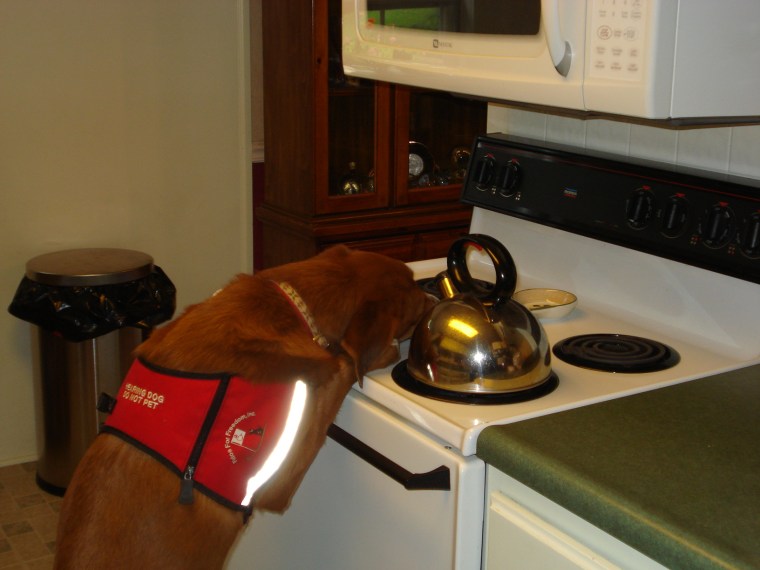
No worries... this is a staged picture. The tea kettle is cold, and a treat is on the stove to award a "Paws up" command.

One of the things I really love about Fidos For Freedom, is that even when you have completed your training you receive follow-up support “for life”. I see Chloe’s trainer about 3 times a month and so when I decided I wanted Chloe to learn a new alert, I contacted Pat.

I was putting the tea kettle on the stove to boil and walking away to check my email in the mornings. It would “whistle” like crazy after I obviously forgot about it after walking away. (You’d think I could wait patiently for all of 2 minutes!) My kids are sleeping in this summer on days they don’t work… at least, they are if the tea kettle doesn’t whistle them awake after it has been boiling for ten minutes or so! They BEGGED me to stop leaving the tea kettle without watching it. Well, I knew one other hearing assistance dog at Fidos who alerted to the tea kettle for her partner. I asked Pat how this was done, and she gave me a step-by-step plan of how to train this alert.

It worked like a charm! In a matter of a week, Chloe was alerting to the whistling tea kettle. The only problem is that I found I now had to turn that alert OFF.

Chloe bumps things with her nose to let me know what is making the sound. If a kitchen timer goes off or my cell phone rings, Chloe bumps them with her nose. When I taught her to alert to the tea kettle, I was finally able to “just forget about it” because she understood that this was now a part of her job. She’d race to get me and then make sure I was following her into the kitchen. Before I could stop her she tried bumping the hot tea kettle with her nose. I screeched and scared her to death ‘mid-bump’!

I thought, “well maybe it is all in the timing…” I attempted to follow her much more closely when she came to get me to let me know the tea kettle was whistling. That worked on days my balance wasn’t giving me fits. However on rainy days when Meniere’s disease caused me to have difficulty walking fast, she would beat me to the kitchen every time! I had to screech at her again!

She started being really anxious to alert to the tea kettle! (Wouldn’t you?) Everytime she did her job, I ended up having to screech at her. For now, I am hanging out in the kitchen for the 2 minutes or so it takes for the tea kettle to whistle. I think I’ll time how long it takes to be “almost whistling” and set the kitchen timer instead. The tea kettle would be an important alert (especially if you ask my sleepyhead kids), but it isn’t worth a burn on Chloe’s nose or paw. It is time to re-think how I want to do this. For now, the alert needs turned off.

Conditioning

When I first began losing my hearing, a subtle yet negative pattern began to take place in the way I interacted with others. If there was a communication blunder, faux pas or misunderstanding, it was always the hearing person’s fault. They not only didn’t understand what I was going through, but they didn’t care! Or so I had convinced myself…

The reality is that my disability is MY problem. It’s not YOUR problem! I had to learn to be proactive – not REactive. It can be very frustrating to tell someone to please face me when they talk – AGAIN. But the truth of the matter is, I make as many or MORE mistakes than the hearing people in my life. I start conversations with someone in my family from another room almost on a daily basis. I can hear them responding, and have to quickly hustle into the other room to at least catch the tail end of what they said. If I cannot understand, I sheepishly have to ask for a repeat (Baa – BAAA)

After I joined HLAA and began to learn from my peers a better way to communicate and advocate, I realized I desperately needed to be re-conditioned. Through the beginning years of my hearing loss I had conditioned myself to believe and react in such a way that hearing people were out to get me and that I needed to harshly and sternly educate in bullheaded opposition in order to gain their cooperation. I desperately needed to turn off this “alert”.

As the result of having established a bad habit in the way I choose to handle conflict regarding communication, I had begun alienating people round me. Worse… my behaving in such a way only insured that the next hard-of-hearing or late-deafened person this “idiot hearing person” dealt with would receive a defensive response. Not only was I hurting myself, but others with hearing loss as well.

Once in awhile I meet someone “new” that has hearing loss and a chip on their shoulder. I want to take them aside and explain my own history and need to turn off an “alert” It’s not always the right time or place, but I have had the opportunity to do so a few times. Sharing my own story seems to mean more than fussing at them about what they are doing. Explaining how to communicate with me best is an important “alert” or task. But to do so the wrong way is not worth “burning” someone else. I was taught and encouraged to re-think how I wanted to convey this information. I had to turn off an old “alert”.

It is very likely that all of us have something we should change… a bad reaction we have towards others. Maybe it’s one person that really gets under your skin. You hear their name and your blood pressure goes up! It may be time to recondition a negative response. You may not even realize it, but you may be hurting your reputation by the way you choose to respond to even the mistakes of others. Your own reputation or testimony may not be all that is at stake. Perhaps you are making all Democrats or Republicans look bad. Maybe you are making all Christians appear holier-than-thou or judgemental. Maybe the way you behave affects the way others look at all people with hearing loss. If you recognize this, you can turn the alert off and recondition the way you respond. If I can do it, anyone can!

Denise Portis

© 2009 Hearing Loss Journal

What does a “Drum Brush” Sound Like?

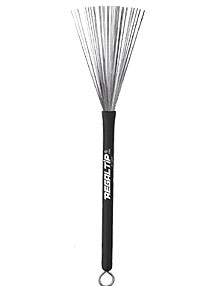
drum brush At church on Sunday I watched as the final seconds counted down to designate the start of our services. A timer displayed on the wall allowed everyone to see when the services were expected to begin at Daybreak Community Church. The band members rushed to thier spots and as the last second disappeared, the music director said “Good morning” to everyone present.

The drummer sat down at a single drum and microphone with a tool resembling the one you see pictured here. I had never seen this before as the “norm” for our drummer includes the entire drum set, cymbals, etc. I craned my neck to watch as he used what looked like a “whisk”, on a rectangular drum placed between his knees. I did my best to see if I could hear what sound he was making over there! Unfortunately, I could only hear the keyboard, base guitar and voices around me lifted in praise. It’s NOT that this is usually an unfortunate thing – smile! On the contrary, I am usually extremely pleased to be able to tell where we are as I look at the lyrics displayed on the wall behind the band! But today… I wanted to hear what this “whisk” sounded like!

Drum Brush

Immediately following the final “Amen” and parting song, I rushed up to the drummer with Chloe in “heel”. Because I didn’t even know what it was called, I reached over to his music stand and touched the “whisk”,

“Bobby… what IS that?”

“I call it a drum brush,” he explained while picking it up so that I could see it closer.

“A drum brush? What does it sound like?”

Bobby bent to his drum and “played it” again. I got down on one knee and moved my CI closer to the drum. I strained to listen… and could just barely make out a sound. It was a tiny, fluttery, BRUSH of sound. I smiled and looked up…

“Cool!”

Bobby asked, “What does it sound like to YOU?”

Hmmm… I had to ponder that for a brief yet “ponderous” second or two.

“I think it sounds like rustling leaves,” I replied.

“Hmm. I have always thought it sounds much like Jiffy-Pop popcorn,” Bobby grinned in response.

“Yeah! Yes, it does!”

I knew that agreeing also meant that I had instantly aged myself. For “Jiffy Pop” was something that was long before microwave popcorn. (Since Bobby and I are close to the same age, I knew he dared not make a crack about my age… besides you can STILL buy Jiffy Pop!)

Crackling Leaves and Jiffy Pop

If you click on the videos below, those of you with normal hearing or those who “hear again” with the miracle of a cochlear implant, you should be able to hear the sounds.


Memory Makers

Since I have been hearing again for four years now, many times when I re-discover a new sound I equate it to a sound that I still have “stored in my memory banks“. The brain is unique that way. If I am hearing a cat purr, I have a memory of cats purring prior to my becoming deaf. I grew up on a farm in southeastern Colorado. We had many cats and I had stored away what a cat’s purr sounds like. However, if what I am hearing is new to me, I am unable to compare it to the same sound that I was able to hear in my past. The best I can do is compare it to another sound in hopes of being able to describe it and make sense of it as I listen with my cochlear implant.

To me… a drum brush sounds much like the combination of crackling leaves and “Jiffy Pop” popcorn! It is the best comparison that I can think of in my attempts to place a new sound from a new “noise maker”.

Adaptation

Having an acquired disability can “make” or “break” you. I remember when my husband and I first realized that my hearing loss was progressive. I was going to the audiologist about every six months as my hearing was noticeably worse. Holding an audiogram with visible, charted proof that you are losing your hearing is very sobering. It seemed as soon as I adapted to communicating at the current level of loss, I would again lose some more of my hearing. Eventually, I could hear very little in spite of two new BTE hearing aids.

Each time I learned to re-adjust I would try to remember what had worked well for me in the past. Having never been deaf before, I had no comparison. I could only remind myself that I needed to continue to be active and proactive in communication. It worked in my best interest to make my invisible disability – visible. I wore my hair up so that my colorful ear molds could be easily seen. I pointed to my mouth and asked for a repeat if I was having trouble hearing. If I could only make sense of PART of what was said, I would repeat that PART and ask for clarification of what I did not get. If the background noise was extreme, I would ask if we could move to a quieter location to finish the conversation. I tried desperately to remain upbeat and positive. The alternative was scary.

Desperation and Despair

At one point in the process of my becoming a deaf person, I had really lost all hope. I had just moved from North Carolina and was trying hard to not only adjust to a new job, a new level of hearing loss, and a new community, but I had lost every friend that had meant so much to me! My North Carolina friends found excuses not to visit and emails were many times lost in cyber space. I had a great deal of difficulty connecting with people at work and church in my new home. I felt alienated and alone. Couple this with a progressive hearing loss that eventually began to even effect how well I could communicate with my family, and you were looking at one WHIPPED puppy!

Instead of adapting and reaching out for help, I isolated myself and became very depressed. Early in 2003, I found that I was actually contemplating how to end my life. How did I get to this point? At what point had I “given up”? When had I decided to no longer attempt living in spite of a disability? I’m not 100% sure of when it all went wrong, but I suspect I knowingly or unintentionally stopped remembering how wonderful life is! My brain had so many wonderful memories of living a successful and abundant life, and yet I seemed incapable of accessing those memories! I’m very glad that God intervened through people in my life who recognized I had given up.

No Alternatives

There are not any alternatives to adaptation. Life can be… and many times IS hard. We must continue to adapt and “roll with the punches”. There are plenty of blessings and wonderful memories as well. Adapting means we deliberately adjust to change. It is a mindset and a choice.

Lose your job?

Work hard at enlisting the help of friends and acquaintances to help you network to find a new position. You will find your friendships strengthened and you may make a friend or two you didn’t know before. Often times God moves us to a new place to live and serve which ends up providing a great deal more happiness than what we enjoyed before. Most people find that they grow and mature as they re-work that old resume, touch base with contacts and put themselves out there to obtain interviews in their seeking employment.My husband recently went through this and even I noticed the growth in his life at the end of the journey. He is now much happier than he was prior to losing his job.

Lose a loved one?

It can be so hard to say goodbye to someone we care about. I cannot write much about this topic, for truthfully I have yet to experience the loss of someone very close to me. I have seen plenty of people in my life go through this even recently, however. Their lives are a testimony to ME whether they realize it or not. It isn’t a matter of “if” I will experience the loss of someone I love. It WILL happen. I am learning how it can affect a person, and observing God’s grace poured out on the lives of those who desperately need it!

I could go on and on about different things that can happen to a person that requires we adapt. However, I would be writing all day if I did that for in truth, life insists we all learn to adapt. There is no healthy alternative!

Denise Portis

© 2009 Hearing Loss Journal

I’m sorry… 5 Different Ways

DSC02941

I’ve always been a big fan of “The 5 Love Languages”, written by Gary Chapman and along with other combinations of co-authors like Ross Campbell, and Jennifer Thomas. In collecting some background information for this post, I see that there are now 7 titles total. I’m behind! I only have 4 of the books! My favorite of the “lot”, is “The Five Languages of Apology: How to Experience Healing in All Your Relationships”. Every person has a preference in how they apologize. This is a good indicator of how they prefer to be apologized to by others!

Doggedly Different

chloe sorry Chloe and I have been working together for a little over two years now. In the beginning, I had to really get to know her and learn what some of her calming signals, body language and other cues meant. Sometimes as clients-in-training, we pick up things from our trainers just by paying attention. The trainers work with more than one dog more often than not. They simply cannot relay every single tidbit of information about your dog to you. When I’ve asked specific questions, they may think a second about MY dog and then answer as best they know. Something I picked up by listening to Pat was the word “phoeey”. It isn’t even said in a harsh way, or with an elevated tone.

We were at a gas station filling up Pat’s car. Chloe wasn’t  staying overnight with me yet, and so the fact that Pat was OUTSIDE the car filling up had Chloe concerned. I could just barely hear Chloe’s high pitch whine. When Pat got back in the car, Chloe hopped up to give Pat’s ear a kiss, and Pat calmly said, “Chloe phoeey”. Chloe immediately went back to her place “happy as a clam” and seemed assured that all was right in the world again.(Is a clam ever happy, folks? Where do we get some of our phrases? EYES ROLL).

By LISTENING, I learned that if I say “phoeey” to Chloe she understands to stop what she is doing. If it is something she knows she should NOT have been doing, she attempts to apologize as well. For Chloe, an apology is a sweet sit, eyes connect with a tiny sheepish duck of the head. She will many times put a paw on my knee if I’m sitting as if to say, “Sorry… we ok?” A pat on the head is all that is required for her to know the apology is accepted.

My Elkhound pup turned two this month, and believe me he is still a pup! tyco1 Tyco is very sensitive, and if I ask him to stop doing something (a louder WRONG for he ignores a “Tyco phoeey”), he belly crawls to me and licks my feet! The poor guy! I scratch his ears and “love talk” him for 10 seconds to let him know there are no bad feelings.(Longer periods of time just rewards his behavior… I want him to know all is well and GET ON WITH LIFE).


naked Peg 003 Pegasus is a nervous little guy. If he is corrected by person or other dog, Pegasus will TWIRL to apologize. He twirls. Constantly. In one direction. Opposite what my world spins due to Meniere’s. Needless to say, I intervene before I fall on my caboose. I reach down and pick him up mid-twirl, smooch him a kiss loudly and confidently, and set him back down. WHEW. Apology accepted.  ebony Ebony? Well she is our senior citizen. If she is corrected, (usually Ebony – NO) she ignores us. After all… she’s deaf (and partially blind, and arthritic, collapsing trachea, enlarged heart, liver disease, rotating patellas, alopecia and MORE).

5 Different Apologies

I think every person should read this book! I have learned so much about how each of my own family members have a different apology language. I’m learning how to do the same with other family members and friends. The apology languages are as follows:

1. Expressing Regret (“I am sorry”)

2. Accepting Responsibility (“I was wrong”)

3. Making Restitution (“What can I do to make it right?”)

4. Genuinely repenting (“I’ll try not to do that again”)

5. Requesting Forgiveness (“Will you please forgive me?”)

In a perfect world there would be no need for apologies. Since we live in a world that is far from perfect, it would be wise to learn to apologize. Let’s face it! We all blow it!

On Purpose

Sometimes we intentionally purpose to make someone mad or hurt them. I wish it weren’t true, but I can be honest with myself. There are times I know that what I’m going to say or do will either make another angry or hurt. Perhaps I justify it because it is done with vengeance. Maybe I’m just in a rotten mood and desire to “share the feeling”. It may be that I’m tired, not feeling well, and should go to bed instead of trying to communicate with someone. The damage is done! I believe when we are willful and premeditated about our wounding, our apology should reflect the seriousness of situation. I believe we should not only SAY we are sorry, but SHOW we are sorry. If I ever find that I am deliberate about being unkind, I attempt to make restitution. Shame on me!

Oops… did I do that?

Sometimes we hurt someone unintentionally. Apologies are given because of how another received what we said or did, not because it was our intent to hurt them. Have you ever discovered you hurt someone and that disclosure took YOU by surprise? If you hurt someone accidentally, you should apologize. Depending on the circumstances, you may try to explain what you were attempting to do. Don’t justify your actions WITHOUT an apology. It doesn’t really matter what you MEANT. If it hurt someone, we should try to make that right. We shouldn’t be so proud that we cannot say, “I’m sorry! I did not mean it that way, and I’m really sorry that what I said ended up hurting you!”

Having said all of that, we need to be careful about our own sensitivity. At certain times in my life, I remember being in the frame of mind where I EXPECTED people to say or do hateful things. Guess what? I was never disappointed. It seemed that every day I was owed an apology for something. What a terrible way to live! If someone says something a bit “off”, try not to jump to the conclusion that is was meant maliciously or callously. Expect the best from people… not their worst.

Recently my son and I were working together to change the cat litter out in the litter boxes. The kids have 3 cats between the two of them and so we have 3 litter boxes. (Ever tried to ask a cat to wait in line with her legs crossed?). We buy cat litter in huge 40 pound bags. I simply cannot lift it and “aim” at the same time. My 6′ almost 3″ son has no problem hefting big awkward bags… unless any dust happens to aggravate his allergies that is! In the middle of hefting, tilting and aiming the bag, he gave a tremendous house-rattling SNEEZE. Yup. You guessed it! When the dust cleared, he and I both looked down at the pile of litter that now completely covered my bare FEET.

“Um… gee mom. Sorry about that!”

I wiggled my toes. They didn’t appear because the pile was THAT DEEP. He didn’t MEAN to bury my feet. It wasn’t his intention to set up an accident to where it would necessitate my cleaning litter out from between my toes. I couldn’t help it… I started to giggle, then I began to crack up… and finally my son and I were both in stitches just dying laughing! We cleaned up the mess, and finished the job… but just barely! Chris gets the hiccups when he laughs THAT hard, which is just about as dangerous as a sneeze!

Heck! Even DOGS understand when it wasn’t on purpose! Sometimes my two big dogs will be playing and one of them may inadvertently nibble/pinch too hard. If Tyco did the “oops”, he drops and crawls to Chloe and licks her feet with his ears flattened. His apology language doesn’t change species to species it seems! If Chloe does the “ouchie”, she will come and sit next to Tyco and give him a soft cuff and lean against him. She looks up under her eyelashes at him with a look that says, “Did I do that? Um, sorry – oops!”

Chip on Their Shoulder

Have you ever met someone who is ultra-sensitive? It seems like every time you are with them you say or do something that hurts their feelings or wounds their fragile ego. Do we owe them an apology every single time? Wouldn’t our conversations with them end up being apologies alone? In the course of my lifetime I have been in contact with people like this. You may have to sit them down and say:

“You know? It seems like whenever we are together I say or do something that makes you mad or hurts your feelings. I’m really not intentionally doing these things! It may be that you have this expectation of me. Can we discuss this?”

Perhaps you should agree to just limit your contact with this person. Maybe you don’t have a choice! This may mean that you have to change your own behavior and carefully, methodically respond when with this person. You may be in a situation where it is impossible to tip-toe around the other person’s feelings. Your one-on-one conversation may include something like:

“It seems I cannot say or do anything to keep you from being upset. If you watch my interactions with others, I love to laugh, tease and interact with others in a positive way. I understand you do not like this and I have never intended to cause you pain. It may mean that we work together as best we can, and just acknowledge that our personalities do not mesh well. That’s OK! We don’t have to be friends to work together with mutual respect.”
clam If you are obsessing over where “happy as a clam” came from, feel free to click the clam to see what “Wise Geeks” says. Yeah… I was obsessing!

Denise Portis

© 2009 Hearing Loss Journal
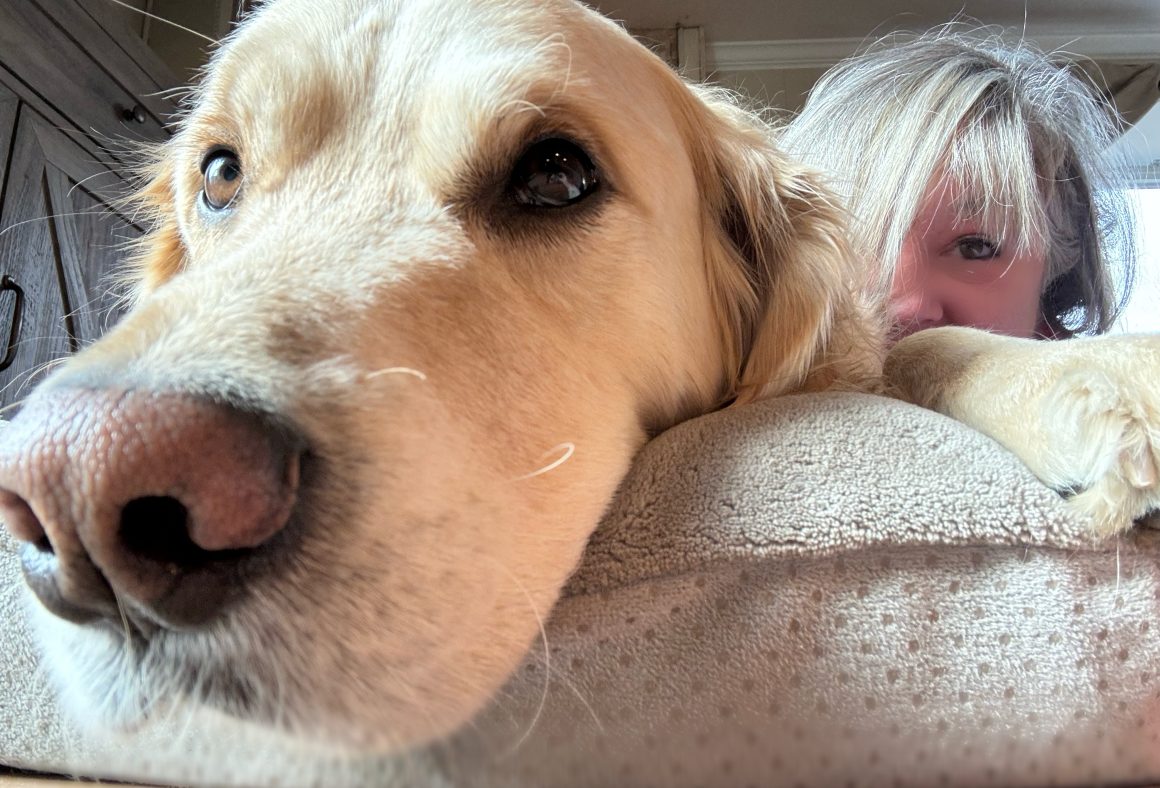

B.L.I.N.G and Invisible Disabilities

B asically L iving I nvisible is N ot G ood

My 19-year-old daughter came up with the witty acronym of B.L.I.N.G. (B asically L iving I nvisible is N ot G ood). It can be tied to a variety of life lessons.

Cochlear implant “bling” and Assistance Dogs

I am a late-deafened adult and I also have Meniere’s disease. Being “late-deafened” is a fancy way of saying that I lost my hearing after I learned oral language. Hearing loss can be mild, moderate, severe or profound. Although all levels of hearing loss affect the way in which a person freely communicates, a person obviously has more serious problems the more severe their hearing loss is. I think part of the reason that HLAA (Hearing Loss Association of America), ALDA (Association of Late-Deafened Adults), and other non-profit organizations for people with hearing loss have trouble attracting new members is that for most people, hearing loss is a nuisance and not a life-changing disability.

According to NCHS (National Center for Health Statistics), there are 37 million Americans who have trouble hearing (NCHS, 2006). A study done by Gallaudet in 2001 reveals that 8 million Americans have difficulty hearing even with the use of a hearing aid (Gallaudet Research Institute, 2007). This leaves approximately 29 million Americans who communicate effectively in spite of a hearing loss. This vast majority of people with hearing loss enjoy the invisibility of their disability as they function well “in spite of”. They “look” like everyone else. They do not have a need for support groups, advocacy or a connection to a non-profit organization because they have no need to identify with the hearing loss group. (I discussed why some people choose to not seek help when they DO have a significant loss here.)

When it became obvious that my own hearing loss was progressive, I began to realize how difficult it is to have an invisible disability. Prior to my cochlear implant in 2005, you would never know I had a disability unless I opened my mouth to speak to you. My speech was beginning to deteriorate just a little bit due to the fact I had not heard my own voice in a number of years. I may have interrupted conversations, not realizing someone else was speaking. I had trouble balancing the volume of my voice and more often spoke to softly than to loudly! Meniere’s disease kindly bestows noticeable symptoms for me when it’s a rainy or overcast day. You would never know it, however, unless I tried to walk a straight line or go up or down steps!

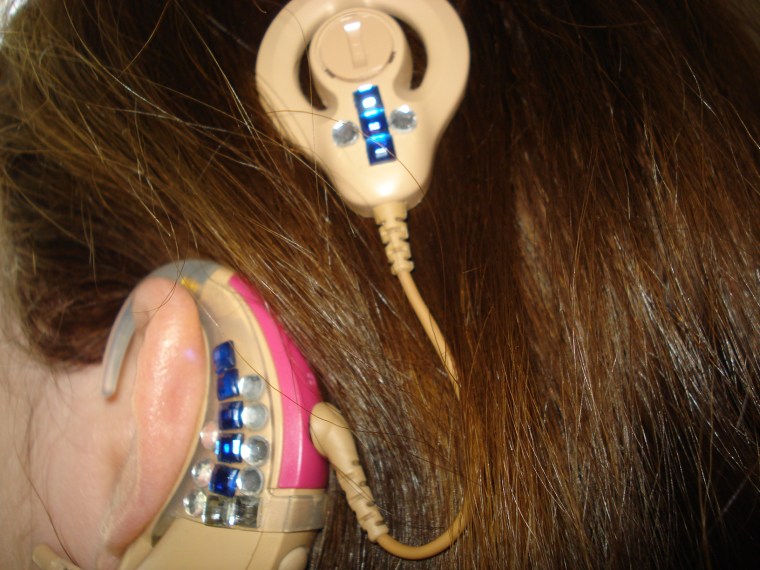
Being surgically implanted with a cochlear implant felt a little bit like a miracle. I could hear my own voice again in most environments and my speech improved dramatically over the period of only a couple of months! Having a cochlear implant does not mean I hear perfectly, however. There are some situations with a lot of background noise or poor acoustical environments that I may have to ask for a “repeat”. I may have trouble following conversations if I’m extremely fatigued. Prior to my implant, I had already adopted bright colored ear molds for my hearing aids and wore my hair up. I found out through a great deal of “trial and error” that it was in my best interests for people to know that I have difficulty hearing. After I received a cochlear implant, I didn’t see the need to change my adopted visibility. I wear “bling” on my CI, and it does draw attention to the fact that I hear but not in a normal way. It allows people to quickly identify that they may need to be sure to face me when they talk, or be aware that if I ask for a repeat it is not because I’m not paying attention. I really believe my “bling” helps other people as much as it helps me.

Having a hearing assistance dog who also does balance related tasks for me, brings attention to my disability as well. If you’ve ever thought about having an assistance dog, but do not like to field questions or have people notice you, then you may want to reconsider. Chloe comes from Fidos For Freedom in Laurel, Maryland. It’s not her bright red vest that gets attention. What makes people notice is simply the fact that she is a DOG! It’s not very often you see a dog in a store, restaurant or even church!

B asically L iving I nvisible is N ot G ood

Recently, God allowed a very mean person to be a part of my life for a short time. I say that GOD allowed this person, because it actually served to remind me that there are bigoted mean people who not only do not understand disabilities, but choose not to understand. Through FaceBook, I ended up “accepting a friend invite” because they were involved with someone I trusted. It didn’t take very long for this person’s true colors to be revealed. Comments left on my uploaded photos or “Notes” and eventually conversations between this person and myself and my husband through “instant messaging”, all revealed how there are still people who don’t “get it”. We received over 45 comments and messages from people astonished that there were still people like this out there! Some people do not realize that disabilities are often invisible. They do not understand that there are good reasons to make an invisible disability… visible! Some people do not understand that disabilities are not chosen. There are some that do not understand that disabilities may not only be life changing, they can be terminal. Many diseases and disabilities are those that shorten a life. God used this person in my life to remind me that some people are not only uneducated about disabilities, but they may willfully choose to believe the worst about those who have them. (It’s a great relief to not have to put up with this person anymore, but I do thank God that it was used to open my eyes!)

For me… basically living invisible is not good. There may be other people with Meniere’s disease or deafness who choose to live another way. I respect that! “Bling” works for me. It reminds even those I know well that in spite of my speaking perfect English (with the exception of a southern accent), I do not hear normally. It reminds them that if I repeat part of what I heard and wait for a repeat of what I didn’t… that it isn’t because I chose to stop paying attention. If I say, “whoa” under my breath and touch the wall in order to snap my visual field back into focus, they are reminded why I have a dog who picks up things for me and “braces”.

“Bling” and an assistance dog both serve to allow me to live with some independence. I don’t have to have family members with me now just to go to the post office or a store.

Invisible Awareness Week   0e1c199b505195ca9883a3faad5994b4

There are others who know what it is like to have an invisible illness or disability. September 14-20 is “Invisible Awareness Week“. If you or someone you know have an invisible illness, I encourage you to check out this site!

If you do not have an invisible disability, chances are you know someone who does. Do you know some of the strongest advocates for people with disabilities are those who do not have one? Think about it… who will get further with a person who misunderstands the needs, reactions, or communications from a person with an invisible illness or disability? Certainly people who live with invisible illnesses or disabilities should learn to advocate in a positive way. Their ability to do so helps us all! However, if you take a person aside and teach them… explain to them a little bit about another person’s disability or illness, it may mean even more! Every person can be a strong advocate for others.

Denise Portis

© 2009 Hearing Loss Journal
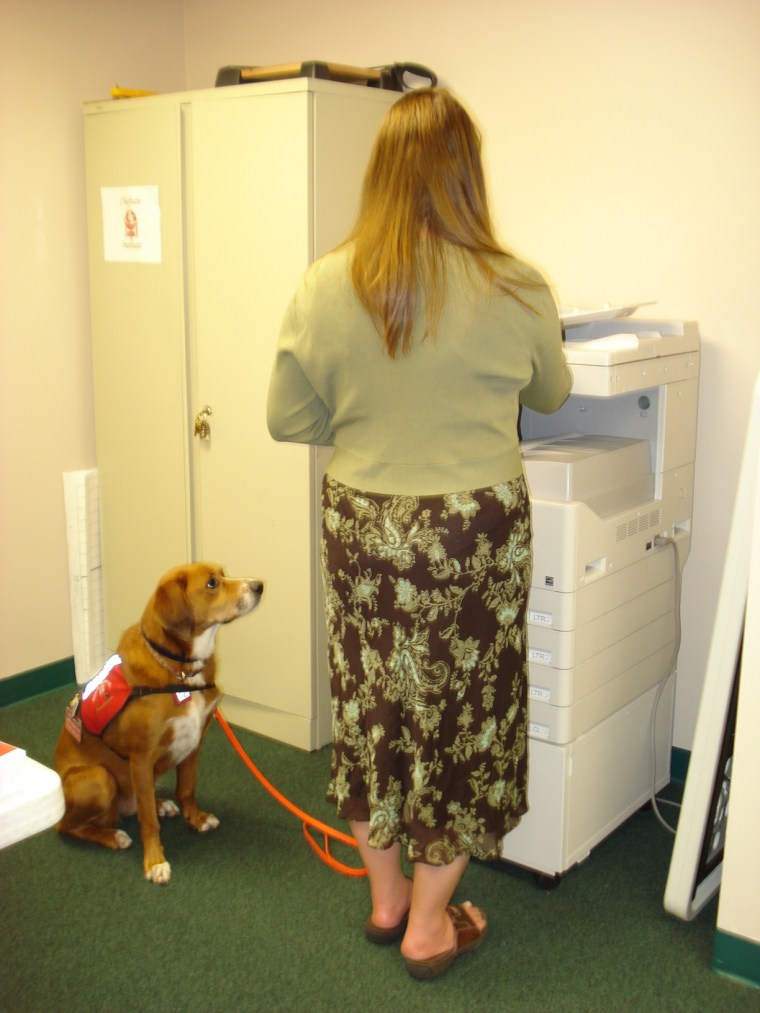
Sponge Bob Turns Ten!

sponge

I remember when Sponge Bob first came on the scene! My son was only eight-years-old at the time, and kept talking to me about “this really funny sponge”. Thank goodness for closed captioning, because it is VERY DIFFICULT TO READ A SPONGE’S LIPS!

Now that I’ve been “hearing again” for FOUR WONDERFUL years, I’ve learned that Sponge Bob has a rather annoying voice. But… it’s at least not as annoying as Patrick’s!

Happy Birthday Sponge Bob! I’m glad I was finally able to HEAR YOU!

Denise Portis

© 2009 Hearing Loss Journal

Plague of Small Things

sadI’m not sure where I first heard the phrase, “When it rains, it pours…” Perhaps from my mother who seems to be full of sage advice and quick with witty and appropriate tidbits of philosophical opinion.

It does seem that trouble comes in waves, breaking against my legs and threatening to topple me caboose first in the white foam of an incoming tide. I’m currently CHOOSING TO PARTICIPATE in great number of small worries. Why I seem so eager to engage in shouldering every care , I have no idea! I’m prone to do this and have to place some checks and balances in my life so that I don’t become truly handicapped!

Series on Job

My church recently finished a series of studies on the book of Job. How that man endured the loss he experienced in one day is beyond me! The Bible tells us that one messenger of bad news followed on the heel of another. “While he was yet speaking, there came another and said,” repeats four times in chapter one. I picture Job sitting there with a stunned look on his face while one messenger after another came to tell him his oxen and donkeys were stolen and servants killed, fire from heaven destroyed his sheep and servants, his camels were stolen and servants killed, and finally a natural disaster… a great wind… collapsed the house where all of his children and their families were feasting. No one survived! It always makes my own problems seem so minor!

And yet… it does seem that at times our worries, problems, stresses and cares come all at once. It can make us feel overwhelmed. They don’t even have to be BIG things, although at times they are! I think of friends who are facing cancer, advanced Lyme, depression and the loss of a home. Many of us experience a bunch of small problems all at once… a plague of small things. It is surprising how HEAVY these small burdens can be when shouldered all at the same time.

A Strange Song

A very strange, rather corny song has been going through my head this morning. I have so many things I have to accomplish this weekend I’m a wee bit overwhelmed. Chloe is even feeling my stress and does her best to cajole me into at least a snuggle moment or two! After my morning tea I found myself humming a song that I couldn’t place the name too. I even started singing the parts I remembered out loud in an attempt to trigger my memory of where I’ve heard it before! I’m fairly sure I was singing in tune too as I have my CI on! (smile) Chloe cocked her head and looked at me like I had lost it when I started deliberately placing my feet one in front of the other! Then it hit me! “Santa Claus Is Coming to Town”! Now if you were born after 1980, you may have never even seen the cartoon. However it use to be one of my favorite!

Kris Kringle just befriended the Winter Warlock, whose icy heart had never known true friendship or love. Kris gave him a gift and it melted that hard, cold heart! However, Winter Warlock despaired of being able to change! After all, he’d lived his entire existence as a burdened, angry cold-hearted grump! He worried out loud to Kris,

“But will it last?” and “… it is so difficult to REALLY change!”  His concern was that this change of heart would continue. Would he revert to his old ways? Could he truly release his cares?

Kringle replied, “Difficult? Why look here, change from bad to good is as easy as taking your first step!”

He then bursts into song… “Put One Foot in Front of the Other”.They shuffled side-by-side as Kringle taught Winter Warlock how to take ONE step at a time.

I had to look up the lyrics so that I could entertain the dogs with more than just the chorus. Oh that we would all learn to release one care at a time! Change occurs one determined moment at a time. Releasing stress happens one deep breath at a time. Parking your semi loaded with burdens in the driveway of a Heavenly Father who CAN handle it, happens one trip at a time!

I leave you with the lyrics, which explains a wonderful mindset far better than I can!

Song Lyrics

Put one foot in front of the other
And soon you’ll be walking cross the floor
Put one foot in front of the other
And soon you’ll be walking out the door

You never will get where you’re going
If you never get up on your feet
Come on, there’s a good tail wind blowing
A fast walking man is hard to beat

Put one foot in front of the other
And soon you’ll be walking cross the floor
Put one foot in front of the other
And soon you’ll be walking out the door

If you want to change your direction
If your time of life is at hand
Well don’t be the rule be the exception
A good way to start is to stand

Put one foot in front of the other
And soon you’ll be walking cross the floor
Put one foot in front of the other
And soon you’ll be walking out the door

If I want to change the reflection
I see in the mirror each morn
You mean that it’s just my election
To vote for a chance to be reborn

(repeat chorus twice)

Denise Portis

© 2009 Hearing Loss Journal
Simple Pleasures

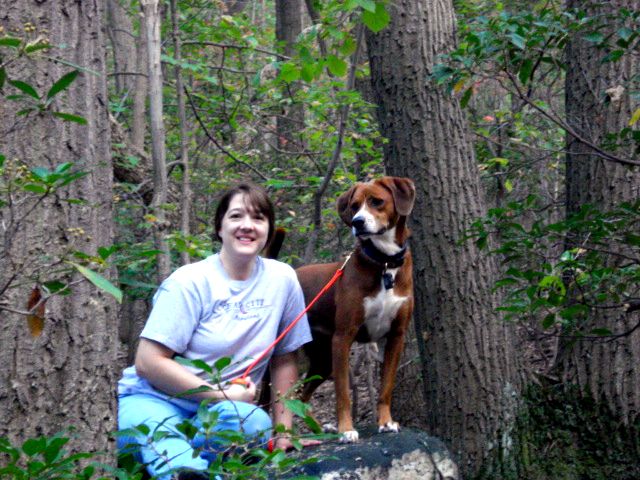
No greater "simple" pleasure than taking a walk in the woods!

You know? I think we try much to hard to find things that will make us happy. One can spend a small fortune trying to remain “entertained” or to find activities that will amuse us. Some of my favorite things are very simple, very inexpensive and yet very meaningful.

Pets are Great Examples

My daughter has two cats, and my son has one cat. Cats can be persnickity. Yet, in spite of uppity airs and snooty aristoCATic attitude, they are perfectly content to play with a milk jug cap. I mean, when they would just as soon watch the toilet paper unroll from the dispenser… why BUY a cat toy? They’ll chase and elminate the stray housefly that mistakenly enters their domain, and will sit and stare at the shadow of an oak tree branch by the picture window on the living room carpet for hours!

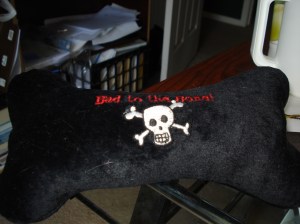
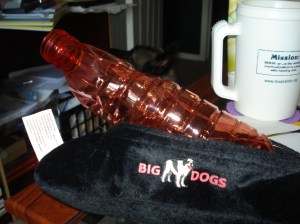
Chloe has plenty of chew toys, but unfortunately her favorite “toy” is a water bottle. It has to be a supervised toy for she inevitably gets that cap off! Luckily, I found a cool toy at the outlet mall from “Big Dogs”. You actually put an old water bottle inside of the velcro “bone” and the dog can “snap, crackle and pop” to their heart’s content!

DSC02915 DSC02916

Pets do not need fancy toys or “wildlife” videos to be happy. A daily walk on a new trail, a tennis ball and a master with a “good arm”, or a milk cap for the cat… they enjoy simple pleasures.

People Can Learn

Thankfully, both of my kids (ages 18 and 19 now) enjoy simple things. They do not require trips to the pool or beach, hanging out at the mall or going to expensive, “run up the credit cards” types of vacations.

Chris, the youngest, loves to putter around the kitchen believe it or not. He actually enjoys cooking and baking. I can’t remember the last time I fixed him breakfast or lunch. He loves to talk on “VENT” with his buddies while surfing the internet.

Kyersten enjoys a good book. One of her favorite things to do is to sit around all day and read a whole stack of books that she checked out at the library. She loves murder mystery books and has been reading some Agatha Christie titles lately that I recall seeing on my mother’s bookshelves decades ago. A tall glass of milk and double-stuff Oreos completes what she believes is a “perfect day”.

My husband is a secret computer geek. One of his favorite things to do is to kick back in the recliner with his laptop and surf the net and read blogs about Macs with a Coke ZERO in hand. He has recently re-discovered Jiffy-Pop Popcorn. The man is NEVER in the kitchen except to refill his glass. To see him patiently shaking the Jiffy-Pop on the burner of the stove and grin while it starts to pop and inflate is enough to make the most disorganized shopper carefully remember to write “Jiffy-Pop” on the grocery list each week.

Thankfully, our family enjoys “day trip” vacations. We live in the DC area and frankly, I don’t know that we will ever see all there is to see here in this area! We go as far north as Amish Country in PA, and as far south as the Smithsonian museums and national monuments in DC. Westward, we always head for Harper’s Ferry. We never go east, although I’m not sure why! Regardless, our vacations are inexpensive yet enjoyable.

Me? Well this time of year my favorite thing to do is to sit on the porch swing and LISTEN. It’s so much fun hearing and identifying different noises. I just celebrated four years of “hearing again” with my Nucleus Freedom cochlear implant. This summer I am hearing insects, lawnmowers, birds and children in the park. If there is a breeze, I can hear the wind whistling through the spruce trees or “twanging” the wind chimes below our deck. If I’m enjoying a cup of green tea while “listening”, you can rest assured that I am a happy, contented “camper”!

Slow Down

If folks are honest with themselves, they too enjoy simple pleasures. Everyone has a favorite “something” that helps to rejuvenate and “feed their soul”. Unfortunately, many think they can only take time to enjoy simple pleasures during the one or two weeks they go on vacation each year – although in truth many people try to accomplish and “do” far to much while on vacation! The reality is that people can enjoy simple pleasures every single day. If you like to read, invest yourself in your own schedule and make sure you are curling up with a good book for twenty minutes before bed each evening. Enjoy the outdoors? Take your lunch break in a nearby park and be sure to leave your cell phone at your desk! On your days “off”, determine to lay claim to two hours where you just relax and enjoy doing something simple. So many of us have so many responsibilities on our days off, that we rarely feel refreshed and prepared for another work week.

Electronics and computers are “simple pleasure” thieves. I’ll be honest and admit that I’m pretty ga-ga over FaceBook. It’s been so much fun to touch base with people I rarely see anymore, and I’m one of those very strange creatures who really does care what your status message says! However, I’m trying to take a break from my computer for one day each week. By doing so, I can be sure to find the time in my schedule to do other things that have become simple pleasures for me.

God is OK with “simple”

Many people believe that if they are too do something important for God, it may mean that they must sell everything they own and become a missionary to the deepest part of Africa. What a shame that folks do not see this world the way God sees it. There are plenty of hurting people that are encouraged by one small act of kindness or thoughtful word. It takes us 5 minutes to make a difference in another person’s day. Today in the mail I received a “friendship quilt” opportunity to write a “love note” to a lady in our church just diagnosed with cancer. It will take me 10 minutes to complete a task that will bring her great joy in putting her “friendship quilt” together!

The person who empties and washes out the coffee pot each Sunday is just as important as the individual gifted with the ability to carry a tune on the praise team. The person who volunteers to watch the little ones in nursery are sure to receive a more hearty “well DONE” from God than another who piously makes sure all know they are a deacon. You are not able to meet once a week to pray with a group of committed people? Do you think God thinks any less of the earnest popcorn prayers murmured daily on behalf of others? If you’ve a heart to pray… DO IT. You don’t have to sign up for a special ministry to be used in this way!

God isn’t impressed nor constrained to use only those who are labeled “super Christians”. I propose that more Christians doing “little things” for Christ accomplish more in a lifetime than one person who points to one summer mission trip they took as a young adult – nevermind that they’ve never done another thing for God since then!

I’ll close this post out with a few of my favorite quotes:

Enjoy the little things, for one day you may look back
and realize they were the big things.
–   Robert Brault

The art of contentment is the recognition that the most satisfying and the most
dependably refreshing experiences of life lie not in great things but in little. The
rarity of happiness among those who achieved much is evidence that achievement
is not in itself the assurance of a happy life. The great, like the humble, may have
to find their satisfaction in the same plain things.
–  Edgar A. Collard, 1974

It’s the little moments that make life BIG.

The best things in life are nearest:  Breath in your nostrils, light in your eyes, flowers at your feet, duties at your hand, the path of right just before you.  Then do not grasp at the stars, but do life’s plain, common work as it comes, certain that daily duties and daily bread are the sweetest things in life.  ~Robert Louis Stevenson

Denise Portis

© 2009 Hearing Loss Journal