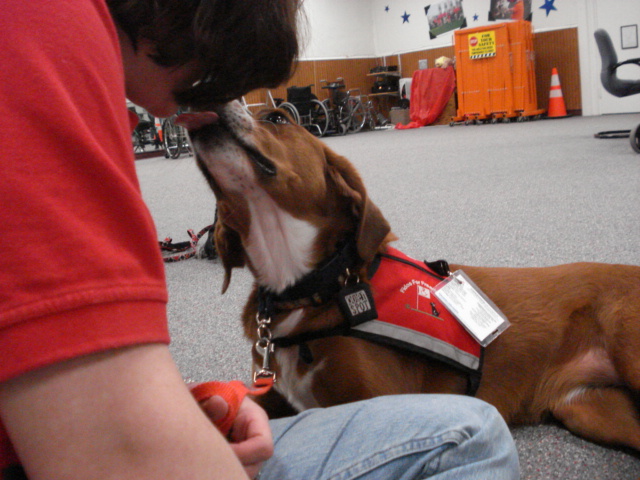
What’s Different? Not So Sure About This After All…

Saturday Chloe and I were both very excited about finding ourselves on the road to Fidos For Freedom in Laurel, MD, for training. We recently moved so that my husband wouldn’t have to travel 90 miles (one way) each day for work and have finally unpacked the last box. With no other pressing responsibilities or priorities in my way to keep me from attending training, I gratefully got up and prepared for a training class.

The closer we got to Fidos, the more Chloe whined. I love hearing her whine because it reminds me that I CAN. In a close environment like the car, I can always hear her “dog noises”. Sometimes outside or in the house I may miss that. (Part of the reason she comes to actually GET me for an alert…) By the time we parked, Chloe was practically clapping her paws together. (Well – yeah, that is impossible, but you get my meaning…)

After warming up on the training floor, Pat (Director of Training) set up some benches for a recall exercise. Now Chloe has recall exercises down and rarely breaks a “stay” command. I can turn my back on her, practically “hide” behind another client, stand 100 feet away, etc., and she will stay where I put her until called. This didn’t come easy for her in the beginning and she managed to cause many a trainer to pull their hair out. Pat had Chloe and 2 other dogs sit within the “box” she made with benches in the middle of the floor and we did a “regular” recall exercise. Imagine my surprise when Chloe broke her “stay” and headed right for me without being called. She responded to moving dogs around her instead of watching me. I put her back where she belonged and set about to try again. Pat was “speaking in my head” (via t-coil and the looped training room) that we should not be surprised if our dogs don’t respond as we expect because “SOMETHING IS DIFFERENT“. With that thought going through my mind I determined to watch Chloe’s body language more closely this time. As soon as I sat her down and went some distance I could tell she was nervous. Although she was staying in a “sit/stay”, she was juggling her body weight and fidgeting. Her ears were down and her eyebrows were crinkled as she looked at me across that distance.

Something was different. It was minor. But golly did it make the biggest difference to my otherwise well-adjusted hound dog! One minor change and she was unsure and ill-at-ease. Likely because I was making an effort to really pay attention to her body language more so than usual, I could tell that for the remainder of the training hour she was unsure of herself.

We approached those same benches later in the hour for an “under” training exercise. Pat advised us to remove correction collars because for many dogs this was “new” and we didn’t want to accidentally tug and give them even a minor correction. I removed Chloe’s leash/collar (and other than a quick interception as she made a bee-line for “her trainer”), coaxed her under those benches and through the exercise in a matter of minutes. Others may not have noticed. I did… because I was taking the time to notice. For even something that was “easy” for her… she was still trembling in approaching those benches. I could see the hair on her legs shaking. She was more confident because of my proximity, but still unsure of this “different”, staged set-up in the middle of the floor. These “different” exercises are good for our dogs. It helps them respond with more confidence when something happens out of the ordinary in public.

What’s Different?

It’s amazing to me how the smallest change in my environment can influence how well I hear. For example, having moved to a home with few carpeted areas, I’m dealing with hearing in an ‘echo’ and having some sounds “bounce around”. New place with no carpet – small change! Yet it still makes a difference in how well I hear.

Two men with very similar voice/speech patterns can be talking to me. Slap facial hair on one of them and I may have more difficulty understanding one over the other.

My new home has very narrow staircases. I can actually ascend and descend at a normal pace! The staircases at work, however? They are much wider and open, in architecture with higher ceilings. Both staircases take you up or down… but the wider, more open ones cause extreme vertigo while I can practically jog up and down the ones at home!

I can “circle left” on the training floor with Chloe and have no problems. “Circle right” practically knocks me on my butt though! When your world constantly defaults to spinning in a counter-clockwise direction, turning the opposite way can be problematic! I can go through revolving doors that go counter-clockwise. I have learned to avoid the ones that turn clockwise! Small changes can have a big impact.

Cumulative Effect of Small Changes

I try to be independent and confident. It’s one of the reasons I chose to be partnered with an assistance dog. I didn’t like having to rely on my family to tell me my phone was ringing or to pick things up for me that I dropped. I can be determined and full of “I am WOMAN – hear me ROAR” attitude and still find that small changes can have a cumulative effect on me. If I’m tired, sick, emotionally spent, stressed because of finances or work, “at odds” with a friend or family member, or haven’t given God the time of day lately, I find that the cumulative effect can really knock me off my feet (which sometimes may be quite literally!).

I’m a real believer in trying to recognize “red flags” and control what you CAN. Getting 8 hours of sleep every night for me is actually a main priority. I’ve had my peers ask, “How in the world can you get 8 hours of sleep EVERY night? Who does that?”

I do.

If I don’t get enough rest, it influences how well I hear and affects my balance. But ya know? As a friend recently emailed me and explained… “life happens” – planning, preparation, and “best intentions” sometimes fall short. Numerous “small” changes and differences occur in our normal routine that can ultimately have a big impact on how well we function – living with disabilities. I think we have to be on the look out for this cumulative effect. We may find we are getting sick more often. Perhaps if you’ve struggled with depression, you may find that you are feeling down more often than you were. Maybe you just NEVER feel completely rested.

Yes.

The reason you may not be hearing as well as you were (or whatever acquired disability you may be dealing with) may be that you simply need a new “map” (for those of you who are CI users), or a new hearing aid. Maybe your family have just gotten lazy and have forgotten that they need to face you. You may need to have a “family pow-wow” again. But sometimes? Sometimes we aren’t hearing well because all of these small changes have snowballed into a major cumulative effect on our hearing. Sit down and make a list. What changes have been going on in your life in the last week? The last month? The last year? You may find that numerous “small” stressors have taken their toll. Bramston and Mioche (2001) found that as people with acquired disability engage life with a higher stress level than someone without a disability, it may only take a small change to create problems for us. I think those of us who have lived with hearing loss for a longer period of time have discovered some tried and true coping techniques. In experiencing some “life happens” moments, we may even have a “plan B” set of responses that enable us to continue to live successfully and victoriously! The funny thing about life though? It likes to throw curve balls occasionally. We need to be wise enough to recognize a series of small changes have occurred that is keeping us from maximizing our potential.

Take a time out.

Regroup.

Ask for advice (and prayer).

Make any necessary changes.

Start again!

Don’t make the mistake of thinking you have this exercise “nailed” like Chloe did. One small change may make you realize things are not as they seem. The first flurry of activity and scrambling of peers may have you making a bee-line for your “mommy” too!

Denise Portis

© 2011 Personal Hearing Loss Journal

Bramston, P., & Mioche, C. (2001). Disability and stress: a study in perspectives. Journal of Intellectual & Developmental Disability, 26(3), 233-242. Retrieved from EBSCOhost.
Random Definitions – Consider the Source

Aren’t definitions funny critters? Oh sure… you can use “Dictionary.com” or Merriam-Websters Collegiate “big enough to cause a hernia” dictionary to look up words. But the funny thing about the English dictionary? Words can mean different things. The words can EVEN mean different things – to different people. Some random definitions I have encountered in the last week include:

Now: To the mother who demanded the trash be emptied, it means immediately. To the 20-year-old son who will get to it eventually, it means sometime today.

D-cup: “What does ‘D-cup’ mean to you?” Response: “Male or female?” Speechless thought: “Wha’…   ?”

McDonalds: To the over-extended, ‘I forgot to thaw out the chicken’ parent, it means SUPPER. To the health-conscious, it means ‘heart attack in a bag’.

Snap: Daughter: “Oh snap, I forgot my key!” Mother: snaps fingers and looks quizzically at daughter. Daughter: (raises eyebrows and shoots an exasperated DUH look at mother…)

Normal: To a teenager, it means someone who “fits in”. To a dog, it means it can be eaten. To a person who happens to have a disability, it means “treated like everyone else”.

Yup! You often have to consider the source to understand how people choose to define common words. The word “normal” has cropped up a couple of times in the past several weeks for me.

First occurrence:

Kyersten and I were at Costco looking around and purchasing some bulk items to take back to Virginia for college. A lady did a double-take, looked at Chloe (my assistance dog), looked at my head and kept walking a few steps. However, she immediately stopped and left her cart, pocketbook and items and trotted over to where Kyersten and I stood to say, “Excuse me! Is that a cochlear implant?”

“Yes,” I replied.

“Oh my husband has one of those. How long have you had yours?” she asked with curiosity.

I preceded to tell her a little bit about my own activation 5 years ago and hearing health history. I was trying to keep an eye on her cart (with pocketbook that screamed, “Steal me. Someone steal me” in it), so was a little startled when she interrupted my nervous glances toward her cart to say, “But your speech! It’s so normal!”

In talking with her, it seems her husband was deafened at a young age and was essentially without sound for 27 years before he received his own bilateral implants. He evidently has a noticeable speech impediment. But what is “normal”? I have met late-deafened and congenitally deaf people from all over the United States. “Normal speech”? Some would argue my southern accent is not “normal” for the DC-Metro area. How one person with hearing difficulties speaks, is much like an individual accent. There isn’t anything “abnormal” about it. My son has perfect (selective) hearing, and he has a speech impediment. It is “normal” for him though. How pronounced his own speech difficulties sound, depends on how hard he chooses to enunciate words and regulate his speed. Who determined what “normal speech” was and determined the “yard stick” by which to measure all speech?

At Pearle Vision Center:

A lady and her daughter stopped to admire Chloe who was in a down/stay. “Oh what a beautiful working dog! Are you training her?”

“Oh! No… Chloe graduated 3 years ago. She’s always training, but I’m not her original trainer” I replied.

“Oh! You mean she is YOUR partner?” the surprised woman asked.

“Yes. She’s a hearing/assist and balance assistance dog. I am late-deafened and have Meniere’s disease”, I cheerfully replied.

“Oh wow… you look so n-norm- normal” she stuttered out (since she realized how inappropriate that was as soon as she started saying it!)

I just smiled and she walked away embarrassed.

Normal?

Very likely, this world would be a better place if people didn’t go around labeling others as NORMAL or NOT.

To someone, somewhere… you aren’t “normal” if you choose to define the word as “not like you”!

Denise Portis

© 2011 Personal Hearing Loss Journal

Yup, I talk to My Dog. Don’t You?

I’ve embarrassed myself a couple of times in Wal-mart recently. I’ve caught the HUGE smiles of people passing by or catch the gleam in their eye as I look up and around. You see? I talk to my dog. It’s not just because she’s an assistance dog either. I talk to all of our dogs. But Chloe is the only one I talk to in the middle of Wal-mart, for obvious reasons.

People have heard me ask, “Chloe do you think the guys will want french-style green beans this week or do you think I can sneak some fresh green beans into the menu?” Chloe cocks her head and wags her tail. For some reason I’m able to make a decision. It’s not that I interpreted her body language to mean, “I’d go with the French-style, Denise”, but it helps to talk to her.

I caught an actual chuckle when I exclaimed to Chloe, “Chloe! Look! Can you believe it? It’s an Elmo Christmas SNOW GLOBE! Hope Santa knows I’ve been very good!” Chloe bumps my hand and wags her tail again. She thinks I’ve been very good.

Paying Attention

You might think I’m crazy. But actually… I’m helping Chloe keep her attention on me. If you look at a dog’s eye-level at Wal-mart, you will see things that aren’t as readily apparent to those who are taller than 3 feet. Stuffed animals, “Roll Back the Prices” price tags that Chloe thinks she really should swipe off the shelf and hand to me… all kinds of tempting things. By talking to Chloe, she pays attention to me. When I have a dizzy moment, I say, “Whoa….” and Chloe knows to take a step out of heel to make sure she can move if I actually fall. It’s important for Chloe to pay attention to me.

That’s why it is really not a great idea for people to “ooo and ahhh” over an assistance dog/service dog in public. You are getting the dog’s attention. They can’t help it. They KNOW they are beautiful/handsome and wonderful. Chloe’s vest actually has a tag on it that says, “Do not distract”. I realize people mean well, but if I’m having a bad balance day AND I don’t hear your “oh what a pretty dog” remark, I could fall just because Chloe wants to go and greet you.

What Distractions Can Do

I had this happen in Best Buy once. I was on my knee, balancing to see something lower, and someone got Chloe’s attention. She broke her heel to stand and WAG at them, and I fell right over. I laid there blinking up at the man whose eyes had widened in horror. “Gee, I’m sorry Miss. I can’t read, obviously”.

“Oh, that’s OK. I just wasn’t prepared”, I replied cheerfully from the FLOOR. I waved his hand away and said, “Actually she needs the brace practice, so no problem”. I had Chloe help me up, and the man again apologized. He even had tears in his eyes. I laid my hand on his arm and said, “Honestly, it’s no big deal. I sprawl at least once a day!” He wandered away unconvinced.

I do understand that seeing a well-behaved, dog identified as a “helper dog” can be really hard to just walk by for those of you who love dogs. I actually do not mind being stopped and asked about Chloe. However, it is really helpful if you talk to ME and not Chloe. Feel free to ask people with assistance dogs if you can pet their dog – because some people do not mind at all. I’m not those “some people” (grin). I will always (pleasantly) say, “I’m sorry she’s working and I’m trying to keep her from being distracted”. Be prepared for some people to say “no, I’m sorry”. They appreciate that you think their dog is “swell”, but it really doesn’t do the dog or the owner any good to constantly allow people to pet them in public. Many people use service dogs for disabilities that are invisible. It may not be easy to pick that up and asking to pet the dog might put the owner at risk.

If we meet someone we know real well, I actually do allow Chloe to say a quick “hello”. She is very good about giving quick kisses and then stepping back into heel. To do so is my choice though. Those who know me well, actually know not to ask on rainy days when they know my balance is going to be really bad. When Chloe sees someone she knows in public (usually folks from our small church, or close friends), she will do better to say a quick “hello”, so that she can get back to work. It is like identifying someone she knows from her “pack”.

Chloe’s Safety

By talking to Chloe in public, I let other people know she is there. Now that I’m completely independent and don’t have to worry about what I’m not hearing or dropping things I can’t pick up, I even head out on really busy shopping days. Not on purpose mind you! I’m not completely nuts! (grin) But I’ve been in a “crush” of people and talked to Chloe non-stop so that people would know she was there.

We made the mistake of going to Hershey’s Chocolate World the weekend after Thanksgiving this year. We go there a lot, but this was the first time it was literally wall-to-wall people. I couldn’t have fallen down if I had wanted too! I was completely surrounded by people! I talked to Chloe non-stop so that people would know she was down there. It’s hard to see someone 3 feet tall! I would even stick out my hand in a real “crush” and say rather loudly, “Excuse me… service dog coming through!” I was so intent on keeping Chloe safe by talking to her and watching where we were going that I mis-placed my daughter. I looked up and could see my husband in the distance, and my 6’3″ son was easy to spot… but where was Kyersten?

My heart was pounding and I held my arm out and just kind of plowed through to the nearest wall. I frantically searched for her little 5’3″ self and could not see her anywhere. I was scared spitless! I reached for my phone to see if I could send an S.O.S. text to her. Just then I felt a hand on my elbow. I whipped my head up and stared right into the smiling eyes of my daughter.

“Kyersten! I lost you!” I managed to sputter out. (It was hard, because I was spitless, remember?)

She rolled her eyes, and gave my shoulder a squeeze. “Mom. I’m 20-years-old. It’s not like I’m lost. If I lose track of you guys I’ll call. You are kind of hard to lose track of” and she gestured down to the red assistance dog complete with holiday jingle bell.

Freedom

You may run into me in a store, restaurant, movie theater, post office, pharmacy or doctor’s office with Chloe. You may HEAR me before you see me. I talk to my dog. But you know something? It’s not ONLY because it helps her pay attention. For you see… Chloe is the reason I’m alone in a store, restaurant, movie theater, post office, pharmacy, or doctor’s office. Before being matched with Chloe, I rarely went out alone. Talking to Chloe is a reminder to me… I’m in public, enjoying life, and yup! I’m talking to my dog. Don’t you?

Denise Portis

© 2010 Personal Hearing Loss Journal

Is INVISIBLE good?

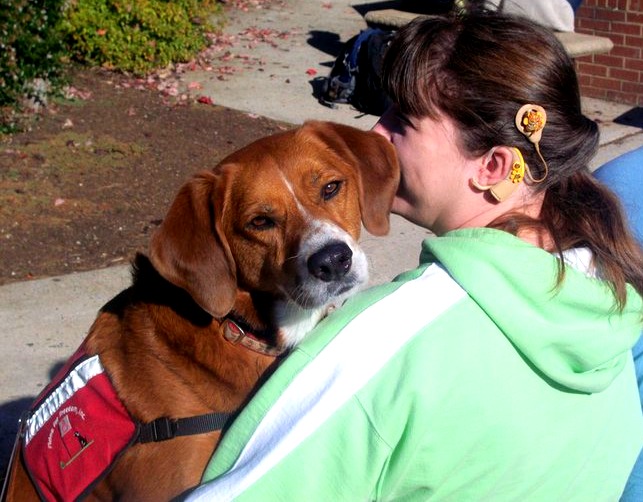
Chloe and Denise at 2010 Fall Family Weekend

A person that I know with invisible challenges (Fibromyalgia, IBS, and Chronic Fatigue) said to me recently, “Denise… you have mostly positive advocacy experiences because you make your invisible disability – visible. That isn’t always possible for other people with invisible problems!”

I thought about that statement for a week. Then I thought about it for another week. I actually thought about it for a third week, which for me? It’s nearly impossible for me to “simply think” on an issue without going ahead and blogging about it! I decided to do a “test”. I would dampen the visibility of my disability and see if I had any problems as a result. If you don’t want an invisible disability to ever become apparent – don’t get an assistance dog. Nothing shouts, “THERE’S SOMETHING DIFFERENT ABOUT YOU” more than having an assistance dog with you. Let’s face it… it’s not the norm to see a dog in a public place. Having a canine partner is not for the faint of heart, for you will have questions, be stopped constantly by admirers, skeptics and the occasional unattended child. Because of my balance problems, having an assistance dog has yielded far more benefits than any negatives. I wasn’t about to leave my assistance dog at home for the sake of a “test” so I had to think of other ways. Thankfully, those who know me well are so accustomed to seeing Chloe with me, she is almost invisible as well.

I have always worn my hair up since acquiring hearing loss. I made the decision early on to make sure my hearing aids could be seen. The decision came as the result of being knocked out of the way in a Sam’s warehouse in 2000. Someone had been trying to get by and I continued to look at the shelves since I couldn’t hear the “excuse me” in such a cavernous place. I think the woman who knocked me down was equally as startled as I, for she certainly had no intent of sending me to the floor. She said, “Why didn’t you move?”

I replied, “I’m deaf”, and watched the color drain out of her face. She helped me up and hurried away. That week I began to wear my hair up AND I opted to purchase brightly colored earmolds for my hearing aids. In 2005, I was implanted with the cochlear implant. It was very natural for me to continue to wear my hair up and to add the CI “bling”. Making an invisible disability – not – has helped me. The only time I’ve had a problem with my CI being so visible is when I would on very rare occasions run into a defensive, belligerent, culturally Deaf person who was vehemently against the technology.

So for my “test” I thought I’d wear my hair down and not have any visible assistive listening devices. I chose to do it on a “long” work day. Shortly after arriving at school I ran into one of my student’s parents. I couldn’t discern any difference in the way we interacted and communicated. I went to the office and made copies for my classes, and checked my folder for any notes from the administrator. My first class seemed to go OK. During discussion time, it can get pretty noisy. It seemed to me students addressed their desk instead of looking up when speaking, but I was very aware I could just be guessing at that. Another student helped me pull the overhead projector screen down and I could tell he was responding to a question with his back to me as he reached to pull it down. Again, I was very aware this was probably just my imagination and… after all what proof did I have that this doesn’t happen on a normal school day?

I was well into the afternoon classes and began to think that this was a poor test since all of my students know I have a hearing loss. I was already “plotting” to venture into a store or restaurant with my hair down for a more accurate test. That may actually BE a better way to test my theory, however I was surprised by a late afternoon comment.

After a requested “repeat”, a student said, “Oh sorry! I forget you have a hearing loss when your hair is down!”

Yes. I realize that my students interact with me quite a bit and are more likely to notice a change in my hair. This meant I needed a new test.

I went to Costco this weekend with my son. He’s 6’3″ and strong enough to assist with all those items we buy in BULK to save money. I deliberately wore my hair down. I hate going to Costco on a Saturday because it is always so much busier. However, I figured for this test… that would be a good thing. I pointed out items and my easy-going, “glad to be of help” son would load them up on the big cart. I had several people stop to admire Chloe and ask questions about her. It seemed pretty standard until my son pointed out…

“You know they only ask how long you’ve been training her because they can’t tell you have a hearing loss, right?”

Ta da! This was the proof I needed, right? Who knows. I did know that my friend with invisible challenges was right about one thing. I do try to make my disability visible and usually it is to my benefit.

I enjoy answering questions about my CI and my assistance dog. People ask great questions for the most part, and most are curious because they know someone who has hearing loss or someone that could use the assistance of a canine partner.

Should everyone with an invisible disability make it visible?

No.

Cochlear implant manufacturers produce the CI’s in a variety of colors… usually HAIR colors. Individuals choose a processor and magnetic coil based on their hair color in order to eliminate the visibility. The idea is to help you keep it “your business” if that is what you desire.

I’ve heard from others with invisible challenges or disabilities who have said:

1. I don’t want anyone feeling sorry for me. If I want someone to know about it, I’ll tell them at an opportune moment.

2. I don’t want my co-workers treating me any differently. It would be terrible if they thought any advancements or promotions I got were the result of special privileges.

3. I don’t want to appear weak. I have bad days but do my best to camouflage them.

4. I don’t want to draw a bull’s eye on my disability, putting me at risk for crime or making me a target.

5. I want people to know who I AM, and not judge me or define me by my disability.

These are legitimate and persuasive arguments. If you have an invisible disability or challenge, it is YOUR CHOICE how open you want to be about it. My heart goes out to those struggling with depression or mental illness. These challenges can be very difficult to disclose. Sometimes invisible challenges carry with them a stigma that can wound and demoralize an individual. Never forget that we are people first. We are NOT our disability or challenge. I chose to look at it as my disability is simply a part of who I am now… a new me. As we mature and/or age (as the two do not always coexist), all of us change. We may choose to color our hair, or take care of wrinkles through the help of a trusted plastic surgeon. Maybe we wear glasses or contact lenses now. Many choose to do what they must to avoid the stigma of an invisible challenge. Those who choose to keep their challenges hidden have the right to do so. I do not judge them and trust my personal choice is treated with the same respect.

Care to comment on why you do or do NOT make your own invisible challenges or disability more visible?

Denise Portis

© 2010 Personal Hearing Loss Journal

Exercising My Right to VOTE

Since my husband wasn’t going to get home until around 7:15 and the polls are crowded right before they close, I chose to walk to our polling place today. It was a beautiful, crisp, cold morning and required very little encouragement to get Chloe to make the long walk to go vote.

About a block from the school where we vote I stopped to get Chloe’s vest out of my bag and “got her dressed”. She looked at me sort of quizzically for I don’t usually “dress her for work” on a walk. She was immediately “all business” though and stayed in a proper “heel” instead of her “I’m on a walk meandering trot”. I entered the school cafeteria and stopped to remove gloves, scarf and unzip my coat. (Hey! I said it was CRISP!) While waiting in line a nice lady asked if she could pet Chloe. Chloe’s body always wags, “yes, please”, but I have to ask people not to pet her in vest in public places. Days my balance is “off” only requires her reaching for a friendly hand that I’m FLAT ON MY FACE. So I pleasantly explained why I couldn’t allow her to say hello, and continued waiting in line.

I didn’t have to wait long. Mr. “I really need a smoke” was sitting waiting for me and motioned me to come over. In this big cavernous, noisy room with hard floors, walls and high ceilings, I had to struggle to hear. Ever try to speech read someone who was chewing gum like a cow? This poor guy really needed his nicotine fix. I asked for a repeat on the birthday question 3 times. I finally pointed to my mouth and said, “I can’t understand you I’m afraid. Would you repeat that once again?”

I guess it was the hound dog head resting on the table top, bright bling on my CI and the fact that I asked for a repeat 3 times that he finally got that “light bulb” look on his face. He looked up, stared me square in the eye, moved his gum to his cheek, and clearly enunciated, “Birthday month and day?” Well WHEW.

Now I headed to a shorter line waiting for a poll volunteer to show me to a booth. The lady standing there waiting with me seemed friendly. She looked at Chloe, looked at me and said, “Oh wow! I saw you speaking to Earl! I can’t believe you are deaf because you speak so well!”

“Yes, most Americans with hearing loss actually speak very well and do not use sign” I explained.

We stood there waiting silently but I could see a funny look on her face like she was about to bust. The polling folks aren’t really suppose to have a conversation with you. Since I was ‘ready for it’ though I heard her whisper, “My husband can’t hear a thing even with hearing aids. It’s driving me bananas“.

Since she was trying to be unobtrusive I lowered my voice and said towards the floor, “Well I hear voices very well now that I have a cochlear implant. They require a very simple surgery and most folks I know do really well. You should have your husband look into it”.

She looked thoughtful and motioned to another worker to show someone BEHIND me to the next open booth. Again talking to the FLOOR she whispered, “Well I don’t know if he’d go for that”. (pause) “Does the dog come with the implant?”

I looked up to catch the wink so I just grinned and shook my head. “Sadly, but no!” I whispered back. I told the floor, “Well you should check into the Hearing Loss Association of America. They have a terrific website. You both could find out much more”.

Finally she could not delay any longer and showed me to an empty booth. “Push the card all the way in until you hear it click”, she said in a normal tone of voice. She turned to leave me to my voting and whispered, “Thank you!”

I took 15 minutes to vote and Chloe and I both got a sticker. (BIG GRIN)

On the walk home I couldn’t help but send up a quick prayer for this lady and her husband. Remembering how hearing loss once drove my own loved ones “bananas“, I really felt empathy for them. Hopefully she will follow through and find out more information about HLAA. I had to grin to myself as we headed up the last big hill towards my neighborhood. I went out to vote and ended up being pro-active about my hearing loss once again.

Funny how our own circumstances allow us to do that, isn’t it? I felt overwhelmed with gratitude to be able to have a whispered conversation to someone random that obviously had a “need”. It reminded me of one of my favorite “lists” that I periodically put around the house when needed.

Alice Gray‘s “Treasures of the Heart” seminar:

How to Put a Wow in Every Tomorrow:

1) Develop an attitude of gratitude: When you are experiencing tough times, remember the blessings in your life. It’s like sprinkling sunshine on a cloudy day.

2) Encourage others: When someone has a goal, most people point out the obstacles. You be the one to point out the possibilities.

3) Give sincere compliments: We all like to be remembered for our best moments.

4) Keep growing: Walk a different path. Take a class. Read something inspiring.

5) Give the gift of forgiveness: Forgiveness is a blessing for the one who forgives as well as for the one who is forgiven.

6) Take care of yourself: Exercise, eat a healthy diet, sing, and dance a little bit every day.

7) Do random acts of kindness: The most fun is when the other person doesn’t know who did it.

8.) Treasure relationships: Eat meals together, take walks, listen. Share laughter and tears. Make memories.

9) Share your faith: You can wish someone joy and peace and happy things, but when you share your faith–you’ve wished them everything.

Hope you went out to vote today!

Denise Portis

© 2010 Personal Hearing Loss Journal

Markers

Sunday I had the rare treat of hearing my husband, Terry speak. In the past I was able to attend and listen to numerous speaking opportunities that he had, but our lives do not “intersect” outside of HOME as often as they once did. So the opportunity to hear him speak on Sunday when our pastor invited him to “fill the pulpit” while he was gone was pretty special. Our church is beginning a study on the book of Ezekiel.

We don’t have a “deaf ministry” in our church. We also do not have a loop system. Our church family is a pretty small group – but we love it! There are two of us with cochlear implants. Myself and a young teenage boy are the “hearing again” crowd in our church family. When you hear with a CI, there is a teeny, tiny delay in processing what you hear until you understand what it is you hear. Most of the time I do not notice the delay at all. However, in large cavernous place like the auditorium in which we meet, plus the fact I have all this noise around me which includes children, rustling of papers, sneezes, adjusting body weight in chairs, etc., I’m a little more distracted by what I’m hearing! It’s also strange to focus your attention on a speaker, but the sound of their voice is coming from another place. I suppose since I was without sound completely for almost two years, I still habitually speech read. Looking at Terry, I “understand” much of what is enunciated on his lips. However, Terry’s voice was coming from the two large speakers from the side. Since we aren’t “looped” for hearing assistive technology, what I heard was what everyone else heard… coming from the speakers. (BIG GRIN). It’s hard to explain… but trust me when I say it can be difficult when you hear with a CI!

Anyway, Terry began by talking about his past work with BIANC (Brain Injury Association of North Carolina). He brought up examples of people talking about markers in their life. As I’m playing a constant game of “catch up” throughout the study… when he said this the first thing that came to mind was Crayola Markers. After I understood what he meant, I was pretty cracked up. Some examples he gave:

“Well before my brain injury, I ….”

“After I lost my hearing, I…”

“Before I got married, I…”

“After we had kids…”

We all have these markers in our life. At some point – LIFE HAPPENS. And when it does, you are left with a permanent “marker” in your life. Things at THAT POINT changed and your life would forever be different. These markers are not always a BAD thing… they can be a good thing too! These markers in our life indicate a point in time where our focus changed. They indicate where we ‘chose a new road’, or embraced a new calling or mission. The markers can also indicate a point in time where the “bottom dropped out” of the world as we knew it. Tragedy, loss, and heartache have a way of searing a painful scar on our hearts and minds, leaving a point in time where we recognize our lives changed.

Terry had some main points from Ezekiel chapters 1-4. Ezekiel’s marker was an encounter with God. Before this “marker” in Ezekiel’s life:

BEFORE

He was entering a new season of life.

He was with people who were dealing with problems.

He was looking for opportunities from God.

Then during the “great moment in time” that would forever change Ezekiel’s life:

DURING

It was impossible to ignore.

Impossible to explain

and Impossible to get over.

After the encounter, Ezekiel found that:

AFTER

What defined him would be different.

What discouraged him would be different.

What satisfied him would be different.

I think all of us can say that these points hold true to any “marker” we have in our own lives. Invisible disabilities may define individuals in different ways but there is one thing we have in common. Our lives will never be the same. That isn’t always a bad thing… for even in “losing something” we often gain so much. It may be hard to recognize at first, but the ‘gain’ is there if you really look for it. I think of my own life and the marker of “After I lost my hearing…” What now defines me and discourages me is different than before the marker. What SATISFIES me is different. My goals, desires, and passions are much different than they were. I have a friend who deals with numerous invisible disabilities. I love her. She has ministered to me in ways she does not understand. She once wrote about her new satisfaction about what a friend was. Allow me to share…

“Several years ago I fell ill, unable to continue a life that was full of people. They were genial folks, kindhearted and interesting. As they faded away when I was no longer able to do things with them and for them, I discovered the difference between a friend and a friendly acquaintance… A good friend changed from something I was owed to a breathtakingly beautiful gift. The sorrow and grief made that change possible, leaving behind it a bit of wisdom. There have been many an acquaintance made after I lost my pre-illness social circle, but now they are held rather lightly. I enjoy them, but resist having expectations of them. Often I will find myself sensing when a relationship feels more like a requirement, or when I seem to be taking more than I give back. Not in IOU or UOME terms, but in an awareness of balance.”

She goes on to explain that really the only ONE who can meet our needs is God.

I am reminded of an Ebenezer. To some of my readers, you may recognize that word from a VERY old hymn, rarely sung in churches today. “Come Thou Fount of Every Blessing” is not widely known in today’s churches. I had a grandmother who was not only fond of old hymns, but also of explaining what words meant. Ebenezer comes from two Hebrew words Even and Haazer. It looks like this:

It means “stone of help” and represents a memorial stone set up specifically to TESTIFY and REMEMBER.

These markers in our life are indelible, permanent fixtures on our own hearts and minds. For some things, however, I like to have a literal Ebenezer. Something tangible, something I can hold, and something that forces me to remember.

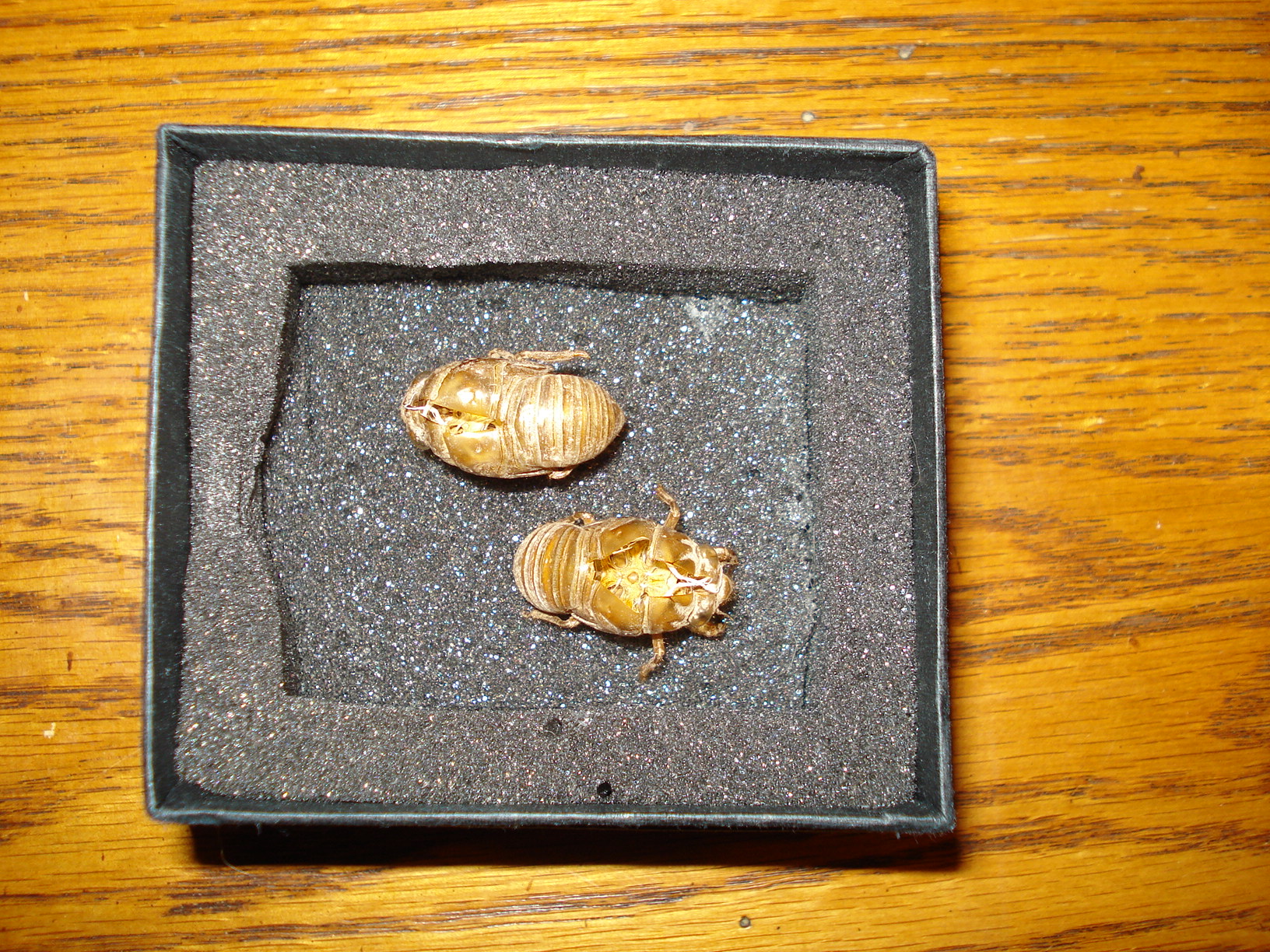
You are going to think I’m crazy… but check out this Ebenezer:

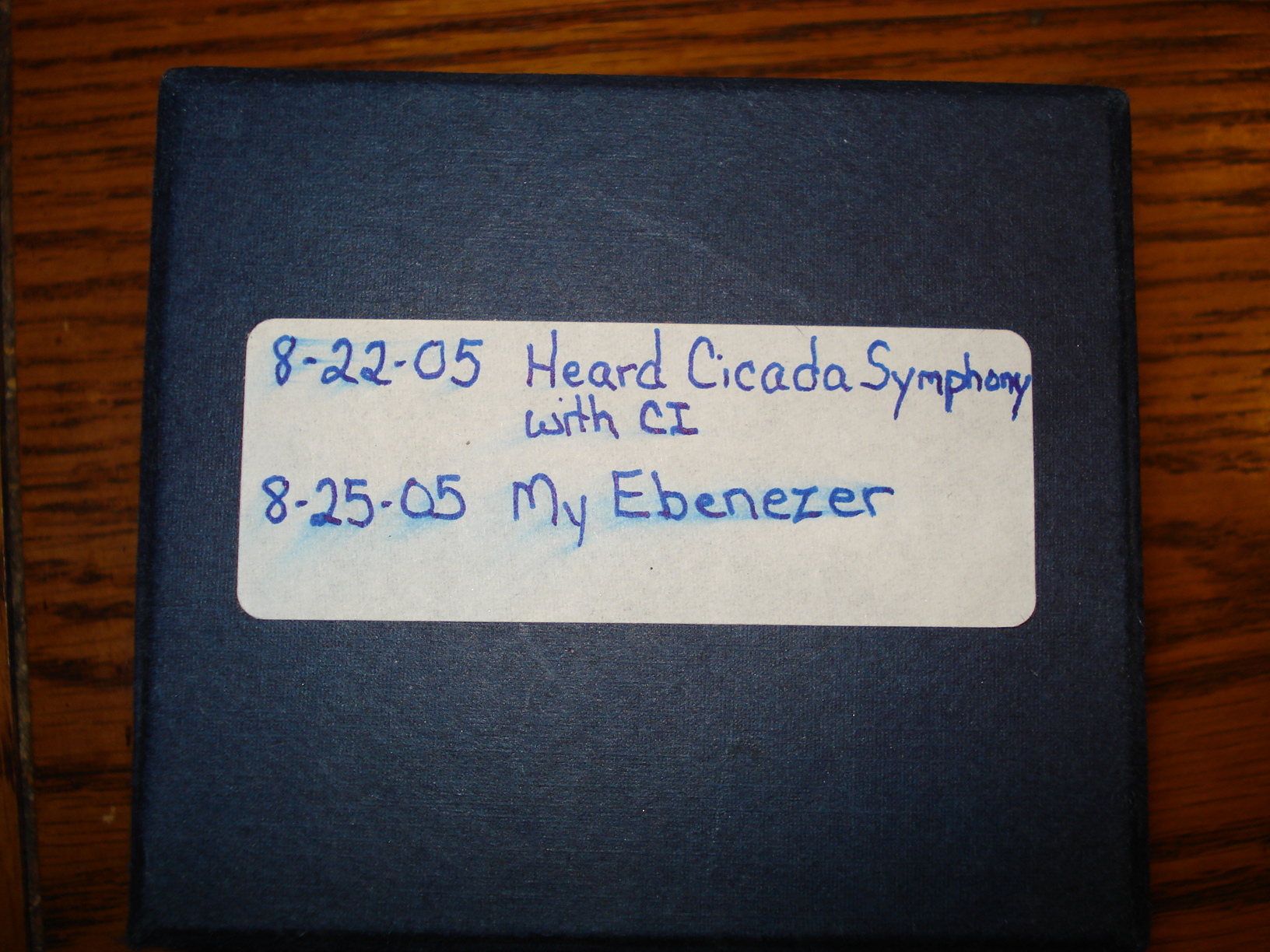
Nope! Your eyes do not deceive you. These are two shed cicada skins. Before you think I’ve lost it and am “gruesome beyond belief”, read the LID of the box:

Unless you’ve lost your hearing… only to regain it through a cochlear implant, you cannot understand what it means to hear and recognize a sound from your past.

You cannot understand what it means to bend and pick up something unless you live with arthritis.

You cannot understand what it means to see again unless you’ve lived with cataracts and then had them removed.

You cannot understand what it means to stretch for a glass from your cubboard and realize you feel no pain today, unless you live with fibromyalgia.

You cannot understand what it means to have independence because of an assistance dog, unless you live with mobility issues and difficulties.

You cannot understand what it means to look forward to “today”, unless you live with mental illness.

Life challenges bring a new appreciation… a new satisfaction for what once were mundane tasks. If you haven’t yet identified markers in your life, well my friend? It’s one of two things… you either aren’t living life, or you haven’t lived enough of it YET.

One of the hardest things about being a parent is seeing my young adult children identify and experience things that etch permanent markers in their own lives. Perhaps you aren’t a parent, but you know someone who is experiencing a first “marker”. Do your best to encourage them. Be a living testimony of someone whose own life markers made them “better”. Make a difference…

Denise Portis

© 2010 Personal Hearing Loss Journal

Prepared For It?

We simply do not take ANY chances

“The dog days of summer”… whew! Has it ever been hot here in my home state! I could take a repeat of last winter’s snows, believe me! I’ve always preferred 3 feet of snow to 3 weeks of 95 + temperatures! Because of the heat, Chloe and I have been forced to walk pretty late at night. At “twilight” it is dark enough that it isn’t safe to be walking. At least not in my neighborhood where people go 40 mph in a 15 mph zone.

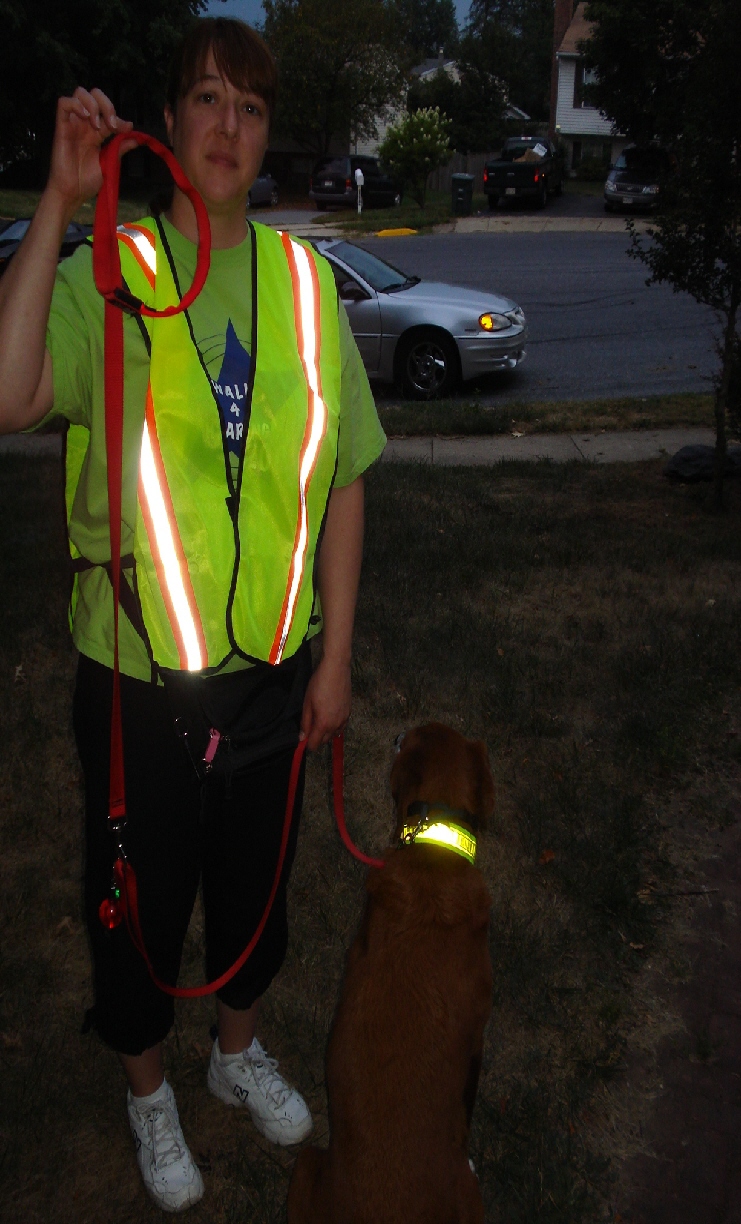
To placate my husband, I make sure Chloe and I are decked out in a number of things that are reflective. I wear a reflective vest, and Chloe a reflective collar. The leash I carry actually lights up near the handle end, and it also sports “lighted bling” of various kinds. I’m sure from a distance we must look like Santa and his team of reindeer! Small price to pay … this GLOW IN THE DARK preparation — for a safe walk! I didn’t anticipate having to walk so late at night, yet preparation has made all the difference.

I’m safe.

It is cooler.

We walk faster.

No… really! Not sure why that is, but the big “loop” we walk is usually 7-8 minutes faster than if we walk when there is more light. Perhaps because we aren’t having to stop to get Chloe re-collected after startling a bunny? Either the bunnies have an early bedtime, or they simply are not seen as easily.

Just Because it Wasn’t Planned, Doesn’t Mean You Don’t PREPARE

I know of very few people who planned to acquire a disability or to be diagnosed with chronic illness. I have become acquainted with people who have progressive hearing loss or are deaf, people who have lost their eyesight due to Usher’s Syndrome, people with MS, Parkinson’s, Meniere’s disease, and Chronic Fatigue Syndrome, people with fibromyalgia and many others who find that they are living a life they didn’t exactly “sign up for”.

So what do you do?

Give up? Try to get a refund? Sue?

Well… most of the people I know “deal with it”. They do so in their own way, and for some it may mean working through it. Working through it for some people may mean that they have a pretty long period of time either denying the problem or grieving the problem. Each of us do this, but some spend more time on these steps than others. That’s OK. I get really aggravated when I hear someone tell a person learning to live with changes that affect their life that they need to “get over it” and “get on with life”. I guess I’m aggravated because the person saying that usually does not have the same diagnosis as the person they are preaching at! However, I do sometimes see someone who DOES share the diagnosis “preach” the same. Just because YOU did not grieve your hearing loss — or whatever it may be that you are dealing with — doesn’t mean that other people deal with the loss the same way.

Once you do work through that process, however, you can start to prepare. Preparation is key. For me preparation looks like this:

1. I always have #13 hearing aid/cochlear implant batteries. I carry some in Chloe’s vest, the car, my pocket book, and Chloe’s treat bag. I have them in my bedroom and my office.

2. My cane is right by the front door. If it is rainy or if there has been a pressure system come into the area, having my cane “handy” insures I actually take it with me out the door. No one “messes” with where I put my cane. If you move it, you risk life and limb (grin).

3. I leave early to arrive early. Let’s face it. It takes me longer to get to where I’m going. For one thing I travel with an assistance dog, and I have to spend a couple of minutes allowing her to “do her thing” before going into a public place. I have to load her up safely in the car. I have poor peripheral vision on one side so I drive the speed limit in a world where no one else does. I allow extra time to get to places ON TIME. Sure! I’m early sometimes, but I am rarely late.

4. I never walk out the door without my cell phone… and I am ZEALOUS about making sure my phone has a full charge. As a matter of fact… I have my cell phone on my person almost every waking moment. (Perhaps something to do with having a kid in college in another state now?)

5. I make it a PRIORITY to get eight hours of sleep. This is so important, I schedule myself to get at least eight hours. Heck! I’ll be honest… I actually do better with nine, so if I can schedule that I do! Having a cochlear implant is terrific! I love being able to communicate without having to actually be in the same room with someone. I’m fairly certain it’s not AGE… it simply takes a LOT of brain power to communicate now! Who’d have “thunk” that communicating with a hearing loss could be so exhausting. It doesn’t seem fair that no calories are burned! It is mentally (and sometimes emotionally) exhausting to communicate with hearing loss. If I get less than eight hours of sleep, it is very noticeable that I do not communicate as well. Fatigue will do that.

6. I make sure I travel with information about service/assistance dogs. You never know when you may have access issues. As a matter of act this has been a pretty prevalent part of our lives lately. (See the links here (with a video too!), here and here).

7. I avoid sodium, limit caffeine (something I find nearly impossible), and take Manganese! These three things I have found to be very helpful in limiting the effect Meniere’s disease has on my own life. Manganese is hard to find too! (Magnesium is plentiful… Manganese not so much). Remembering to make these “BIG 3” a priority, really makes a big difference in how severe my symptoms may be when an episode hits.

8. I memorize and use lines that best describe my communication issues and how I can solicit positive responses. These include:

A. You speak wonderful English! However, I have a hearing loss so I have trouble with accents. Could you repeat that a little slower please?

B. I have trouble understanding in background noise. If you would face me when you talk, I should be able to speech read and hear with my CI (point to it) and hear you much better!

C. I missed what you said. What I heard was (and I repeat the parts I heard). Could you repeat what I missed? (This way folks aren’t having to repeat EVERYTHING).

D. It’s so noisy in here that I am having trouble pulling your voice from “all this chaos”. Can we step over there (points) to a quieter spot? I really want to hear what you are saying.

E. Do you mind if we sit down? My balance is “off” today and if we sit it will give me one less thing I have to deal with!

F. Let’s step over here to talk so that I can put Chloe in a “safe place” so she won’t get stepped on.

There are many more… but it pays to rehearse and have specific examples to communicate to others your attempt at being proactive to help yourself. I have never… not even one time… had someone respond to these types of explanations in a negative way. Preparing explanations like this keep me from slipping and offending someone by spouting off:

A. Geesh, your accent is killing me! I can’t hardly understand what you are saying!

B. Would you quit mumbling and speak slower please? Gee whilackers!

C. HUH?

D. WHAT DID YOU SAY? (In a super loud voice trying to drown out all the noise. Now ever eye is on you and the person who was trying to talk to you).

E. (Denise is bumped and falls to the floor in a tangle of arms and legs… including doggie legs).

F. STOP STEPPING ON MY DOG!

Preparation = Ownership

In preparing and planning, a person with an acquired disability or chronic illness in essence choose to take ownership of their own life. It isn’t another person’s responsibility. It is ours. What ways do you prepare and “own” your life to better live with a disability or chronic illness?

Denise Portis

© 2010 Personal Hearing Loss Journal


A Common Dust Speck

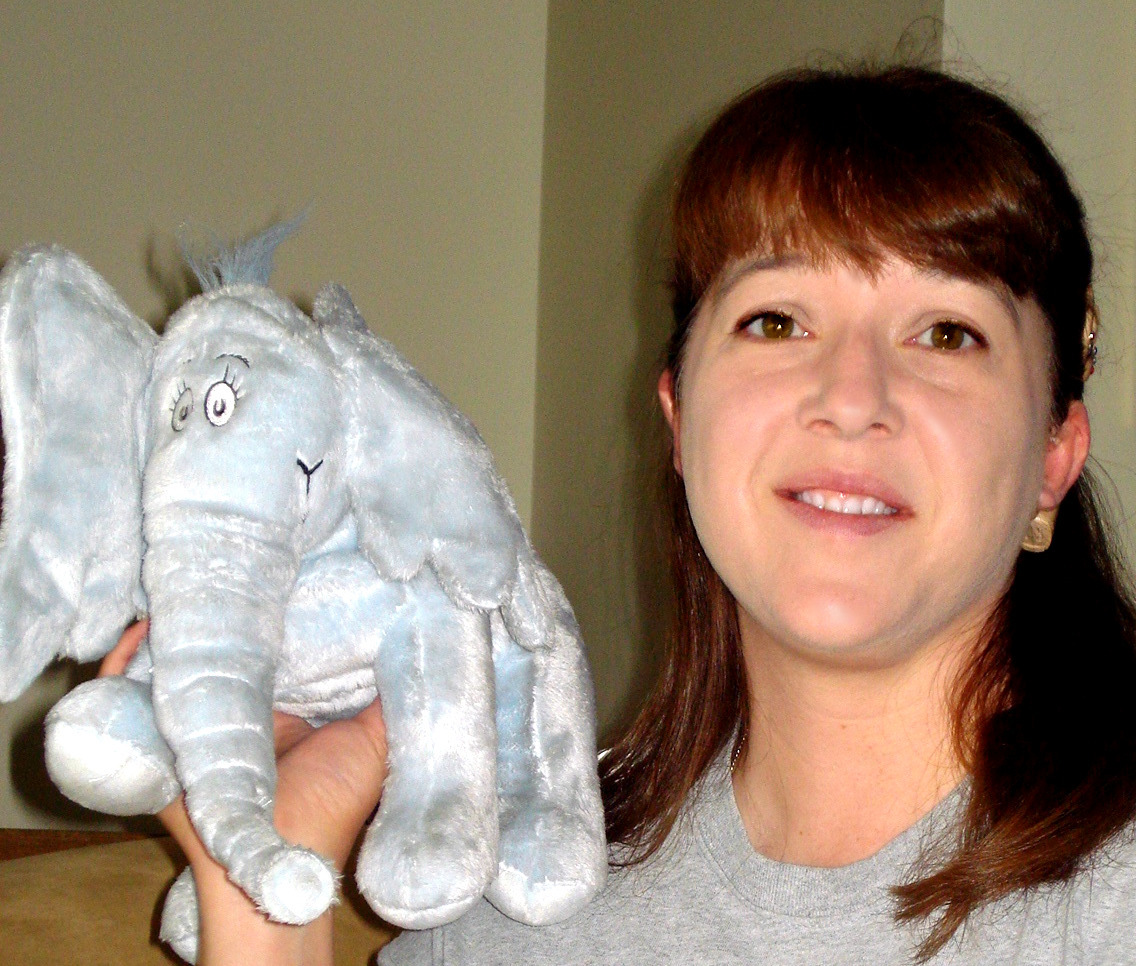
To others it was just a common dust speck. To Horton, it housed an entire world in need of assistance, with hundreds of lives at stake on the brink of being (gulp) boiled. “Common” is subjective, for what is commonplace and boring to one individual may be exactly opposite to another.

Losing to Learn to Appreciate

Having an acquired disability like hearing loss and a balance disorder often teaches me to be appreciative of things I once took for granted. Activated merely eight days before, what blended into the background as a normal, ordinary, and mediocre sound to my husband, was the astonishing, spine-tingling gurgle of sound to me! It took me 15 minutes to finally pinpoint the sound of the electric coffee-maker in his office.

“How could you not hear THAT! What a wonderful sound! It is so distracting! It fills the entire room!” I exclaimed.

“Honey, it is such a commonplace sound it doesn’t even register for me!” he replied.

I was stumped! This gurgle-burp, sigh of steam… commonplace? Doesn’t register? No way!

Subtle cues

If you’ve never had any experience with a hearing assistance/balance assist dog, there are cues that are subtle… even invisible to someone other than their partner. My husband is constantly amazed that I am able to scoot the cart out of the way of a “mother of two in a hurry” at a store when I only have one cochlear implant. Finding the direction of sound is quite a challenge. However, Terry isn’t watching what I’m paying attention to while we shop. If Chloe turns her head and pricks her ears up, I automatically look in the direction her nose is pointing. To me this subtle cue shouts, “Well! Would you look at THAT, Denise!”

When air pressure and bad weather create a vestibular nightmare for me, it is the subtle cues that Chloe and I communicate most effectively. On a “normal day”, I’ll drop something and can slowly bend to retrieve the object. However, on a “bad day”, I only need to look at the object I dropped and intercept Chloe’s gaze… for she has most certainly already noticed the dropped item too. Sometimes I only smile and she cheerfully retrieves the object! Other times I may point and ask her to specifically fetch something. (You don’t ALWAYS want your dog to retrieve dropped items. For example, my husband Terry dropped a large candle from the top of the closet this weekend. I did not want Chloe to retrieve any of the glass scattered over the carpet and had to “shoo” her away!)

Chloe may go through a day and only alert me to the kitchen timer a couple of times, my cell phone, and retrieve my garden gloves from the yard. Those tasks may seem very ordinary and commonplace. Yet without those alerts, my tea kettle would have boiled empty and the chicken defrosting in the microwave may have sat in there all day! I would have missed the call from my husband reminding me that he was working late. I would have had to retrieve those garden gloves myself in the middle of a yard with nothing nearby with which to pull myself back up! So common and subtle cues are subjective. They may be very important alerts that enable me to live more independently.

Just Help

I know people who do things to help others who are never noticed. They don’t want the attention. It can be something as simple as paying a military person’s meal for them when you see them in a restaurant.

Perhaps you help a mother get her stroller up on the curb, or take a shopping cart to the “cart corral” for a customer in a hurry.

Don’t ever underestimate any help you are prompted to give. We are called to serve… to make a difference. Even people with disabilities can help others. I know someone who is blind and deaf who emails “10 Blessings” a day to various people. As I’m the occasional recipient, I can tell you those blessings come on days I need them most.

You don’t have to have money to help. Most acts of service are free.

You don’t have to have a lot of time to help. Most opportunities take seconds.

Don’t ever look at a day as a “common” one. If you really set out to do so, you can make a difference in someone’s life.

If you listen really carefully, you may even hear…

“We are here, we are Here, we are HERE”

Denise Portis

© 2010 Personal Hearing Loss Journal


5 Year Mapping at Johns Hopkins Hospital

Today I went to Johns Hopkins for my 5 year mapping. It always feels surreal when I go, for five years is simply not enough time to pass that I have already forgotten what it felt like not to hear. As I go in the parking garage, I can clearly hear the ticket machine ask me to take my ticket with me so that I can pay before exiting. When I approach the hospital, I can hear the revolving door “clicking” as it slowly rotates inward. I clearly hear the “ding” of the elevator as I wait for one to come to the first floor. None of these things were discernible to me 5 years ago. I guess you could say my ears became “reborn” on May 13, 2005.

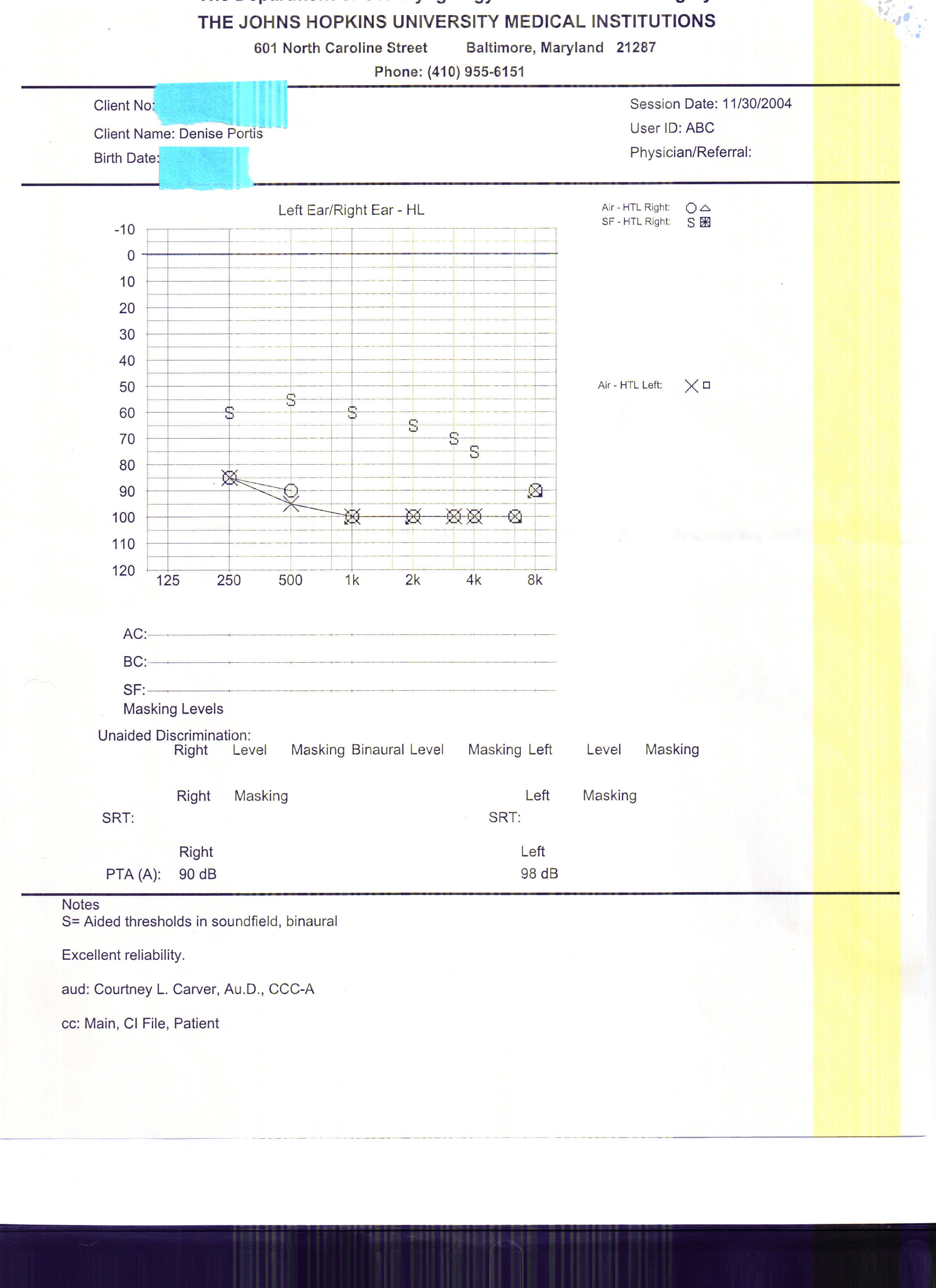
Below is my audiogram 5 months before my surgery. It shows I had a 90 dB loss in my right ear and a 98 dB loss in my left. My left ear is the one I decided to implant.

Audiogram 11-4-2004

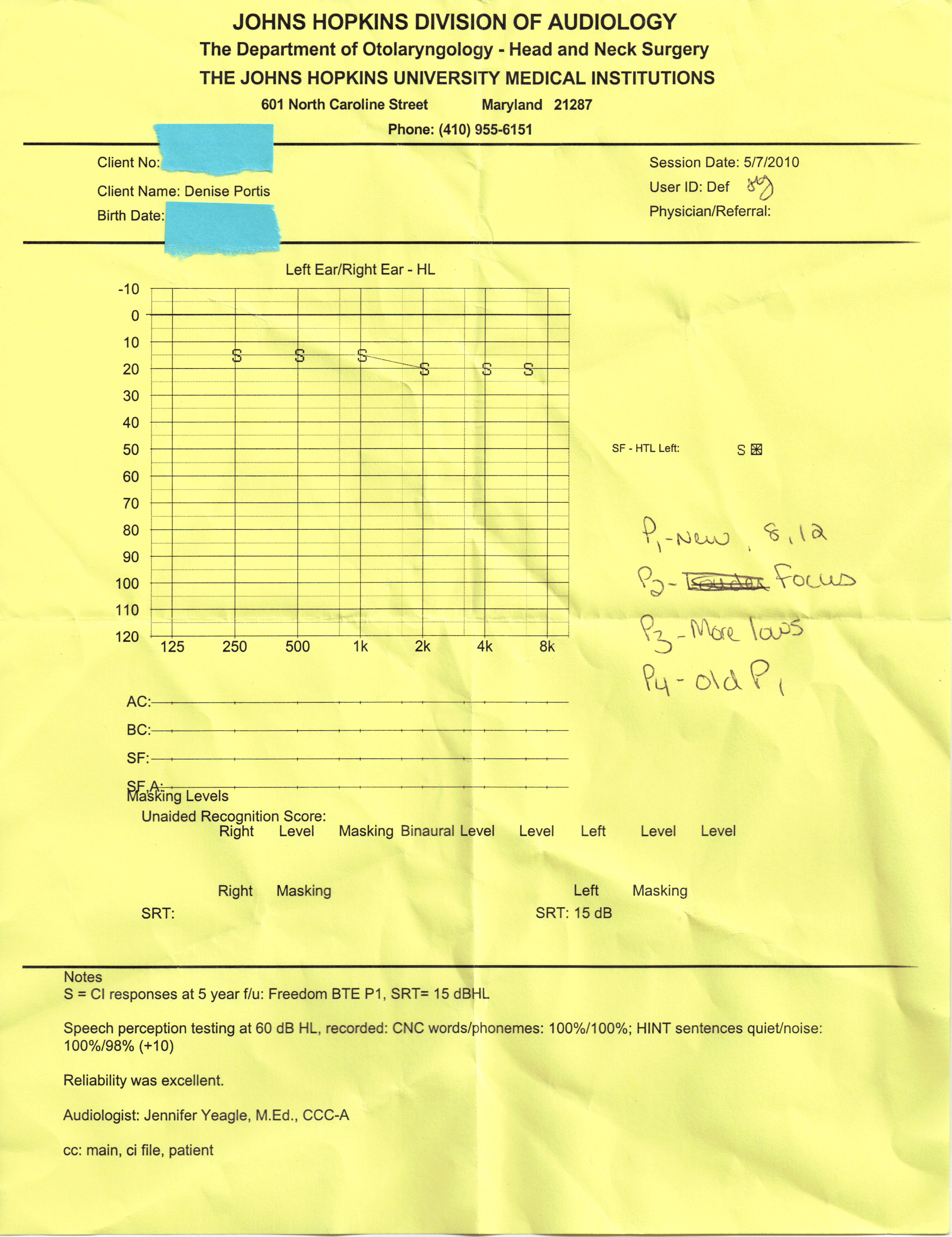
Below is the audiogram from today. My audiologist is one of my favorite people. She’s very easy to talk too, and VERY good at what she does. She created a new program in my “P3” slot that I’m going to work with to see if I can hear my son’s voice any better with in comparison to my normal program. In the sound booth… I actually tested “best” with the lower tones, so it could be that I’m going to have to start fussing at my son to project a little better with that deep voice of his! (Look up when you talk… don’t have your face buried in your laptop).

She doesn’t test my right ear anymore, but you’ll note that my left ear (once a 98 dB loss) is now testing at 15dB loss. Better yet, check out the bottom where it has my words/Phonemes and HINT sentences testing in quiet/noise!

Audiogram 5-7-2010

My audi is never “pushy” but she reminded me that should I ever wish to consult with Dr. Niparko about getting a 2nd CI, that I can just call and make an appointment. Right now with my balance issues, I just do not feel the need to pursue that as I’m “hearing” so well. Maybe… SOME DAY.

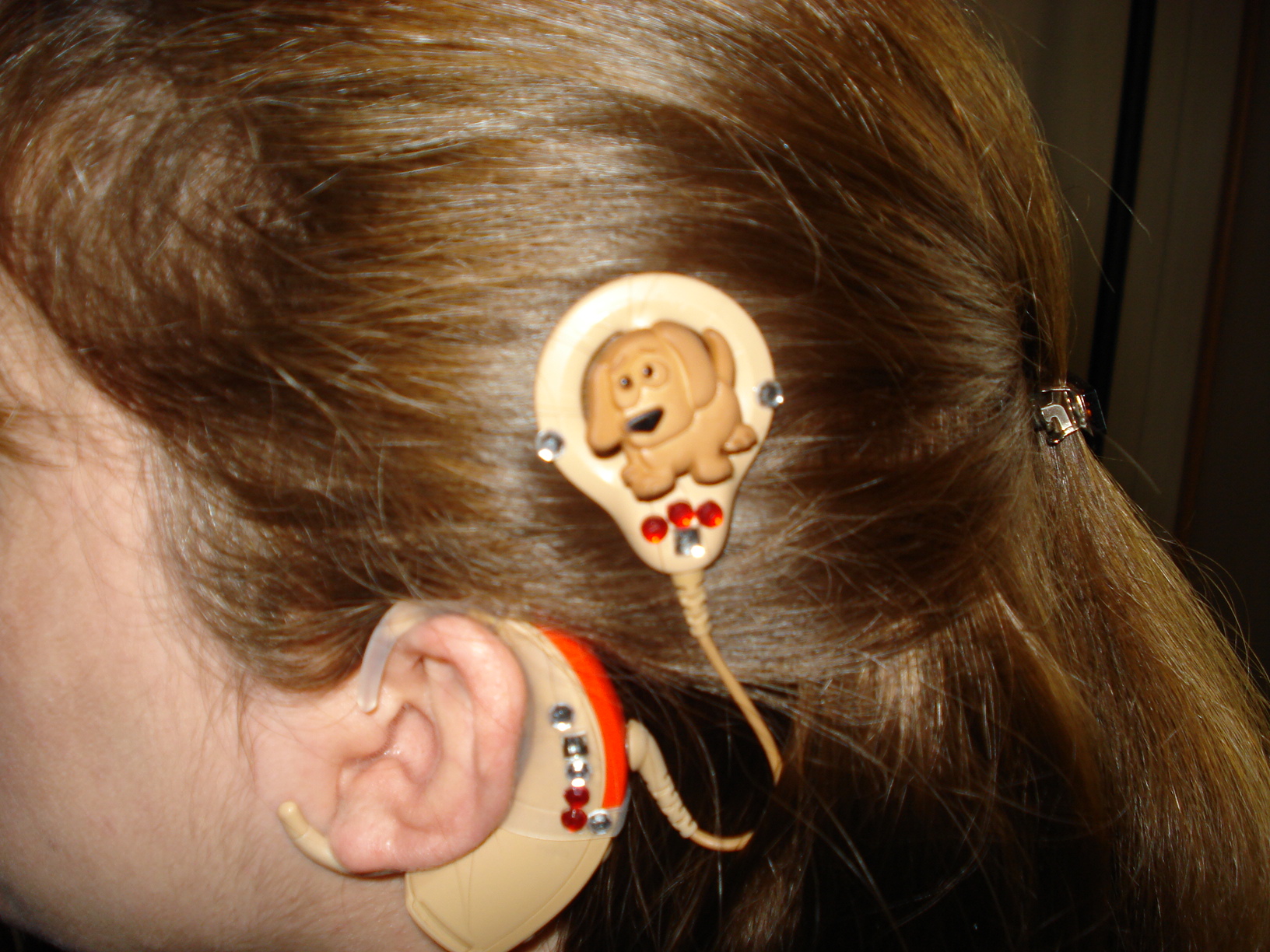
Check out my May “bling”. Remind you of anyone?

May "Chloe" bling

Denise Portis

© 2010 Personal Hearing Loss Journal

Have a Great Imagination?

Chloe and Denise at an old Rock Quarry April 2010

So do you have a great imagination? Unfortunately, I did not have my camera when the incident occurred that I’m about to explain. Even had I located a camera at the time, I certainly would not have had time to “snap” pictures! (You’ll understand in a moment).

So allow me to try to explain with words what happened at work yesterday. Perhaps it is just “one of those things” that happens to people with assistance dogs. This had never happened to me, however, and so I was totally taken by surprise!

I tread carefully in the tellin’ for it took place in the bathroom of all places! Ever wonder what a person with an assistance dog does when they have to go to the bathroom? It’s not like you can hitch your dog up at the post while you go in and “do your business”. You do not want your assistance dog sitting or laying on the floor. I mean… we are in the BATHROOM, folks! A “stand” and “stay” is the perfect obedience command for this environment.

If the handicapped stall is free, I always head for that one. The extra space is nice when accompanied by a furry partner. Sometimes the handicapped stall is NOT free, so then we have to make do with the smaller area. Yesterday the handicapped stall was free, however, so Chloe and I went into that space.

I put Chloe in a “stand” and “stay” first. She rarely moves, however she will sometimes duck her head to peek into the next stall. I try to watch for this because honestly? What would you do if a furry, friendly head looked under to say “boo”? (I’ve heard screeches and even SPLASHES before… so yeah. I try to keep her from doing this!)

Now yesterday was a sunny day. For those readers who may not know me very well, for ME this means that my balance was pretty good. My Meniere’s disease is at its worst when it is rainy outside. Mine seems to be triggered by the weather. So on a sunny day, I … like most grown women… have the ability to erm… HOVER. It’s very handy. (Men just have it made in this regard, don’t they?) On rainy days I have to make sure I can locate a seat protector, or take the time to lay toilet paper down to cover the seat. On sunny days, I can get right down to business and out of there fairly quickly.

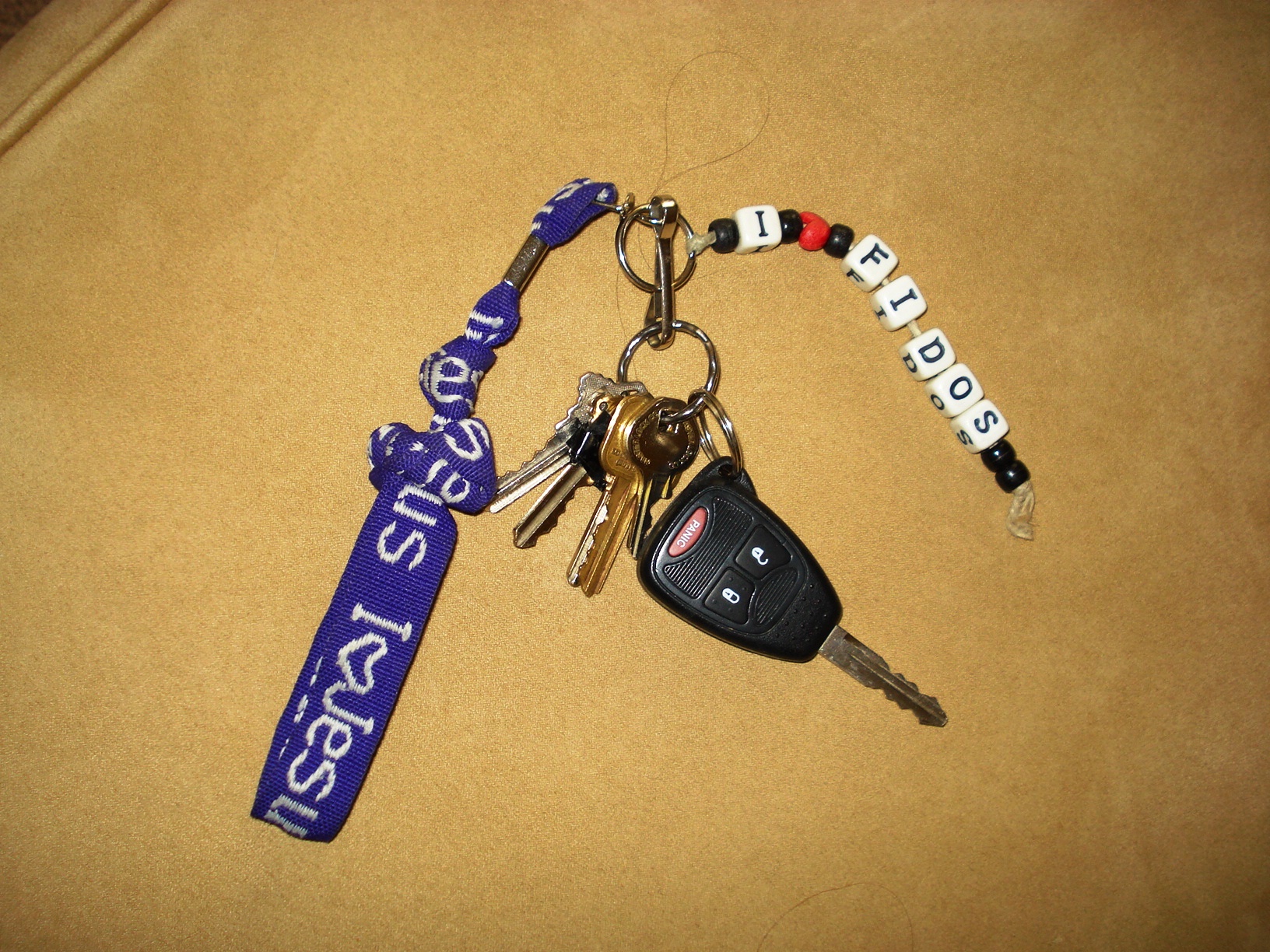
My restroom “OH MY GOSH I’LL HAVE TO WRITE ABOUT THIS” escapade was one of the last things I accomplished at school yesterday. I already had my car packed up, and only took my keys and Chloe to the restroom. Because it was sunny, I was able to HOVER, but I needed to be able to put my keys somewhere. They have a long purple strap on them so that Chloe can pick them up easier on my “bad days” should I drop them. I put the purple strap in my TEETH, hovered … and took care of business in 10 seconds.

Without going into a lot of detail about what happens immediately following the “hover” (use your imagination), I still had my keys in my teeth. Chloe was still in a dutiful “stand” and “stay”. Remember that this was a “good balance day”? I never flush the toilet with my hands on a day I can stand on one foot and accomplish the task with my other foot. It’s the germs ya know? So I did a “karate kid” immitation, and used my left foot to flush the commode.

Chloe decided to side step out of the way. (She’s seen this WEEBLE wobble and FALL DOWN so many times, she evidently wanted to make sure she had space to move if needed). I saw her out of the corner of my eye getting ready to move, so I said, “Ach… wrong”.

Funny thing about holding something in your teeth and deciding to talk at the same time? Yeah. The natural law of gravity will never let a person down. My keys tumbled and bounced off my extended “flushing” knee and right into the toilet!

I screeched. I’m pretty sure it wasn’t quietly.

Chloe retrieves objects that I drop in what the trainers call an “automatic retrieve” for partners with hearing loss. So she scooted around me and looked down into the disappearing water in the commode at my keys in the bottom of the bowl.

I screeched. I’m pretty sure it wasn’t quietly. (This isn’t a typo… it simply happened twice).

I was scrambling… what to DO? I didn’t TRAIN FOR THIS. Chloe put her paws up on the toilet seat to better lean down into the bowl so I reached for my treat bag, and my hand connected to my clicker. Now… I was running on adrenaline at this point. When my hand came into contact with the training clicker, I did an automatic “click”. (Erin would be so proud…) So now Chloe thinks that what she is doing is what she is SUPPOSE TO BE DOING! I clicked … which indicates to HER… “YUP, you got it right”! She now has her head down in the toilet bowl and is bobbing for apples my keys.

I screeched. I’m pretty sure is wasn’t quietly. (yeah… you get the picture!)

I pushed her wagging body out of the way and quickly reached in to pluck my keys from the toilet bowl. It now had completely filled back up with water. Chloe stood there expectantly … eyes on the keys… waiting for me to drop them again. Cuz, ya know? This was a TERRIFIC GAME!

There I stood in the bathroom of Chieftain Institute on the campus of Gaithersburg Church of the Nazarene with dripping keys in one hand, while looking into the dripping face of my assistance dog. I had two choices. I could laugh – or cry. So I…

screeched… I’m pretty sure is wasn’t quietly. (There was a 3rd choice).

I exited the stall with as much grace as I could muster. I washed my hands well, and my keys. I tried to avoid getting soap and water in the electronic key to my car, but honestly? Did it matter at this point?

I walked forlornly to my car with a very happy assistance dog in heel, my head bowed in defeat. As I neared my car I tried to unlock my car with the very wet key… which of course didn’t work. I went around to the driver’s side of the car and looked for the “unlock” key hole which I had NEVER HAD TO USE BEFORE. After loading Chloe up and getting her settled, I climbed into the car and adjusted my mirrors. I caught sight of Chloe’s wet head and finally saw the funny. (You really DO have to laugh to keep from crying sometimes!)

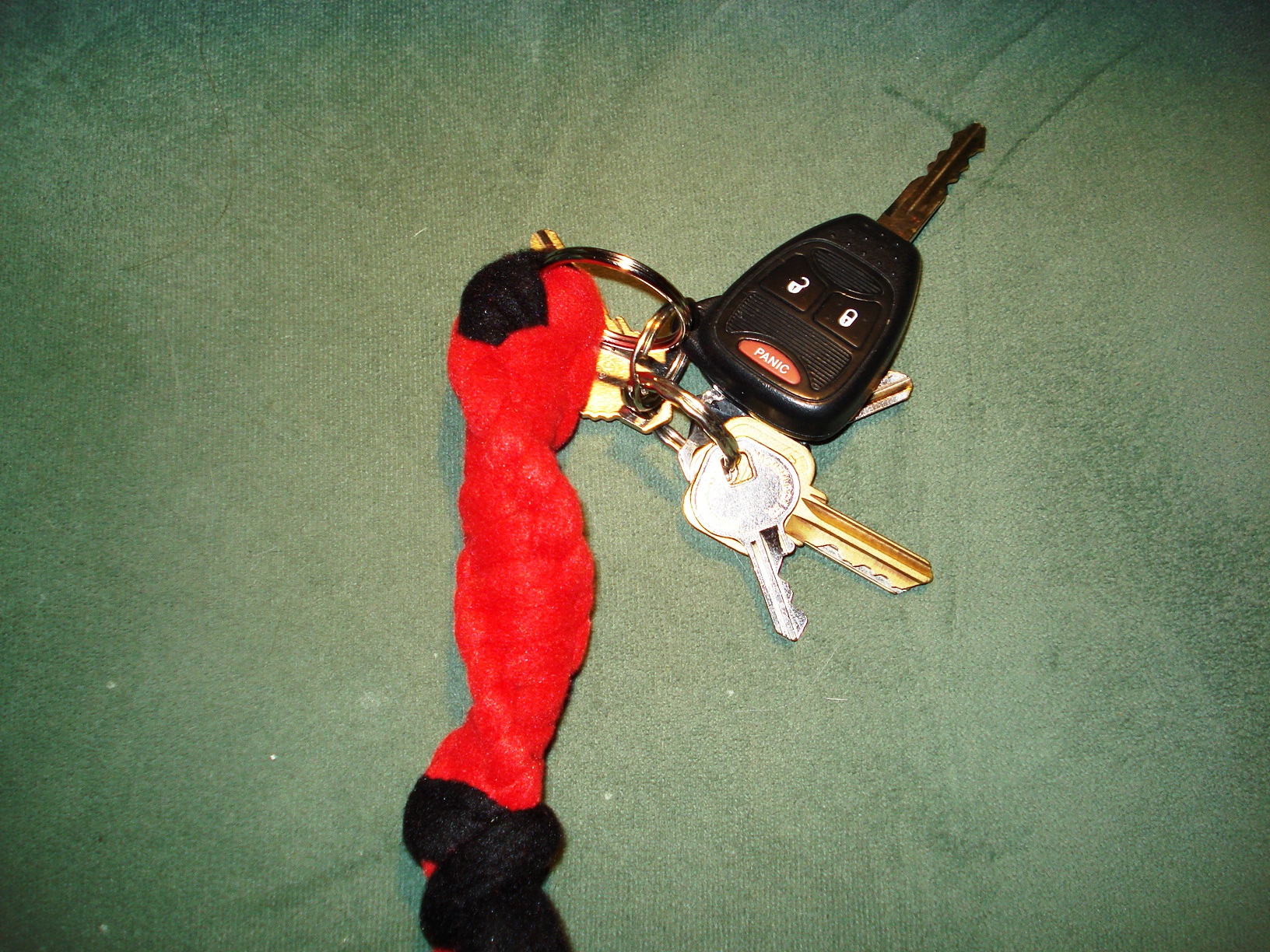
When I pulled into my driveway about 45 minutes later, the first thing I did was use a hair dryer on my key. (Yes… no worries! Chloe got a bath too!) Would you believe the key is working this morning? It will lock and unlock my car just as if I hadn’t given it a “swirly”! I DID have to give it a new attachment though! I carefully washed my other keys and rings, and used a macrame stitch to create a new “bob” for Chloe to be able to pick up.

On the bright side of things, at least it matches Chloe’s vest now!

Denise Portis

© 2010 Personal Hearing Loss Journal