It’s the little things that make a difference when you are “hearing again”.
This morning we had to put my daughter’s cat, Mandie to sleep. Kyersten is a junior at Liberty University in Lynchburg, VA. She doesn’t have a car and yet through friends was able to get home. (We currently only have one car and couldn’t do it).
It was a series of phone calls – some in a panic, to get all the plans just right so that she could get home in time. The cat could not wait. I’m just amazed at what a difference being able to hear on the phone means even in the midst of a small family crisis.
Not only could I hear to communicate plans, etc., but when we went to the vet I could hear whispered voices as the technicians tried to remain sensitive to the reason we were there. WHISPERED VOICES.
I am so thankful for cochlear implant technology and for being able to “hear again”. I’m certain that if I had not been able to have CI surgery, we would have still found a way through family crisis without my hearing. However… it just makes the biggest difference. You just really can’t imagine what it means unless you’ve lost your hearing and regained it through cochlear implants.
It’s so nice to have guest writers from time to time if not for any other reason, than to give you a break from me! Today I am posting a well-written and thought-provoking comment from Dr. M.E. Osborne, whom I share a “community” with at the Cochlear Community. Feel free to leave your comments (as always), and if you like I can forward personal messages to her via email.
Dr. M. E. Osborne
Denise : We are all thankful you are a member of the Cochlear Community. You bring us different, clear viewpoints and concepts to think about.
Your description of the grocery store incident put me there as if I had been a butterfly on the top shelf. Some thoughts flew instantly to mind, and others developed as I thought about the incident throughout the day.
FIRST: How sorry I am for the little boy; he is being taught prejudices. If a parent actively, consciously imparts a narrow connotation of “normal” – for 7 years – you know there are other interrelationship terms that are also skewed.
SECOND: I take it she also was hearing impaired and was referring to “normal” in the “deaf community” through her experiences and the results of the choices she made. By 7 years of age a child’s basic personality and framework of values are 80% set. But the input of details that determine our ability to make our own choices is only about 30% set [Kaugher, 2004] That little boy is on the cusp of making important choices for himself.
His language development is still open. Unless his parents permit his examination, it will be another 11 or 14 years [depending on “legal age for self-care” in the state where he is then living]. Those of us in the Cochlear Community each know at least three people who had no hearing until Cochlear Implant[s] happened. That might be case for that little boy. He would be eligible for speech/ auditory/ aural/ oral services. He might come to speak as clearly as a couple of Cochlear Volunteers. IF THE MOTHER’S ATTITUDE PREVAILS, HE WILL NOT HAVE THAT CHANCE EARLY IN HIS LIFE. HOW TRAGIC.
THIRD: You were SO much more polite than I would have been. I would have flown after her to “ask” her, HOW DARE SHE MAKE THAT IMPORTANT CHOICE FOR HIM! No matter how I had to communicate – sign with the ASL I remember, spell words one letter at a time, or write it. She would understand my intense furor with her making life choices for another person.
She is exactly the type of parent who drives people in my chosen area of expertise out of our minds. She is afraid of technology and teaching that prejudice to a child, not describing options.
[For those of my Cochlear Cousins who do not know, one of my doctoral concentration areas is Special Education Administration. The program I completed was heavy in being an advocate for the client – especially for youngsters.]
Then I would have emphatically flown off into “WHAT IS ‘NORMAL’ IS SITUATIONAL.” The two of them “out in the usual world in a grocery store, using ASL to communicate,” was not normal right then – unless everyone in the store at the same time was using ASL
“Normal” implies behaviors, clothing, manners, foods, rules, customs etc. that are highly predominant among a group of people.
THERE IS NO ONE NORMAL FOR EVERYWHERE, ANYTIME. I have lived both as a citizen and as a military member, literally around the world; traveled extensively on four continents, and have been privileged to be part of many social communities. Communities may be defined internally – people who have chosen to be self-segregated from interaction/ participation with those outside. Communities may be people forced to separate, by customs, laws, etc. Communities may be segregated from each other on some binding reason the members consider enough – an example is the “upstate homies” and the “downstate homies” in a juvenile prison.
While teaching in a southern city, I was accepted by the Deaf Community as one of them because I tutored/ taught the children. The same reason was in force in a northern city as I taught three young people for 6 years. Their three “accompanying interpreters” in public school, agreed to provide a concentrated ASL class for the 24 teachers involved.
What are perceived as communities, sometimes must merge, not just function, but each individual interact successfully. Consider the situation: Nancie was one of the school interpreters; Black; attending an active Catholic church with an almost total Black congregation, and the congregation kept many traditions of Black, southern churches – the Mother of the Church and the Sodality Members wore white, all other members wore navy blue, to any church service. Nancie’s mother passed away. The three students, the two other interpreters, all 24 teachers, students close to the signing student’s, & the students’ families, piled into a school bus at the school located on the fringes of the city, to ride deep into the city, down to the river. In the melee of people were Black, European, Hispanic, Jews, Catholics, Baptists, Methodists, hearing, partial hearing, and totally deaf. We were greeted and welcomed by the Priest and the Mother of the Church. You bet we had it together … because it meant something to Nancie, and us. We sat behind the Deaf Community – one of the two interpreters signed in the front – the other about in the middle, both up high enough to be seen. All teachers, families, etc were in navy blue dresses or suits. The Catholics spread out through the group to help the others get through a completely sung, old fashioned, high Mass. [For those of you who wonder, the cemetery was a short drive to the north. Yes, our bright yellow school bus was in it.]
Imagine the chaos, the pathos, the inflicted insults and injury had every individual clung only to what made them comfortable.
Currently I am in the USA, living in a SC rural area near an average small city, 50K people. Permit me to list some things that might not be the norm, the usual, in public situations:
ASL, or for that matter, any language other than English;
an assistance dog, lemur, ferret, or tree monkey;
a lady who covers the left side of her head, but puts a finger in her right ear when eight F-16s go fly low, landing/ taking off. [Guess who with a BAHA]
people using heavy, metal, leather braces and cup crutches;
families of 21 children;
people wearing clothing that openly indicates their choice of religion/ religious practices – Hutterite plain clothes, burqa, nuns in habits, yarmulke/ Kippah;
people with little screens on their head attached to a weird looking hearing thingy – you can see one on Rush Limbaugh.
Some things that here are the norm:
No matter the time of day, lots and lots of men and women in military uniforms for the Air Force or Army [NOT Navy or Marines] Shaw AFBase is in Sumter, Ft. Jackson Training facility is in Columbia, and the 3rd Army is coming to Sumter piece by piece
Many large, off road capable, pick-ups with a full gun rack inside the back window of the cab. Often there is not a need to lock the truck, there are a couple sets of large barking teeth on guard
After people have been home from medical, banking, other “white-collar” jobs, welding shops, construction, several groups of motorcycle riders gather – Legion Riders, Sons of God, Hyundai Hots – each in a different huge, parking lot
Men and women who proudly have Concealed Weapons Permits, carry their handgun, and love to take them out [unload all] and compare. [Me too]
NONE OF THE LAST FOUR ITEMS WOULD BE “NORMAL” IN DOWNTOWN CHICAGO AND ZIP CODE 60625.
Thank Our Lord for people in the Cochlear Community who
chose to create and maintain an open, welcoming community
accept input from professionals, family, and friends in making decisions; and also welcome the prayers of us who offer them
respect and embrace the decisions community members make
have the personal courage – sometimes at the cost of pride – to ask for support from others who also live with Cochlear technology
encourage us who are slugging our way through our CI/Baha journey by sharing in both disappointments and joys
are ready to show their own personal hearing technology to people – recently I listened to a campaign manager explain that a car magnet was worth 300 votes for a political candidate – so I was thinking, can we assume every CI magnet explained will bring 300 more people to hearing ? Maybe the person spoken to, maybe someone they talk to ?
belong to SEVERAL social communities and move comfortably from one to another – even if we make a mistake now and then – such as when I heard my name called in exasperation in Eastern Star meeting, and snapped to my feet, smartly made a Navy military about face, to attention, and said sharply, “Ma’am”. Wrong community. The response should have been to stand graciously, make a small bow, and say respectfully, “Worthy Matron.”
are not afraid to risk making new friendships, that begin in the ether of the Internet, and because of geography, might never move to in-person friendships.
Recently Chloe and I were at our neighborhood grocery store. I rounded a corner and came face-to-face with a young boy approximately 6-years-old. His eyes grew wide as saucers and his mouth dropped open. Curious, I looked around quickly to make sure his astonishment was at my own appearance and not on someone in my vicinity. Since it was just Chloe and I… I surmised he was surprised at ME. He looked at Chloe carefully and read her vest. I could see his little mouth sounding out the words on her vest. I could “see the light bulb go on” for him about what Chloe does as her job. He took a step to the side and leaned so as to better see the side of my head. My smile let him know I was OK with that – I even turned my head so he could better see the cochlear implant. His answering smile seemed thrilled to understand as the result of his attentive perusal. I wasn’t prepared for what happened next. So unprepared was I, my own mouth dropped open in surprise!
A lady who looked like she’d lost a 7-year-old boy came around the corner in a near trot. She stopped dead in her tracks and looked with relief on the boy and waved at him to “get over here“. He shook his head “no” and signed, “Look (towards me)! Cochlear Implant receive me, able dog own can/able? yes?” His mother practically interrupted his sign and shook her head NO.
She signed back, “Dog want – cochlear implant want not. Appear normal important!” She took him by the hand and drug him away to the cereal isle. I stood there for a few minutes digesting what I had over – erm – HEARD. Obviously, she didn’t realize I am fluent in ASL. I stood there … in all my NOT NORMAL glory… not fitting in… while Chloe sat and stared at a box of Uncle Ben’s rice that happened to be nose-level.
I was speechless! For those of you who know me – well that is a RARE THING – THAT! I finished my shopping in a near-daze.
Not Normal
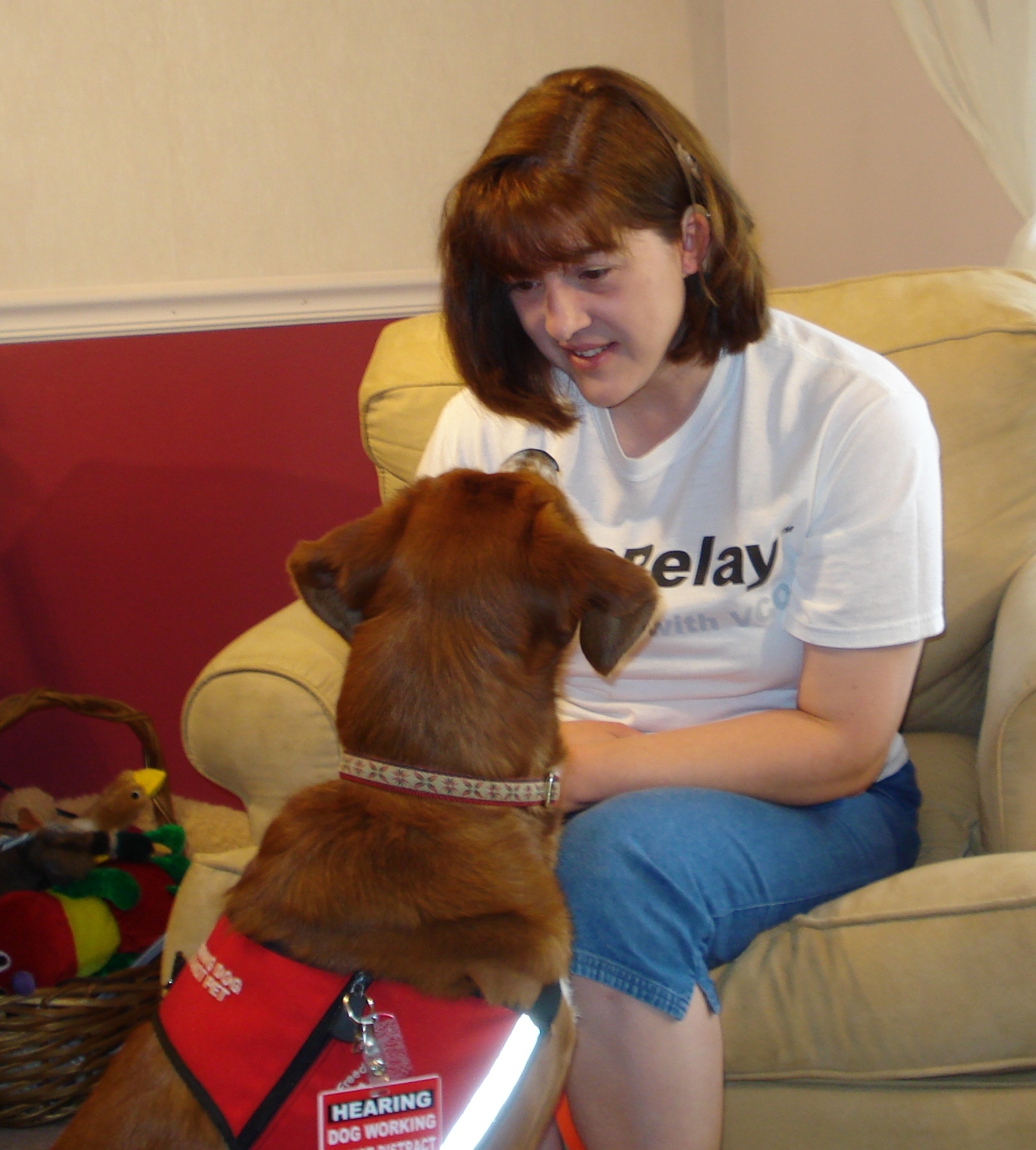
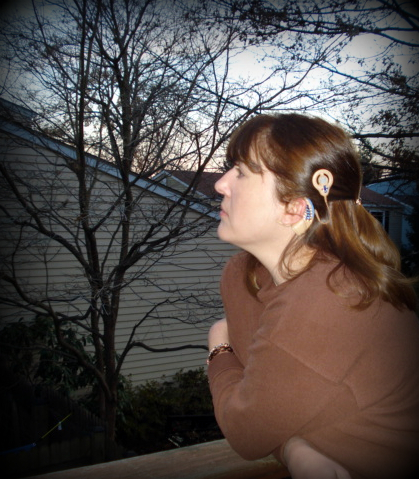
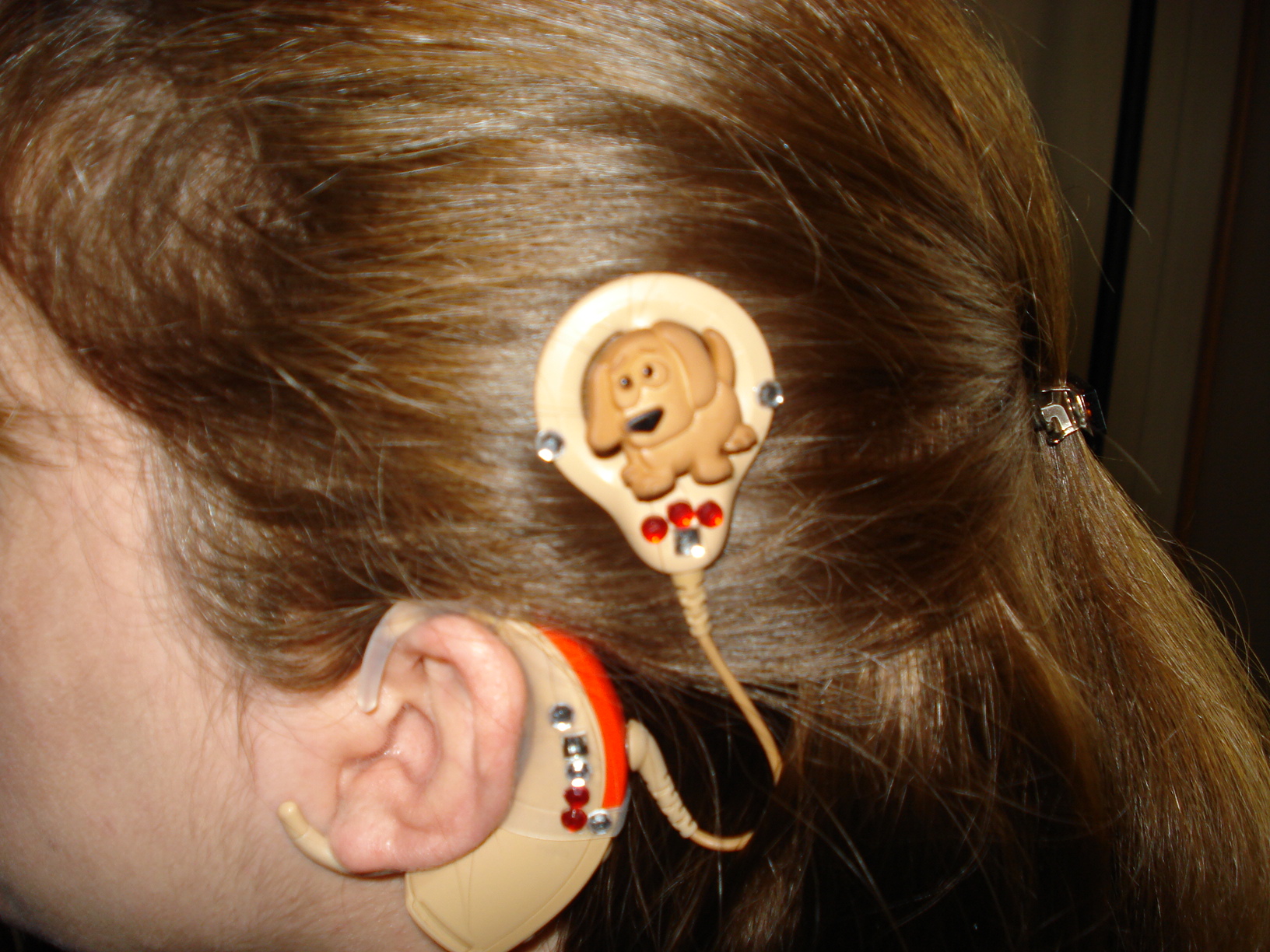
I wear “bling” on my cochlear implant and have a bright, red ear mold on the hearing aid in the opposite ear. I have an assistance dog who alerts me to direction, sounds I miss, and helps me with balance related tasks. You can look at me and guess pretty quickly there isn’t a lot NORMAL about me. But that isn’t because I have a hearing loss and balance problems. Plenty of people wear cochlear implants or hearing aids. Plenty of people have balance problems. I believe my not being “normal looking” lies in the fact that I make sure my invisible disabilities – AREN’T. There are numerous reasons for that… likely best left for another post. It is in my best interest to be visible. It keeps me from getting injured – although it doesn’t guarantee that.
Not everyone with hearing loss chooses to be as visible with bionics or assistive listening devices and technology. Not everyone with Meniere’s disease is partnered with an assistance dog. Yet this works FOR ME. I’m happy, confident and independent. Isn’t that what every adult wants, after all? Sure – like everyone I have things I am dependent upon. My faith – the love of my family – connections with others. However, what I choose to use in order to live my life independent of the help of others is my desire. I’ve taken steps that I felt were necessary to ensure that independence.
A “Brag” on the Hearing Loss Crowd
Can I just brag for a minute? Do you know that I believe people with hearing loss tend to be more accepting and understanding about differences than any other group? I am MOST at home in a crowd of people who all have hearing loss yet are extremely different.
Some have assistance dogs
some “sport” various CI’s represented by all three manufacturers of cochlear implants
some have vision loss as well
some have hearing aids
some wear neck loops and are using assistive devices
some use sign language
some carry notebooks and READ and WRITE messages…
Yet I am at home among this group. I was reminded of how at home I feel after enjoying the numerous pictures taken by friends who were able to attend the recent Hearing Loss Association of America convention in Milwaukee. Everyone “fits in” at these conventions. It’s much like a family reunion. I don’t agree with everything HLAA does, nor do I believe they always seek to fulfill their original mission. But one thing HLAA does very well is – COMMUNITY. Through forums, live chats, national conventions, state conferences, local support groups, and the Walk4Hearing, HLAA provides community to an every-growing population of people living with hearing loss. Being a part of this community encourages people to do more than live with hearing loss. This community encourages LIVING WELL with hearing loss. I think we all want an abundant life!
William Mather Lewis: The abundant life does not come to those who have had a lot of obstacles removed from their path by others. It develops from within and is rooted in strong mental and moral fiber.
Socrates: Living well and beautifully and justly are all one thing.
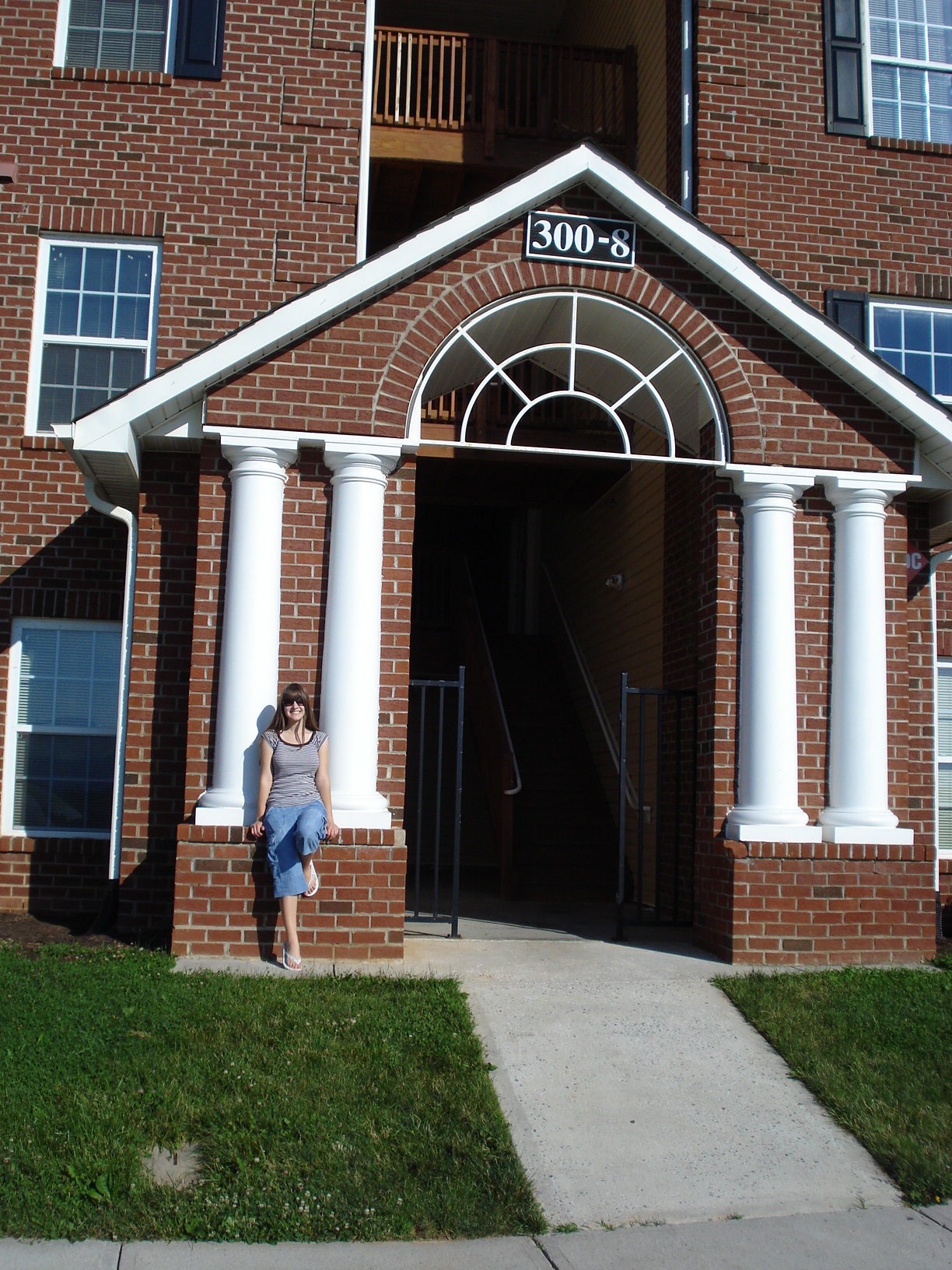
Kyersten standing in front of her new dorm at Liberty University.
This past weekend my husband, firstborn and I headed to “Summer Orientation” at the college my daughter is transferring to this fall. She will be transferring in as a junior and we came to complete the remainder of her check-in requirements and participate in some on-campus meetings.
I’ve been deliberately and methodically choosing not to think about this fall and the impending separation from my firstborn. I’ve always been pretty good at that and it keeps me from perseverating about unpleasant events. However, attending meetings about “how to let go” and how to encourage independence, forces the issue to the front of my mind.
Because of the forced concentration on this coming fall, I came to a startling discovery. I’m actually going to be OK! Kyersten is confident and excited. She received fantastic scholarships and is lined up for Work Study. One of Kyersten’s roommates is a young lady who graduated high school with her. Elise will be transferring in as a junior as well. I have easy access to email, SKYPE, Facebook, cell phone, and texting. I may shed a few tears after dropping her off this fall, but truthfully I am more excited than devastated about our family beginning a new chapter. We’ve prepared for this and we are ready. I have faith that God will keep her in the palm of His hand. I can let go – and let God.
Kyersten overlooking her "new city", Lynchburg, VA
I’m not as good at that about all things, however. Some things I find it more difficult to… “let God”?
1. Finances: My husband works full-time and also works part-time as an adjunct professor. I work “very” part-time as a teacher at a private school. I currently only work one day a week, and only during the school year. I will not be finished with my Master’s degree until the end of this year, and even then I will probably have to wait until the following school year to work a truly “part-time” schedule. This means that things are tight financially. Really tight! I try not to complain or worry because I know so many who are unemployed or struggling with more difficult financial issues than we are. Our car needs fixed. We have debt. It’s really hard for me to release some of these worries to God. I want to “fix” things… stay in control. I believe God equips us to make decisions to work through financial problems, but at some point you have to have faith too! I struggle with having that faith…
2. Hearing: I am truly blessed to have bionic hearing and experience daily the miracle of “hearing again”. Each morning when I slip my coil magnet into place, I am reminded of the miracle of hearing again. A confession? I always fear “how long will this last”. Perhaps it’s because I experienced profound deafness for a couple of years prior to implantation. I know what it means to not be able to hear and communicate well. It had such a devastating effect, it left invisible scars on my heart and mind. I am implanted with the “most reliable” cochlear implant on the market. Yet because of FEAR, I always get a hitch in my breath right before I connect the magnet each morning. I have trouble letting go of this fear… and letting God give me the confidence that He is in control.
Do you have trouble letting go – and letting God? I believe it is because there is a small part of us that wants to control our own destiny. In some ways, if we are the only ones in charge of our destiny then we are the only one responsible for the outcome. But is that true?
Reality check: Decisions OTHER PEOPLE make often impact our lives and our future. Natural disasters can have an influence. A devastating health diagnosis can impact our future – our very life. Stock markets crash, wars continue, the housing market may plummet. Someone we love may be killed by a drunk driver. People may be robbed, raped or murdered. Nothing like painting a rosy picture for you, huh? GRIN.
The good news? God is in control. John Ortberg said, “Peace doesn’t come from finding a lake with no storms. It comes from having Jesus in the boat”. I don’t think we can truly “let go – and let God”, if we aren’t in the habit of daily interacting with the God who loves us. You cannot think about God part-time and expect His peace full-time.
I love studying and using the names of God in my daily interactions with Him.
Jehovah-Rophe or Jehovah-Rapha: The Lord God heals
Jehovah-Sabaoth: The Commander to the Angelic Host and the Armies of God
Jehovah-Jireh: The Lord will provide
El Shaddai: God all sufficient
Jehovah-Shalom: The Lord our Peace
The names of God remind us of all the things He IS. These reminders make it possible for us to “let go – and let God” with confidence.
I encourage you to make a list of things you have trouble letting go of and discussing them with the One who really cares. I still have two big issues that I have trouble letting go of… yet learning to release these worries daily create a confidence that I can feel is growing. My hope is that I will one day realize I have truly “let go”.
My parents came to visit last week as they wanted to attend my son’s graduation. They live in Florida, so it was great they could stay awhile after Chris’s ceremony as we don’t get to see them that often. Mom and Dad live in a gated community in Florida. They play cards there… a LOT of cards. When they come, they often teach us a new game. That may seem pretty “ho-hum” to most of you, but I grew up in a household that played ROOK and Gin-Rummy. That Mom and Dad come and teach us brand new games with elaborate sounding names like Shang-hai Rummy, we are pretty thrilled. It gives us a chance to sit around the table and visit while playing cards each night.
They brought a new game with them this time called “Bohemian Poker”. It was really fun, and the hands are relatively short so that those of us with short-attention spans can concentrate. Without going into the details of how the game is played, mom reminded us all through the game (usually after a mistake was made) to “play your own hand”. Eventually I was able to do just that, but it did take quite a bit of repetitious reminding on her part.
The opposite of “playing your own hand”, would be to look ahead at the person or persons after you and intentionally play in such a way that they do not benefit from your play. Some players go so far as to collect more points in their OWN hand to keep others from benefiting from their play. (The object of Bohemian Poker is to have the FEWEST points). Mom reminded the novice players at the table to concentrate on what would benefit them the most… to not look at other’s hands, and concentrate on your own. I suppose another way of putting it would be to “mind your own business”!
So freshly ingrained is this new phrase, I have been thinking about how that applies to so much in our life. With her permission (and blessing) I decided to blog my thoughts on the idea!
What It Is NOT
“Play Your Own Hand” does not mean that you intentionally live an isolated, segregated life. It does not mean that you ignore the needs and problems of others and concentrate on taking care of your “own” exclusively. It does not mean that when we see an opportunity to serve or minister in our community or circle of friends, that we do not reach out to those we see in need.
“Play Your Own Hand” does not mean that you do not make short-term and long-term goals, for in truth, both are wise practices in the life of any adult. Sometimes those goals include relationships with others, and so we must determine how our goals affect those who are in our circle of influence.
What It DOES Mean
I believe that “Play Your Own Hand” teaches the following lessons:
1. Pay attention to what God has given you to do. Don’t worry about what others are doing as it is not your responsibility. Your choices, decisions, and planning ultimately affect YOUR life.
2. Don’t live defensively, countering wise decision for your life in order to keep someone else from benefiting.
3. There are gambles in life. They can be both exciting and nerve-wracking. May the chances you take only influence you, unless some benefit or blessing is passed on to another.
4. If someone you care about is ruining their life, try to be a good influence… pray for them… encourage them. But don’t allow their problems to become your problems. They may have some hard lessons that need to be learned through reaping the consequences of their own decisions.
Hearing Loss – So Much Variety!
I have met a great number of people with hearing loss through the years. Through speaking engagements, conventions, online support groups, HLAA and other hearing loss venues, I have discovered that hearing loss is not “one size fits all”. I have Meniere’s disease as well, and am amazed at the variety of symptoms and triggers individuals who struggle with this disease exhibit.
I have also seen people with hearing loss criticize decisions others have made to best cope with their hearing loss. Those who are pro-ASL, often butt heads with those who are anti-ASL. In my opinion, it makes both crowds… BUTT HEADS. Some people choose to use technology, or to be surgically implanted with a cochlear implant. There are three cochlear implant manufacturers. I have seen “CI Wars” both in forums on the Internet, and also face-to-face. Cochlear Americas, Advanced Bionics, and Med-El seem to have enthusiastic and loyal recipients. Is it not best to celebrate “hearing again”? Why does it matter what implant an individual chooses in order to best hear again? Sure – some companies have different perks, low “fail” rates, etc., but being negative or belligerent to an individual sporting a different brand is stupid and immature. (Not really pulling any punches am I, grin!)
“Play Your Own Hand” and do whatever it takes for YOU to hear best. To do so, insures you may communicate as best you can and to practice independence towards hearing all you can with the ears you have. Celebrate when others are learning to be proactive about their own hearing loss. Always be willing to try something new… you may learn a thing or two about your hearing loss even decades after you began living with these communication issues.
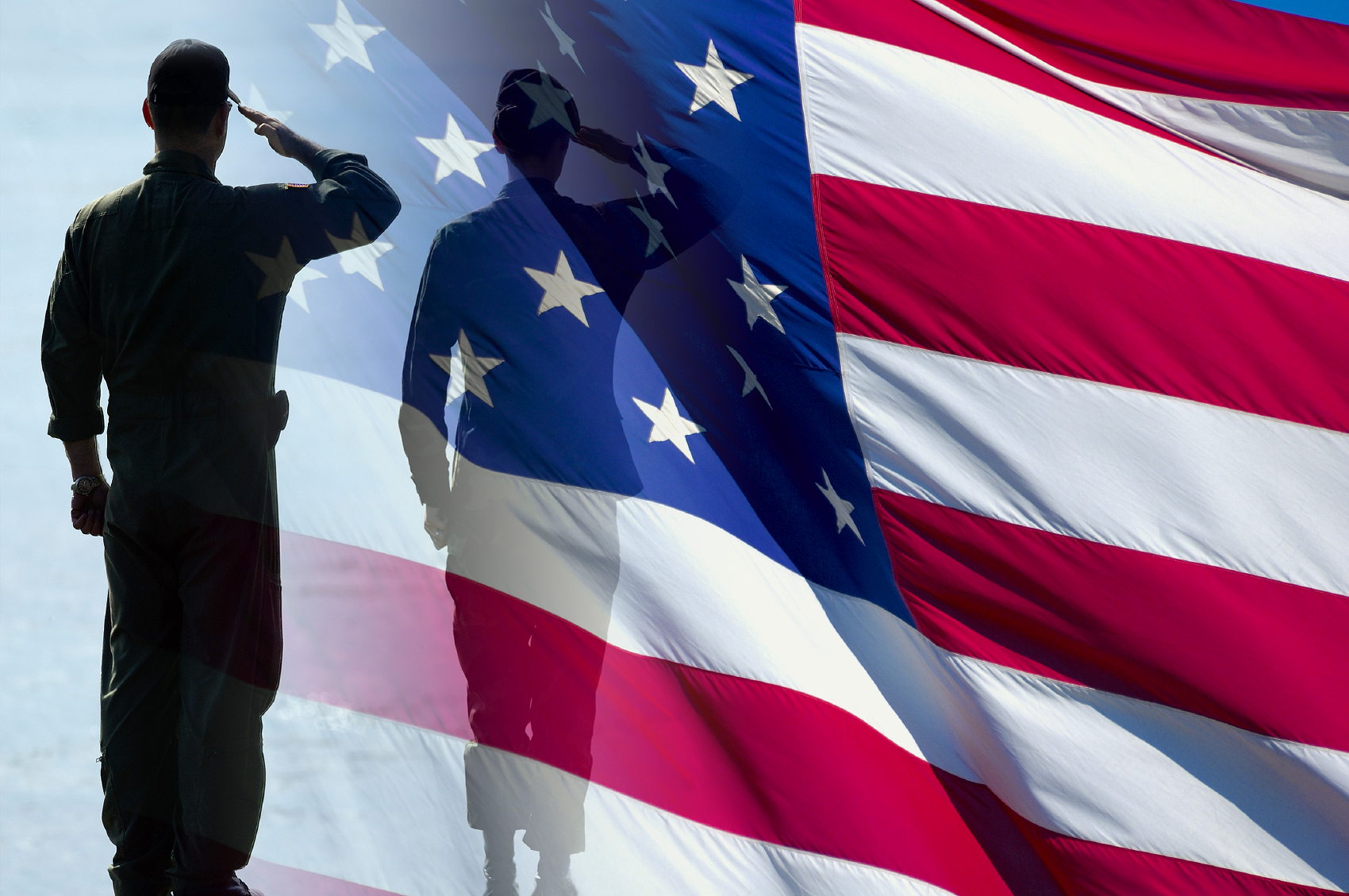
I am grateful for the men and women who have given their lives in the service of our great country. Memorial Day is often misunderstood and some folks think the day is to honor all the men and women who serve in our armed forces. Memorial Day is specifically set aside to honor the “fallen”, and those who have literally given everything in service to the United States.
However, I am closely connected to those who have a hearing loss since I “hear again” with the technology of a cochlear implant. I’m also keenly aware and thankful for the men and women who serve our country and as a result … lose their hearing.
A man I have come to respect for his fair and straight-forward approach to dissimulating stories and news about hearing loss is Larry Sivertson of Hearing Loss Web. He has an excellent list of recent stories about hearing loss and our military. If you have time, please check out the stories from his website. Many men and women come home after serving our country in active military zones with a hearing loss. Thankfully, many are able to be implanted with a cochlear implant.
I thank God for those who have given their lives in service to our country. I am grateful for those who have served and as a result lost their hearing or suffered some other acquired disability. There are sacrifices made that we can never understand or fully appreciate. Many come home with invisible disabilities like hearing loss, but others come home internally wounded by what they have seen, heard, and experienced. Today I pray for all the men and women who serve our country and gratefully pray for them.
~ All the blessings we enjoy are Divine deposits, committed to our trust on this condition, that they should be dispensed for the benefit of our neighbors ~ John Calvin
My young adult children enjoy going to the bank with numerous paychecks and depositing their money into both savings and checking accounts. I envy them sometimes, for my husband and I certainly cannot wait to deposit numerous checks. Instead we worry about looming car repair bills, vet expenses and other various “unexpectedness” that ensures every paycheck is automatically credited to our account.
This week I have been thinking about “divine deposits”, perhaps because I’m feeling DIRT POOR but more likely because I’ve experienced what it means to have someone deposit part of themselves into my life. No matter how hard things are in my life, I can always “count my blessings”. I’ve experienced financial crisis, loneliness, loss, fear, disability, heart break and depression; yet, I’ve never been completely bereft of blessings.
An old hymn once sung with some frequency before churches switched to more contemporary worship music, is entitled “Count Your Blessings” and written by Johnson Oatman, Jr. The first verse:
When upon life’s billows you are tempest-tossed,
When you are discouraged, thinking all is lost,
Count your many blessings, name them one by one,
And it will surprise you what the Lord hath done.
Bing Crosby use to sing a song entitled, “Count Your Blessings Instead of Sheep”. The first verse, crooned by this music legend, is:
When I’m worried and I can’t sleep
I count my blessings instead of sheep
And I fall asleep counting my blessings
When my bankroll is getting small
I think of when I had none at all
And I fall asleep counting my blessings
I’m certainly a believer in considering the “good” and recognizing the power of blessings perceived. However, I believe John Calvin best described the REASON for our blessings. Blessings aren’t actually blessings unless we turn around and do something with them. If we simply receive a blessing and let it “sit in our soul bank”, the value of that deposit plummets.
So HOW Do I Bless Others?
Oh sure! Some people use anonymous gifts of money to be a blessing to someone else. However, I believe that blessings are rarely monetary. The cash value of blessings may be low, but the eternal value is considered priceless!
I recently stood in the hospital room of a dear lady dying of cancer. She could no longer speak because of the difficulty in breathing. Yet even in her pain-wracked body, you could see the yearning in her eyes to “give back” to those visiting her crowded hospital room. Each person who entered was greeted with a small smile, warm pat on the hand and dazzled by the twinkle in the eyes of this “walking blessing”.
I know of people who have adjusted to a life-changing, unexpected hearing loss, who cheerfully participate in the Walk4Hearing so that others can benefit from the local and national support of the Hearing Loss Association. Cochlear implant recipients often become mentors to others who are thinking about being surgically implanted with these bionics, or are new to “hearing again”. An investment is made in the life of someone else… an investment of time, advice, friendship, and understanding.
The trainers at Fidos For Freedom are volunteers. Countless hours of dedicated training and expertise are poured into every match of client and canine. The trainers are not paid for their work… at least not on THIS side of Heaven. I believe these compassionate trainers do what they do because someone else invested in them… they are simply “paying it forward”.
Who Are Your “Neighbors”?
“All the blessings we enjoy are Divine deposits, committed to our trust on this condition, that they should be dispensed for the benefit our our neighbors.”
Sure, the neighbor that benefits from your own “dispensed blessings” may be someone who actually lives nearby. Yet a ‘neighbor’ is often someone you have never met. It is possible to even be a blessing without being consciously AWARE. This is the result of living a life in such a HABIT of kindness, that blessings just ooze from your pores and influence complete strangers!
“Pay it forward”. To whom, you may ask? Anyone you can! I’ll leave you with one of my favorite commercials:
Today I went to Johns Hopkins for my 5 year mapping. It always feels surreal when I go, for five years is simply not enough time to pass that I have already forgotten what it felt like not to hear. As I go in the parking garage, I can clearly hear the ticket machine ask me to take my ticket with me so that I can pay before exiting. When I approach the hospital, I can hear the revolving door “clicking” as it slowly rotates inward. I clearly hear the “ding” of the elevator as I wait for one to come to the first floor. None of these things were discernible to me 5 years ago. I guess you could say my ears became “reborn” on May 13, 2005.
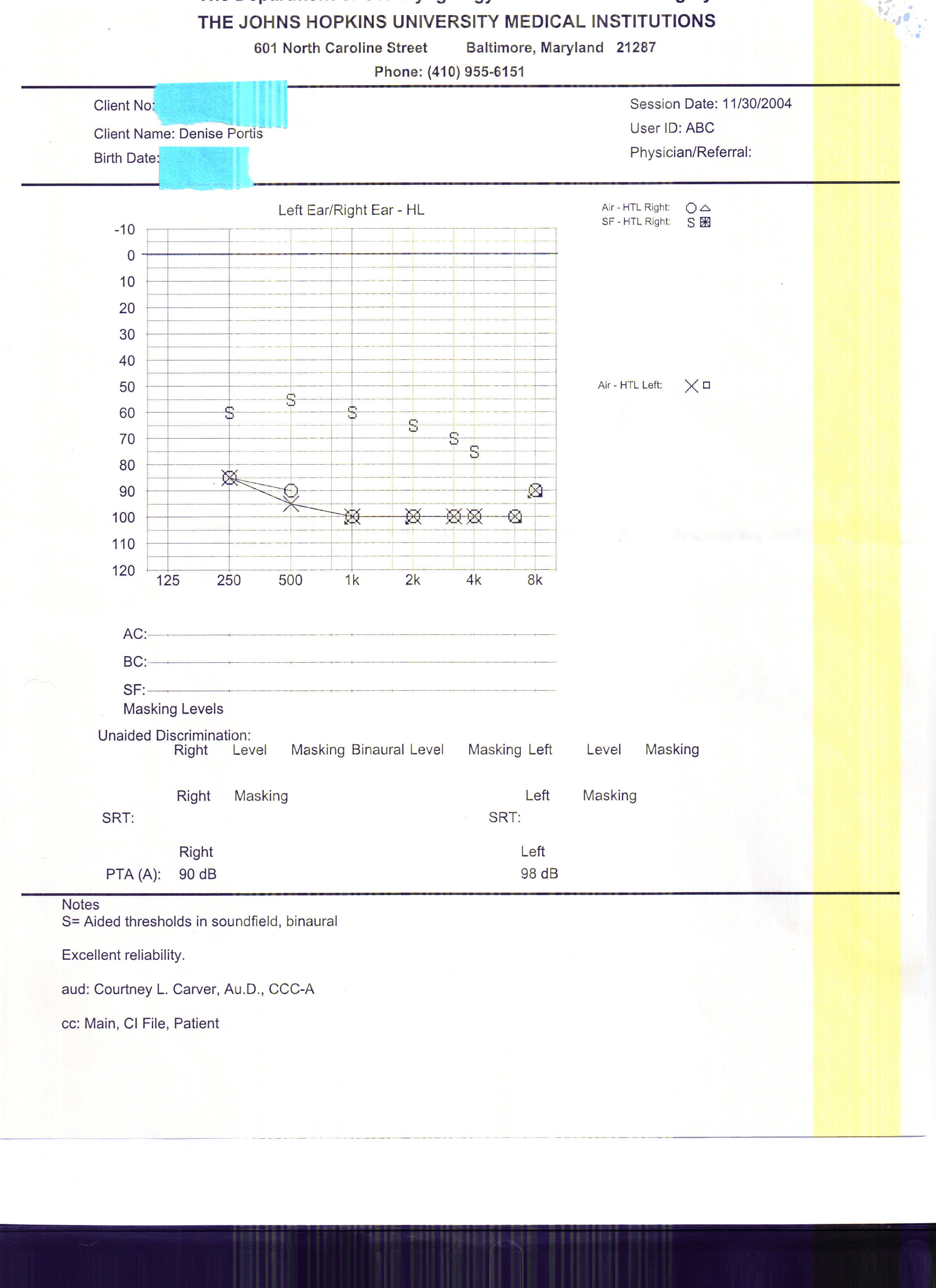
Below is my audiogram 5 months before my surgery. It shows I had a 90 dB loss in my right ear and a 98 dB loss in my left. My left ear is the one I decided to implant.
Audiogram 11-4-2004
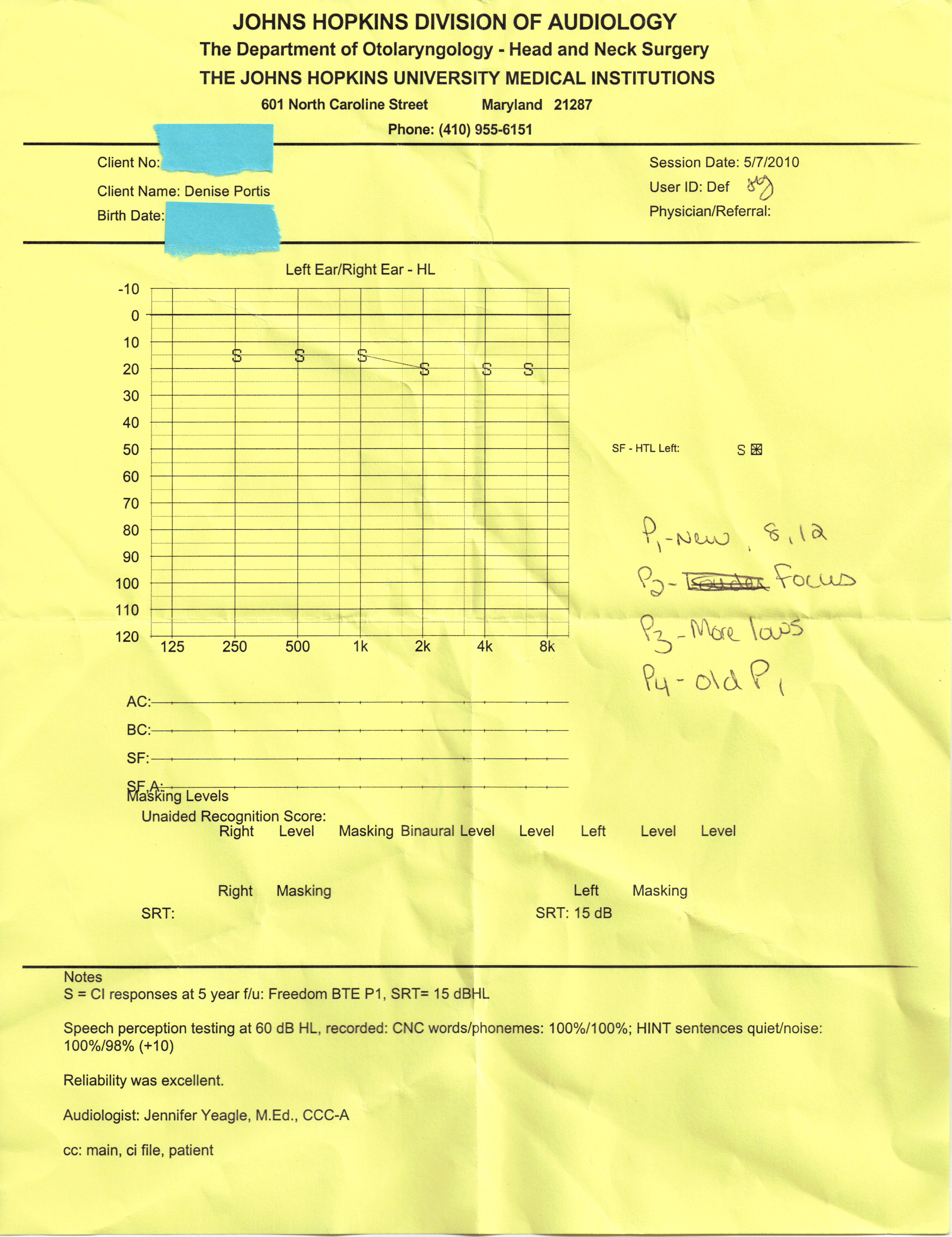
Below is the audiogram from today. My audiologist is one of my favorite people. She’s very easy to talk too, and VERY good at what she does. She created a new program in my “P3” slot that I’m going to work with to see if I can hear my son’s voice any better with in comparison to my normal program. In the sound booth… I actually tested “best” with the lower tones, so it could be that I’m going to have to start fussing at my son to project a little better with that deep voice of his! (Look up when you talk… don’t have your face buried in your laptop).
She doesn’t test my right ear anymore, but you’ll note that my left ear (once a 98 dB loss) is now testing at 15dB loss. Better yet, check out the bottom where it has my words/Phonemes and HINT sentences testing in quiet/noise!
Audiogram 5-7-2010
My audi is never “pushy” but she reminded me that should I ever wish to consult with Dr. Niparko about getting a 2nd CI, that I can just call and make an appointment. Right now with my balance issues, I just do not feel the need to pursue that as I’m “hearing” so well. Maybe… SOME DAY.
I’m always so tickled when one of Hearing Elmo’s guest writers offer to post something! This one was really “timely” for me and I needed the reminders about what some common misconceptions are! Thank you to Tywanna, one of Hearing Elmo’s guest writers!
MISCONCEPTIONS
Guest writer: Tywanna
The American Heritage Dictionary defines misconceptionas “A mistaken thought, idea, or notion; a misunderstanding.”
Prior to the decline of my hearing, I could not explain what it was like to live with a hearing loss. I was incapable of completely explaining something I’ve never experienced. If I had tried to do so, my words would have been awkward, confusing, incorrect, or ignorant.
I’ve cross across some people with “normal” hearing who feel as though they understand but their reality is often a misconception.
Here’s a list of the top misconceptions I’ve heard and experienced throughout my hearing loss journey.
1. All people with hearing loss use American Sign Language
According to Wikipedia, while there has been no reliable survey of the number of people who use ASL as their primary language, estimates range from 500,000 to 2 million in the United States. As of 2009, the United States population was estimated at $307 million people. If these statistics are close to the actual numbers, ASL users are in the minority.
In 2006, Gallaudet University published a study which indicated the estimates need updating.
2. Yelling will make the person with hearing loss hear better
Imagine speaking with someone and hearing but not fully understanding what’s being said. To a person with hearing loss this is a regular encounter. Sometimes we often nod, smile or shake our head out of politeness or because we don’t want to interrupt the speaker with “what” or “can you please repeat that.”
Sometimes when people with a hearing loss find the right moment to intervene with a polite “can you repeat that”, we’re faced with someone yelling so loud that their words become distorted.
I often feel compelled to ask, “will yelling make me hear or understand you?”
3. People with “normal” hearing may not talk with someone who has a hearing loss
A manager at work explained to me that she knows I’m smart but she was afraid people would not talk to me because I could not hear them. Is this the way my co-workers feel or the way she feels? I’m inclined to believe it’s the later due to her ignorance about hearing loss and her lack of being comfortable around someone who is slightly different than herself.
What does being smart have to do with hearing loss? How are the two related?
4. The word “impaired” sounds nicer than hearing loss or deaf
While taking an ASL class for the first time I used the word impaired with our instructor who was born deaf. She politely explained to me impaired means broken. After that experience I looked up the word in the dictionary. Impaired is a synonym for broken, ruined or messed up. Wow, did God make me broken? – of course not. He made me exactly the way he intended. He made me to be unique, different and one of a kind. Since finding out the true definition of the word impaired, I have eliminated the word from my vocabulary when referring to others with hearing loss or myself.
The terms dumb, mute, and handicapped and several others are no longer acceptable. Let’s band together to eliminate the words that may be offensive or degrading to certain members of the population.
Let’s ask people what they would prefer to be called and honor their wishes.
5. All people with hearing loss want to be “fixed”
Have you ever come across people who feel as though they have the answer to everything? Every time a new product or infomercial comes on television, they feel compelled to let you know. “Oh my, I’ve seen this wonderful new head phone set that will enable you to watch television without using closed captions.” Well, I’m wearing a BTE hearing aid that costs $3000 and you’re telling me a product for $19.99 will enable me to understand the television?
“You’ll never guess what, “I’ve seen a new hearing aid that is suppose to fix all types of hearing loss.” Who told these people there is a cure for deafness?
Who also said deaf people want to be fixed? As a whole, the hearing loss and Deaf community are proud of who they are.
6. Deaf means “No Sound”
Wrong! The term deaf does not mean without sound. According to the Center for Disease Control, deaf is the inability to rely on your hearing to understand and process information without the use of visual cues.
7. Deaf people want sympathy
Recently while interacting with my supervisor at work, I explained to her I would prefer written instructions because I was going deaf. Her reply was “I’m sorry”. I quickly explained there is nothing to be sorry about. People who are Deaf, deaf or hard of hearing want empathy not sympathy. I don’t want people to pity me or feel sorry for me. That’s not the way I see myself. I’m using my hearing loss as a way to help others.
My cousin recently sent me an e-mail with the following quote:
“Nothing in all the world is more dangerous than sincere ignorance and conscientious stupidity.”
–Rev. Dr. Martin Luther King, Jr.
People with “normal” hearing, may never be able to fully understand our journey. Often times true understanding comes from experience. We do not have to live in continued ignorance. There are so many libraries, books, television programs and Internet websites. Let’s educate people one at a time. Let’s band together to wipe out the misconceptions. Let’s continue to share our experiences to help others.
So do you have a great imagination? Unfortunately, I did not have my camera when the incident occurred that I’m about to explain. Even had I located a camera at the time, I certainly would not have had time to “snap” pictures! (You’ll understand in a moment).
So allow me to try to explain with words what happened at work yesterday. Perhaps it is just “one of those things” that happens to people with assistance dogs. This had never happened to me, however, and so I was totally taken by surprise!
I tread carefully in the tellin’ for it took place in the bathroom of all places! Ever wonder what a person with an assistance dog does when they have to go to the bathroom? It’s not like you can hitch your dog up at the post while you go in and “do your business”. You do not want your assistance dog sitting or laying on the floor. I mean… we are in the BATHROOM, folks! A “stand” and “stay” is the perfect obedience command for this environment.
If the handicapped stall is free, I always head for that one. The extra space is nice when accompanied by a furry partner. Sometimes the handicapped stall is NOT free, so then we have to make do with the smaller area. Yesterday the handicapped stall was free, however, so Chloe and I went into that space.
I put Chloe in a “stand” and “stay” first. She rarely moves, however she will sometimes duck her head to peek into the next stall. I try to watch for this because honestly? What would you do if a furry, friendly head looked under to say “boo”? (I’ve heard screeches and even SPLASHES before… so yeah. I try to keep her from doing this!)
Now yesterday was a sunny day. For those readers who may not know me very well, for ME this means that my balance was pretty good. My Meniere’s disease is at its worst when it is rainy outside. Mine seems to be triggered by the weather. So on a sunny day, I … like most grown women… have the ability to erm… HOVER. It’s very handy. (Men just have it made in this regard, don’t they?) On rainy days I have to make sure I can locate a seat protector, or take the time to lay toilet paper down to cover the seat. On sunny days, I can get right down to business and out of there fairly quickly.
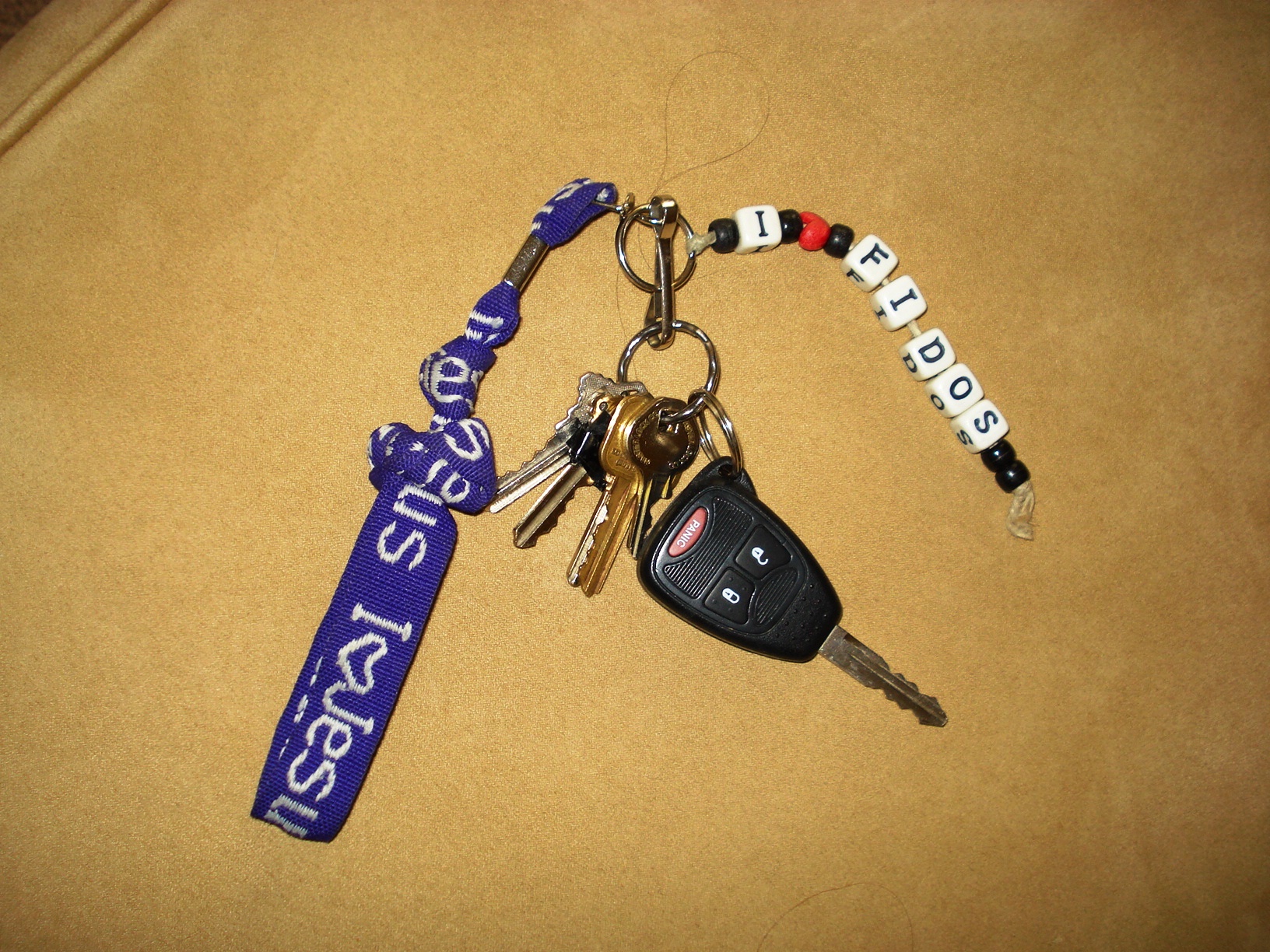
My restroom “OH MY GOSH I’LL HAVE TO WRITE ABOUT THIS” escapade was one of the last things I accomplished at school yesterday. I already had my car packed up, and only took my keys and Chloe to the restroom. Because it was sunny, I was able to HOVER, but I needed to be able to put my keys somewhere. They have a long purple strap on them so that Chloe can pick them up easier on my “bad days” should I drop them. I put the purple strap in my TEETH, hovered … and took care of business in 10 seconds.
Without going into a lot of detail about what happens immediately following the “hover” (use your imagination), I still had my keys in my teeth. Chloe was still in a dutiful “stand” and “stay”. Remember that this was a “good balance day”? I never flush the toilet with my hands on a day I can stand on one foot and accomplish the task with my other foot. It’s the germs ya know? So I did a “karate kid” immitation, and used my left foot to flush the commode.
Chloe decided to side step out of the way. (She’s seen this WEEBLE wobble and FALL DOWN so many times, she evidently wanted to make sure she had space to move if needed). I saw her out of the corner of my eye getting ready to move, so I said, “Ach… wrong”.
Funny thing about holding something in your teeth and deciding to talk at the same time? Yeah. The natural law of gravity will never let a person down. My keys tumbled and bounced off my extended “flushing” knee and right into the toilet!
I screeched. I’m pretty sure it wasn’t quietly.
Chloe retrieves objects that I drop in what the trainers call an “automatic retrieve” for partners with hearing loss. So she scooted around me and looked down into the disappearing water in the commode at my keys in the bottom of the bowl.
I screeched. I’m pretty sure it wasn’t quietly. (This isn’t a typo… it simply happened twice).
I was scrambling… what to DO? I didn’t TRAIN FOR THIS. Chloe put her paws up on the toilet seat to better lean down into the bowl so I reached for my treat bag, and my hand connected to my clicker. Now… I was running on adrenaline at this point. When my hand came into contact with the training clicker, I did an automatic “click”. (Erin would be so proud…) So now Chloe thinks that what she is doing is what she is SUPPOSE TO BE DOING! I clicked … which indicates to HER… “YUP, you got it right”! She now has her head down in the toilet bowl and is bobbing for apples my keys.
I screeched. I’m pretty sure is wasn’t quietly. (yeah… you get the picture!)
I pushed her wagging body out of the way and quickly reached in to pluck my keys from the toilet bowl. It now had completely filled back up with water. Chloe stood there expectantly … eyes on the keys… waiting for me to drop them again. Cuz, ya know? This was a TERRIFIC GAME!
There I stood in the bathroom of Chieftain Institute on the campus of Gaithersburg Church of the Nazarene with dripping keys in one hand, while looking into the dripping face of my assistance dog. I had two choices. I could laugh – or cry. So I…
screeched… I’m pretty sure is wasn’t quietly. (There was a 3rd choice).
I exited the stall with as much grace as I could muster. I washed my hands well, and my keys. I tried to avoid getting soap and water in the electronic key to my car, but honestly? Did it matter at this point?
I walked forlornly to my car with a very happy assistance dog in heel, my head bowed in defeat. As I neared my car I tried to unlock my car with the very wet key… which of course didn’t work. I went around to the driver’s side of the car and looked for the “unlock” key hole which I had NEVER HAD TO USE BEFORE. After loading Chloe up and getting her settled, I climbed into the car and adjusted my mirrors. I caught sight of Chloe’s wet head and finally saw the funny. (You really DO have to laugh to keep from crying sometimes!)
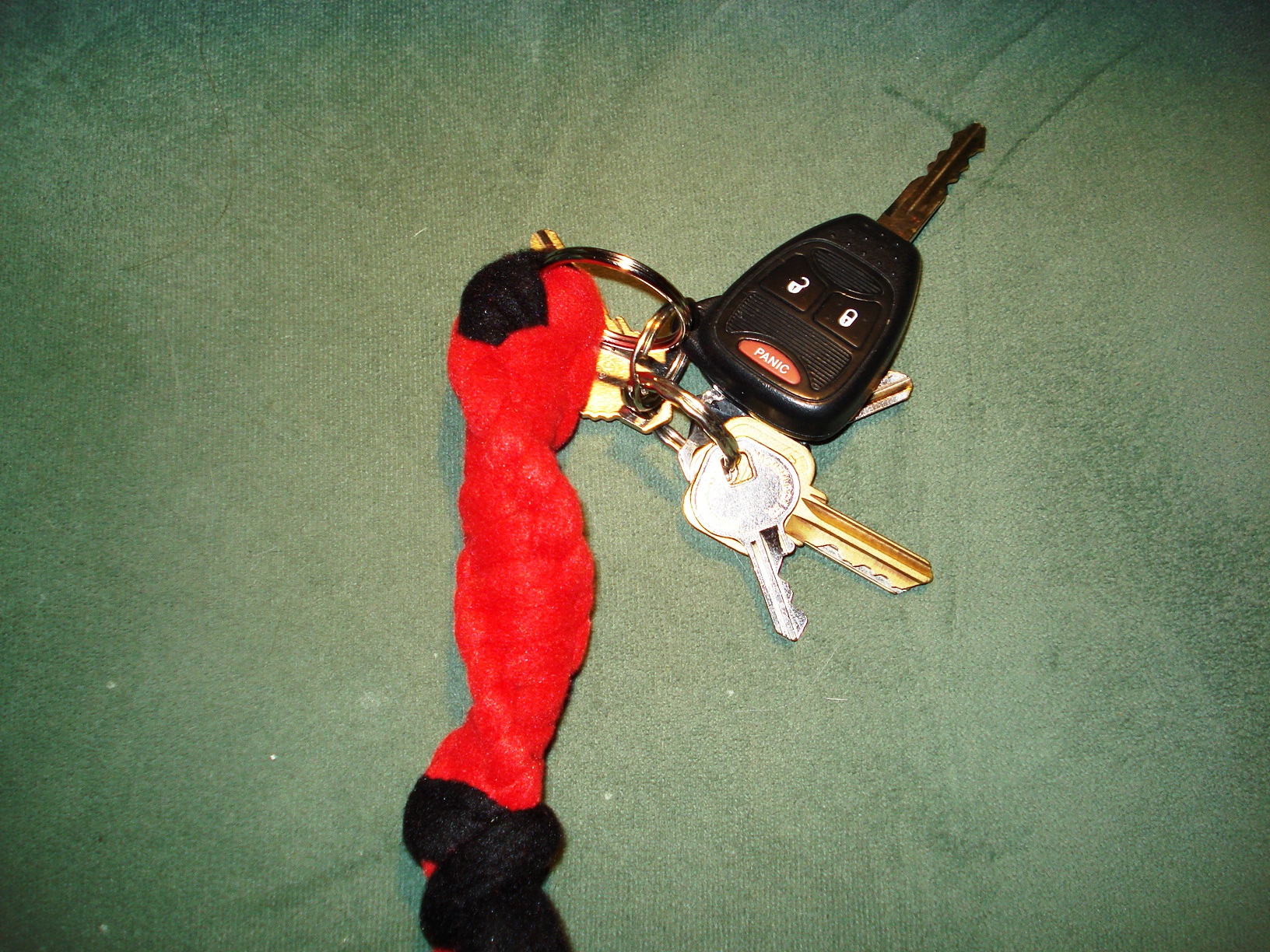
When I pulled into my driveway about 45 minutes later, the first thing I did was use a hair dryer on my key. (Yes… no worries! Chloe got a bath too!) Would you believe the key is working this morning? It will lock and unlock my car just as if I hadn’t given it a “swirly”! I DID have to give it a new attachment though! I carefully washed my other keys and rings, and used a macrame stitch to create a new “bob” for Chloe to be able to pick up.
On the bright side of things, at least it matches Chloe’s vest now!