It is hard to believe we’ve seen the 10 Year Anniversary of “9-11” come and go already. It really put it into perspective for me when my 21-year-old daughter relayed an amusing anecdote to me. She had gone to Union Station to pick up “the boyfriend“. They walked around a bit before getting on the METRO and she spied a police car outside with “9-1-1” on the side. Because of the anniversary of 9-11, and a result of what I think those numbers MEAN to someone of her generation, she pointed at the car and said, “Oh look! I guess that is on there to commemorate the 10 year anniversary!” I think “the boyfriend” was hard pressed not to laugh.
Hers is a generation that grew up without William Shatner and his “Rescue: 9-1-1” television show. Although 9-1-1 was covered in school, for her it left a permanent link to a different meaning other than how to call in the event of an emergency. For her, those 3 numbers meant something far different. She was old enough to understand that the world had changed for those here in the U.S.A., but young enough to experience different kinds of fear, anxiety, and apprehension experienced by parents and their peers.
On 9-11 I was “only” hard-of-hearing at the time. The progressive loss and downward spiral of my own hearing had not left its life-changing mark as yet. However, even with my first hearing aid, I still relied on closed captioning. I think if I had to put my finger on ONE memory of 9-11, it would be being afraid and confused about what was happening because those professionals who did closed captioning were FREAKING OUT. At times, the closed captioning was just gibberish, and there was a great deal more of instantaneous corrections being made for “Live” television. When the first tower came down I remember sitting – quickly – STUNNED.
Ten years later I am a different person. Hopefully, all of us can say we are “different” after a decade of life. Our goal should be to mature, learn, and even blossom. I am completely deaf now, but “hear again” through cochlear implant technology. Who I count as friends are peers who also live with hearing loss, live with invisible disability/illness, or work with those populations. Sometimes we live victoriously and sometimes there are setbacks. I have found a “community”, however, and they have become family and friends to me. I watched a number of specials about 9-11 and still used closed captioning. However, it was with some confidence that I also HEARD the commentary and watched the speeches at various memorials. I am grateful for my cochlear implant and for the privilege of living in America.
30 Things About My Invisible Illness You May Not Know:
1. The illness I live with is:
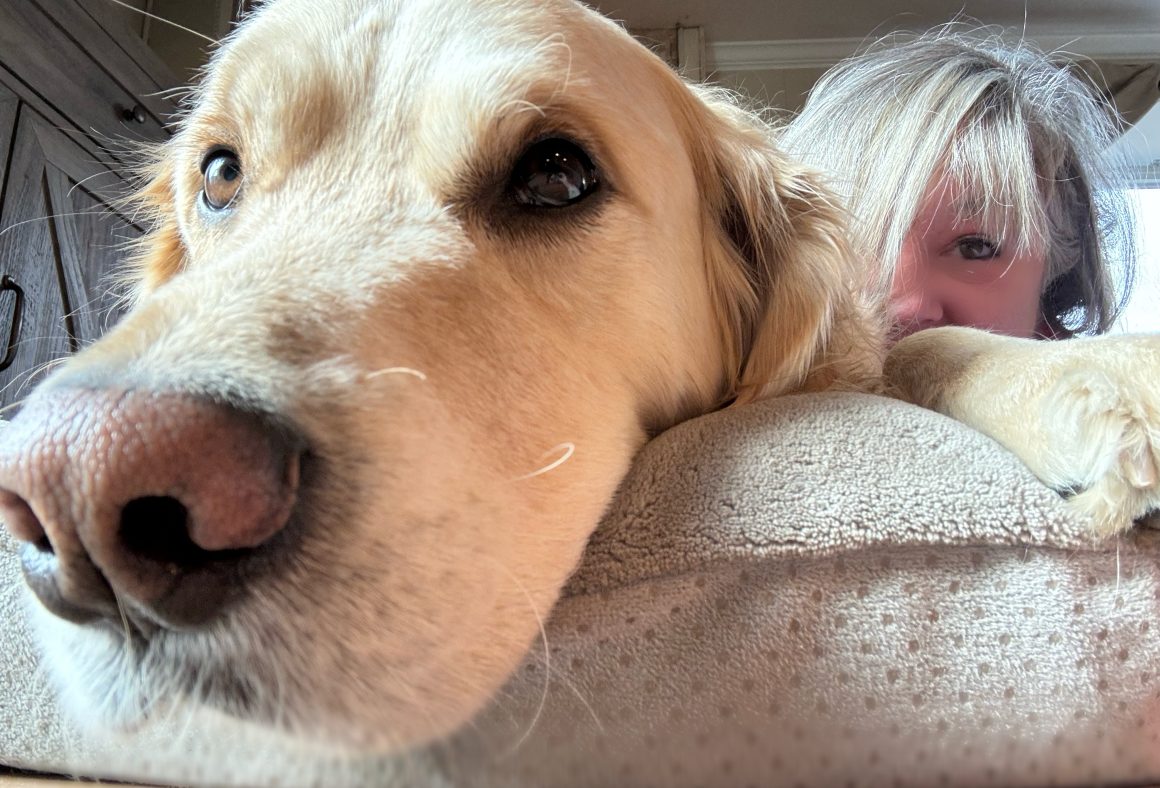
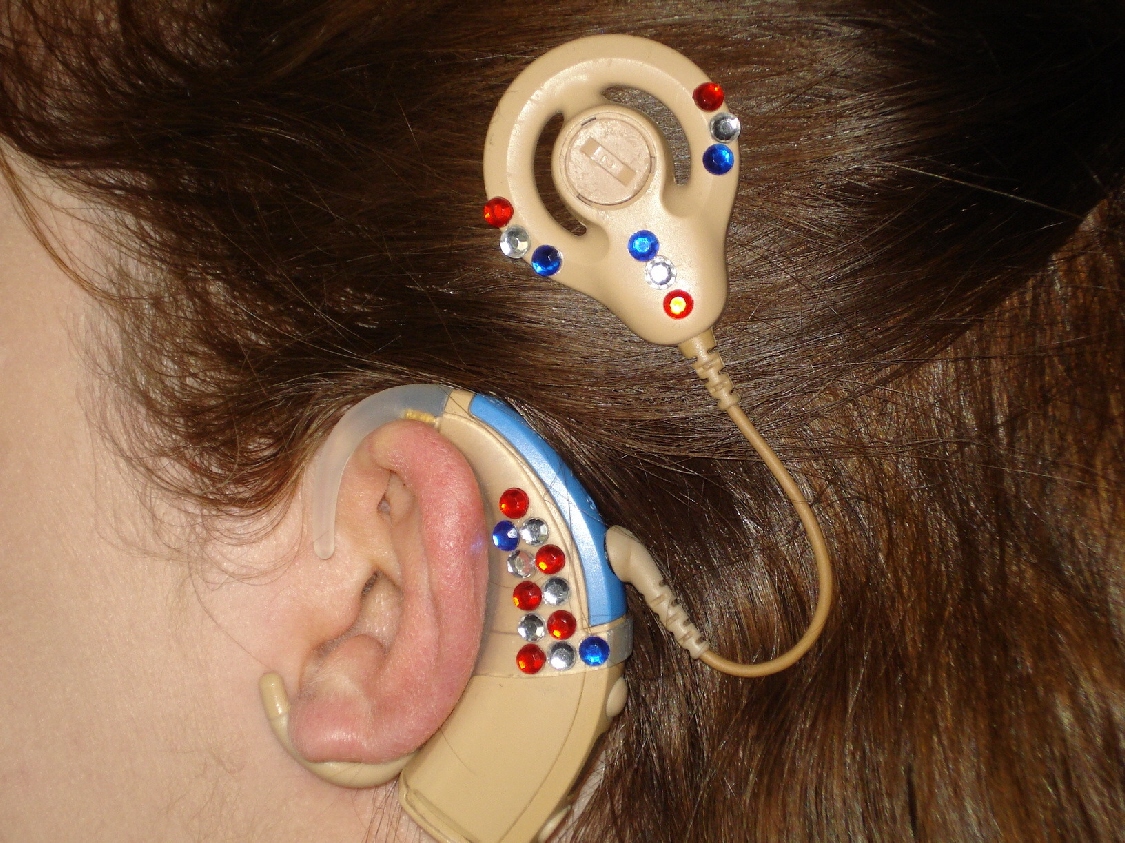
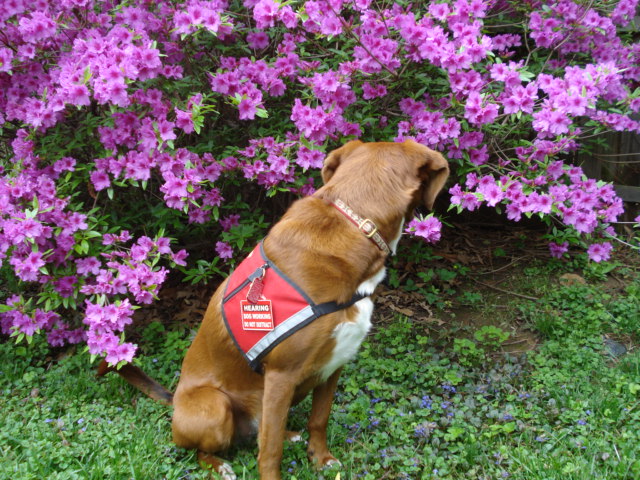
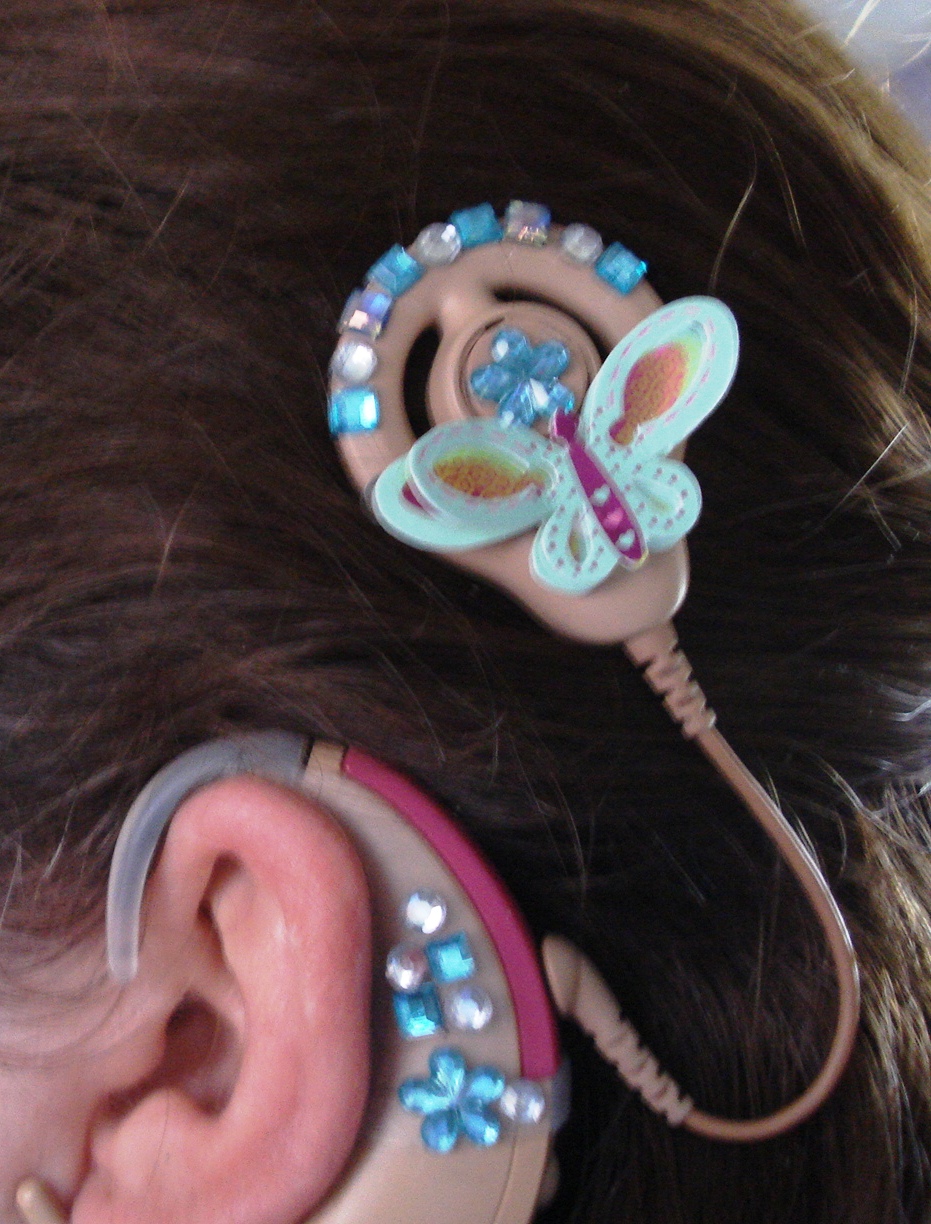
Invisible if I want it to be, but I wear bling and use a service dog so that it is not.
2. I was diagnosed with it in the year:
1993
3. But I had symptoms since:
I was 6 years old after a car accident.
4. The biggest adjustment I’ve had to make is:
Learning to hear with a cochlear implant and learning how to adjust on days my Meniere’s disease symptoms have me wobbling around with poor balance.
5. Most people assume:
My cochlear implant has “fixed me”.
6. The hardest part about mornings are:
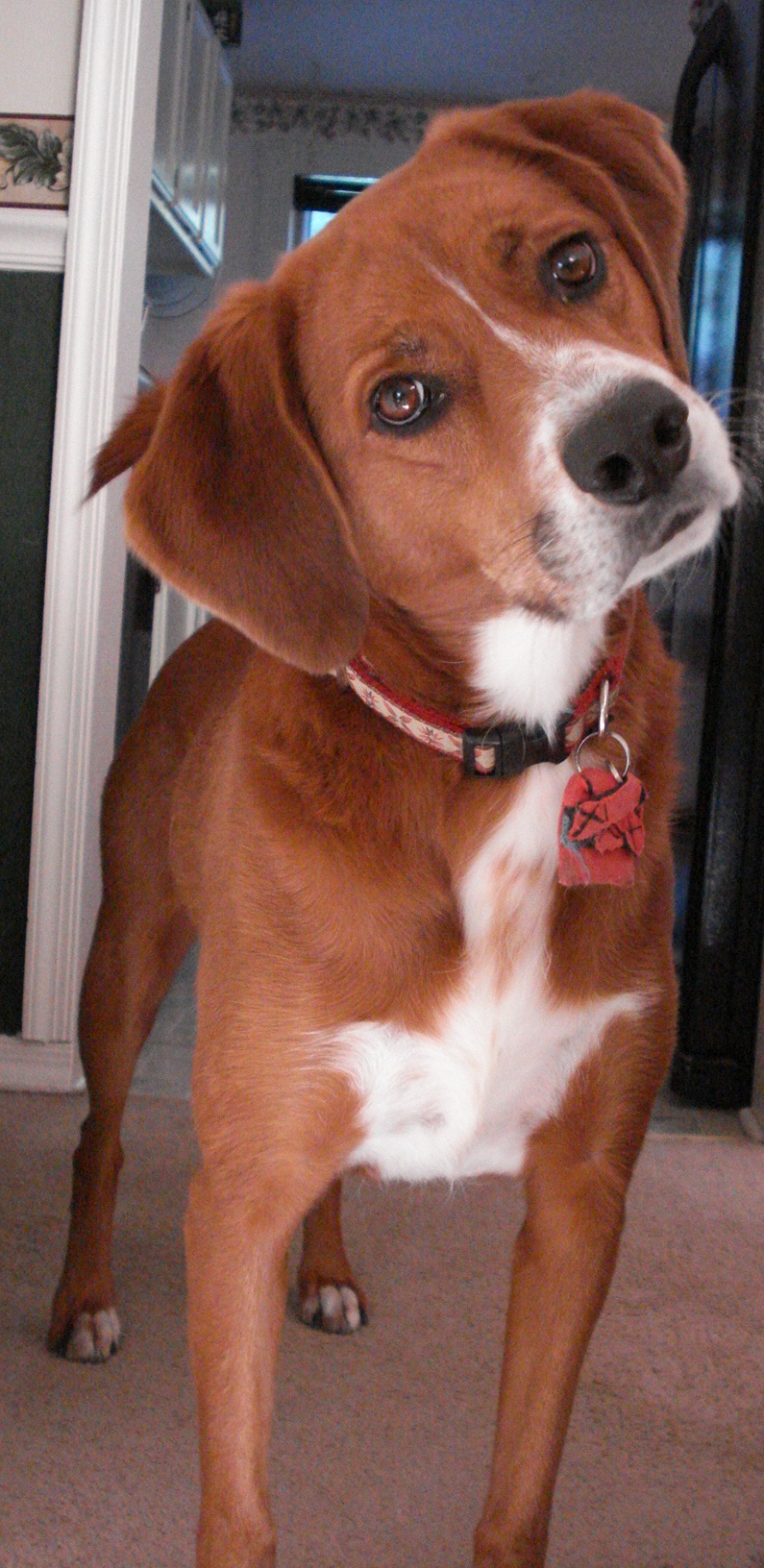
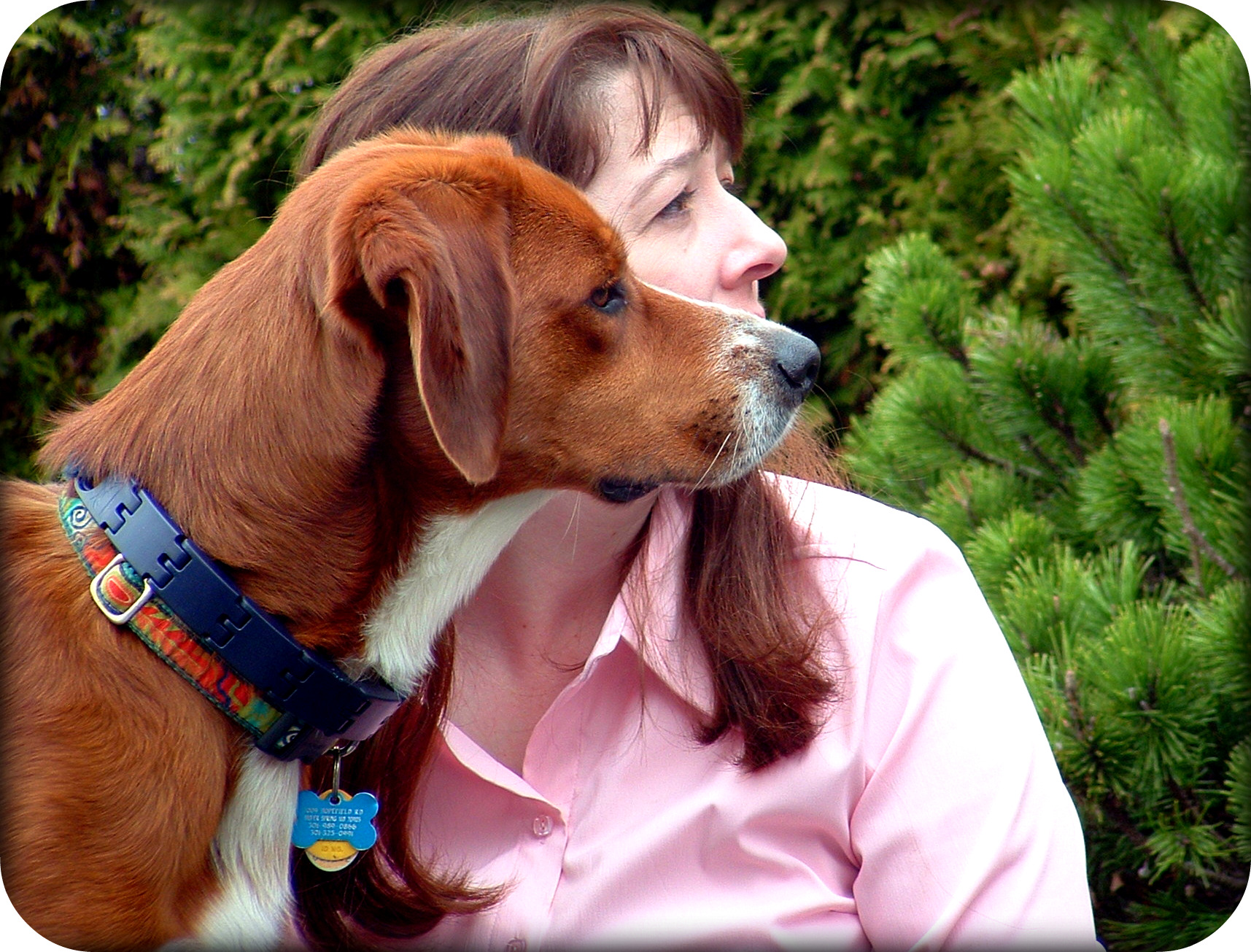
Not being able to hit “snooze” on my alarm clock since that happens to be my service dog, Chloe. When the alarm goes off, she kisses me awake and there is no going back to sleep. The dog is definitely a “morning dog”.
7. My favorite medical TV show is:
Not really a medical show but I do like Dr. Phil. He’s a “reality therapist” and I think everyone who has an invisible illness needs to have a healthy dose of reality!
8. A gadget I couldn’t live without is:
FM Clipboard for classes.
9. The hardest part about nights are:
Trying to ignore the tinnitus that comes roaring into play after removing my cochlear implant.
10. Each day I take __ pills & vitamins. (No comments, please)
1 prescription (blood pressure) and 9 different vitamins – one of which is Manganese. Studies have shown that people with Meniere’s disease may have a Manganese deficiency.
11. Regarding alternative treatments I:
Have tried numerous ones including acupuncture, chiropractor, and vitamins.
12. If I had to choose between an invisible illness or visible I would choose:
Visible – no question. This is why I try to make my invisible illness – VISIBLE.
13. Regarding working and career:
I am proud that I am able to work having made a number of adjustments and having chosen to be partnered with an assistance dog.
14. People would be surprised to know:
That I dread group activities because I don’t hear as well as they think I do.
15. The hardest thing to accept about my new reality has been:
That I must sometimes choose not to do things I once enjoyed because of my symptoms. For example: If there is a movie I wanted to see that is coming out, but the weather is bad and my Meniere’s disease has flared up, I cannot go and have to put it off.
16. Something I never thought I could do with my illness that I did was:
Go back to school and finish my MS.
17. The commercials about my illness:
There are none. I’ve never seen a late-deafened/cochlear implant commercial, nor a commercial about Meniere’s disease.
18. Something I really miss doing since I was diagnosed is:
Listening to music.
19. It was really hard to have to give up:
Friends who couldn’t cope with the new me accompanied by a service dog.
20. A new hobby I have taken up since my diagnosis is:
Blogging/writing
21. If I could have one day of feeling normal again I would:
Go to an amusement park and ride every roller coaster there!
22. My illness has taught me:
That the disability community is live and well and fully utilize the Internet to connect, support, share information and to be proactive.
23. Want to know a secret? One thing people say that gets under my skin is:
“Nevermind”. If you aren’t willing to repeat it for someone who hears differently are you not behaving as if it doesn’t matter to THEM?
24. But I love it when people:
Include me.
25. My favorite motto, scripture, quote that gets me through tough times is:
Helen Keller: “Blindness separates us from things but deafness separates us from people. “
26. When someone is diagnosed I’d like to tell them:
Email me. Ask questions. I want to help!
27. Something that has surprised me about living with an illness is:
How family members who once knew you “when” are not willing to learn about the new you.
28. The nicest thing someone did for me when I wasn’t feeling well was:
Email me and ask how I was doing.
29. I’m involved with Invisible Illness Week because:
Many illnesses and disabilities are invisible. I want to raise awareness.
30. The fact that you read this list makes me feel:
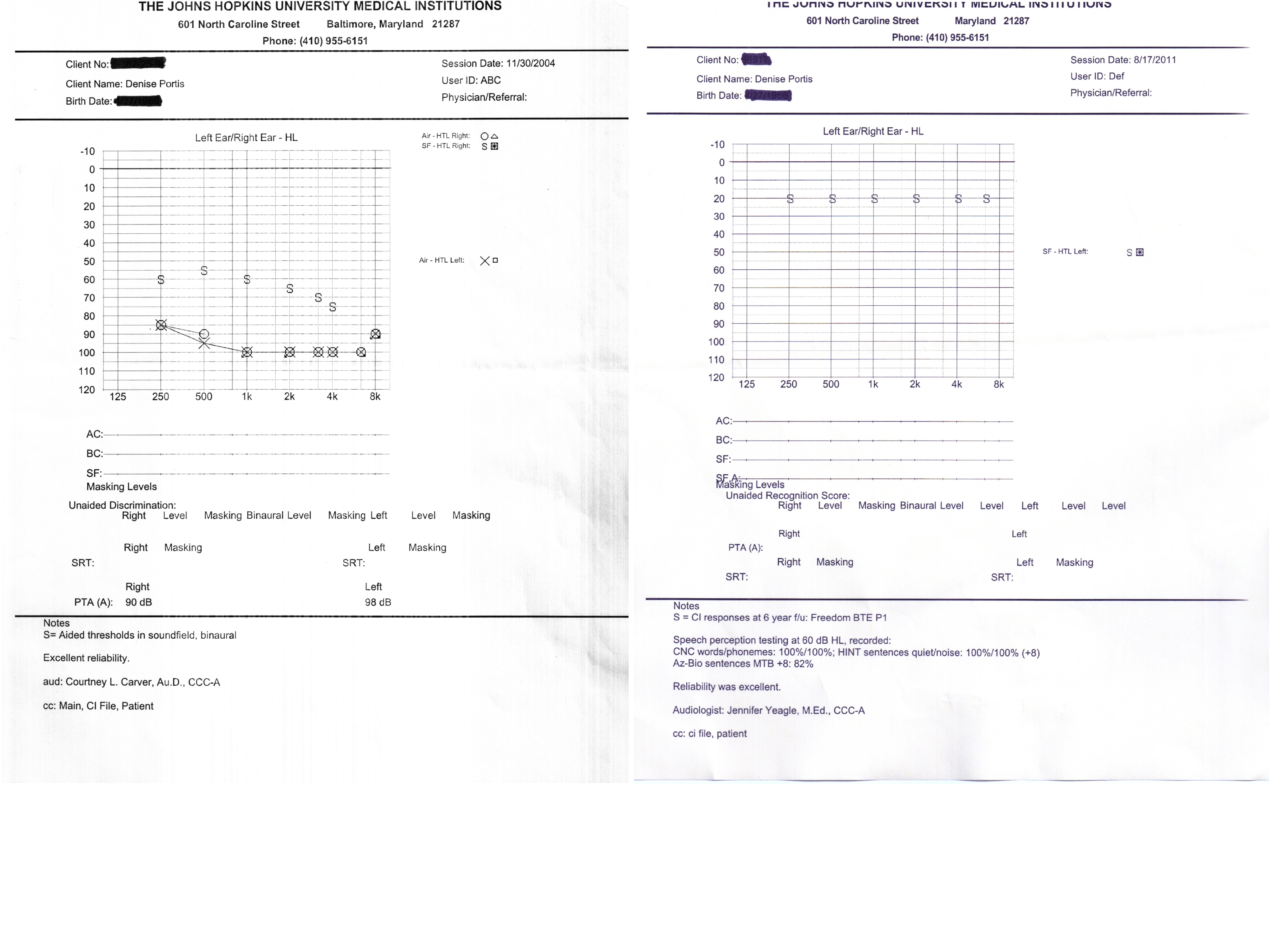
Today I traveled to Johns Hopkins for my 6 year post-activation mapping of my cochlear implant. A number of things went through my head as I traveled a familiar road to my audiologist at the Listening Center. For one thing, I listened to the GPS give directions and didn’t glance at it once – for I was hearing it. I talked to my assistance dog, Chloe, in the back seat when I pointed out the stadium as we passed and heard her bark in response to let me know she was an Oriole fan.
As I entered the parking deck for Johns Hopkins Outpatient Center, I mashed the button to give me a ticket. I heard the instructions to pay before returning to my vehicle prior to leaving. Walking across the enormous lobby I could hear families chatting while they waiting to check in, and admissions counselors quietly talking to patients ON MY DEAF (implanted) SIDE. As I approached the elevators I heard a series of “dings” as different cars reached the lobby level waiting to take patients “up” or “down”. The elevator announced the floor level on each concourse and warnings to stand clear of the door echoed through the car.
All of these sounds were silent for me in 2005. Six years later I hear them all and do so with relative ease. When I was originally tested to see if I qualified for a CI, I entered the sound-proof booth with my husband. I waited to hear sounds in order to “mash the button” and turned to my husband to say, “Gee… when will it start do you think?” My voice drifted off when I saw the look on his face. SHOCK.
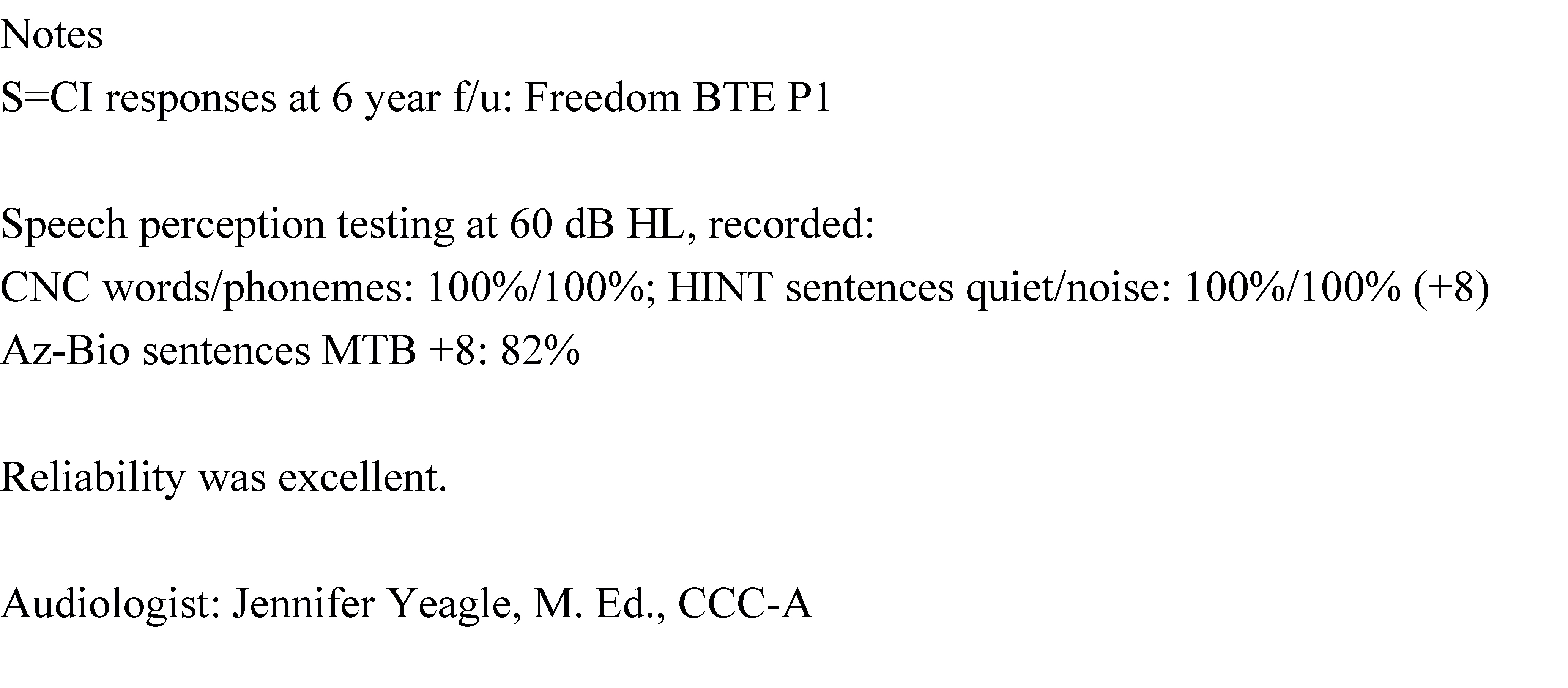
He gestured to the window and then the speakers and said, “Denise, the test has been going for 2 or 3 minutes already”. Neither one of us realized how poorly I was hearing since I relied on speech reading so much. Today I entered the booth with confidence and even took a test “brand new” for me. With crowd noise I had to repeat different voices (male and female) of a conversation. My audiologist was very impressed. She said she could see “the switch turn on” after a sentence or two when my CI picked out the important voices from among all the others.
I realize cochlear implants are not an option for everyone with hearing loss. I also know that some people get a cochlear implant and are not 100% happy with the outcome. For me… the Nucleus Freedom cochlear implant changed my life. I hear SO well, in fact, that I’ve chosen not to go bi-lateral like many in my peer group have done. On my “bad” balance days, I cannot risk having my balance worsen because of a 2nd implant at this time. I was diagnosed with Meniere’s disease PRIOR to my first CI, and my family and I cannot tell that it made my symptoms any worse. I have, however, found some research that may indicate a 2nd CI could worsen Meniere’s symptoms – so for now? I wait to see what the future may bring. My audiologist believes I hear as well with one as well or better than many do with two. I’m happy with how I am hearing!
Sometimes? There is not a great solution available for positive advocacy.
This past Friday, my 21-year-old daughter asked me to go shopping with her. I’m always thrilled when she CHOOSES to spend time with me, so I agreed so long as it was the morning so that we could “beat the heat”. She agreed. She wanted to shop for new “under things” and I knew JCPenny was having a sale on these items. Kyersten, Chloe and I headed for Annapolis Mall to shop.
The bad thing about shopping in the “intimates” department is that there is not much room to maneuver. I was having some difficulty with my balance as well so I was just being extra careful about how much moving I had to do. Chloe does great even in confined spaces with the exception of that tail. I talk to her a great deal while we are out because it helps to keep her attention on me. Kyersten was busy looking at different styles available. My main job was to offer the occasional opinion and situate Chloe so that her tail didn’t knock things off with her loving “wag”. Chloe may not understand all that I say to her, but she does know her name and will wag as if she is paying attention to everything else I’m saying. Because my attention was on HER, and as we were in “tight quarters”, I was taken by surprise by two little girls who ran up and threw their arms around Chloe’s neck.
One little girl was about 4-years-old, and the other (obviously big sister) was probably 9 or 10-years-old. I stuttered out, “Oh! I’m sorry. She’s a working dog and cannot be petted right now”. The girls continued to squeeze and talk excitedly.
I tried to tune in a bit better and realized they were talking in Spanish. With my heart plummeting to my stomach, I held up my hand and shook my head NO saying, “Please don’t pet her. She is a working dog”.
The older girl stopped and tried to talk to me in English, and I understood “She’s a pretty dog”. At this point Chloe broke her sit/stay in order to break the choke hold. I was unprepared and went to my knees and caught myself on a rack.
With bras, panties, and tiny hangers attached to various body parts, I again held up my hand, shook my head no and said, “No please!” in a very firm voice. As I was still wobbling, I sat on my caboose to get my bearings.
The older girl said, “Oh … sorry” with some other words that I could not make out because of the accent. I did understand that she understood that Chloe was NOT to be petted. In Spanish she (I think) explained to her younger sister about Chloe. I think she realized something was amiss because I was now sitting on the floor with lingerie scattered around me. She left quickly with her little sister in tow.
I had Chloe brace so that I could get up, and asked my daughter to pick up some scattered articles. (Chloe could have, but I didn’t figure anyone else would want dog saliva on merchandise). Right as I was on one knee about to stand, the youngest came zooming around the corner with a squeal to squeeze Chloe again (who was now in a stand/stay and “brace”). I held up my hand and intercepted the young lady and my hand blocked her at the chest. Although I did not PUSH, it did stop her in her tracks. I said firmly with a head shake, “NO!” She turned and ran away.
I did NOT want to place my hands on someone else – let alone a child. I didn’t injure her, but I really felt out of options. I was “rattled” the remainder of the day. I was very upset with MYSELF that the resolution to this problem ended up playing out like it did.
When All Else Fails… Be Firm
I did look around for the youngster and never did see her or her older sister during the remainder of our shopping trip. When something doesn’t go according to plan I tend to beat myself up about it I’m afraid! I kept thinking about other options I may have had, and tried to think of what I might do should this happen again. (I’m open to suggestions – grin).
Sometimes we can try to advocate in a positive way – and the situation may just fall apart. Sometimes? You just have to be firm and resolute. We should always try to be positive and upbeat at the beginning…
“It would assist me in staff meetings if everyone would just pop a hand up before speaking so I can locate who is talking”.
“I can easily do my share of answering the phone if I had access to a captioned telephone that would provide understanding for when I don’t hear everything”.
“She’s not a pet. She’s a service dog and she can come into the store with me”.
Yet there are times we may have exhausted other options and have to stand firm.
“I need everyone to simply pop your hand up with a small wave before you speak. Thanks in advance”.
“I will require a captioned telephone so that I can do my job and share the task of answering the phone”.
“Here is a flier about what the ADA says about my rights. I’ll be over there shopping should you have any additional questions”.
I don’t think ANY of us welcome having to be firm and insistent, but there is a time and place for being firm. I try to always remember that there will be others who come after me that may also have accessibility issues. How I handle a situation may condition someone with normal hearing to respond to the next person they interact with who has a disability. There are times, however, when all pleasant and positive avenues have been closed to you. Even in your firmness… keep your cool. Keep it short and stick to the facts. My husband grins and tells me, “Denise! TMI. Keep it short! They don’t care about your background or care to hear your story”!
Accents, Foreign Languages, and Hearing Loss
The great thing about our country is the diversity. Because of where I live there are a large number of minority populations who speak English as their SECOND language. I do not speak an oral foreign language so I’m a little jealous of those who can! My mother taught high school Spanish for over twenty years, but her children never learned (much to her dismay). I have a lot of respect for people who speak English as their 2nd language. It is difficult, however, to understand language when an accent distorts the way a cochlear implant and/or hearing aid pick up the words. I have trouble understanding people with thick accents that may speak PERFECT English. I even have problems with American accents such as folks from Boston, Texas, etc. (I understand “Southern” as I lived there for so long!)
However, the fact that I have difficulty with accents, is MY problem. People with hearing loss should have patience with those who speak other languages as their primary language. I have heard late-deafened folks demean and criticize those who speak other languages. I always think to myself, “Really?” It is far more productive to explain that you have a hearing loss and have trouble understanding when an accent is present. Let them know that you are aware it is your problem, and pleasantly ask if they can perhaps speak slower and face you when they speak. I’ve overheard HoHearies blast people with heavy accents – as if it is THEIR fault! Always – ALWAYS – remember you are an advocate for others with hearing loss whether you signed up for it or not! If you are negative, critical and defensive, you are having a negative influence on how the rest of us are treated in the future. Yes, it can be frustrating and even embarrassing to have to ask someone with a heavy accent to repeat themselves again and again. But “own” the problem as yours – it isn’t their problem. It’s a big thing to be fluent in more than one language, so treat them with the respect they deserve.
I recently attended the annual national convention of the Hearing Loss Association of America because it was actually held in my area this year. At one point, I was in the crowded convention hall perusing the numerous hearing loss vendors and booths. At a distance, I saw an old acquaintance scoot by in their scooter. I tried to wave them down but I was not in their peripheral so they did not see me. After they quickly rolled out of my sight, it hit me! I could have raised my voice and said, “Hey Bob!” This friend did not have a hearing loss, but attended these conventions alongside of his wife who WAS deaf and hearing again with two cochlear implants. I had to smile at my mistake, because I forget that people with normal hearing do not have to have a visual cue in order to get their attention. (Thankfully we ran into each other later…)
I see this all the time in my kids. Kyersten and Chris (now 21 and 20-years-old) attend college but live at home. They really have no memories of my not having a hearing loss. Even though I had a progressive loss, it took twelve years before my hearing was completely gone. They have both told me that they don’t remember my ever hearing well. They are so accustomed to speaking with someone who has a hearing loss, they automatically do things that are more difficult for someone who isn’t in constant contact with someone who is deaf. They always come into the same room that I am in, and rarely try to have a conversation from another room with ANY family member… even those with normal hearing. Recently my son came all the way into the family room to ask my husband a question. It was a simple question that could have easily been asked from the kitchen. The television wasn’t on, and the area was fairly quiet. However, he is so accustomed to facing the person he is talking to, it is difficult to remember that he can do some communicating from another room when it comes to his dad. My daughter is often told that even as shy as she is, she has “uncanny eye contact” when communicating with someone.
Teaching Them Early
When my kids were about 2-3 years old, they were already “old hats” at communicating with a person who had hearing loss. They cannot remember watching television without captions. Even “Barney, the Dinosaur” had captions, as did “Sesame Street” and “Thomas the Tank Engine”. I believe it helped them learn to read as early as they did!
If I needed to tell my kids something, I would walk over to them and get down on their level. I would put my hands on each side of their face and say, “I’ve got my GUESS WHAT FACE ON!” I’d then (almost nose to nose) tell them what I wanted to tell them, or simply say “I love you”.
If they came to talk to me, I could hear that they were talking, but not understand what they were saying. So I’d lean down and put my palms on each side of their face and ask, “Wow! Do you have your GUESS WHAT FACE ON?” It didn’t take long for them to begin putting their own palms on the sides of my face when talking to me. As they grew older, we dropped putting our hands on the face of the other, but they would come and tell me with direct eye contact… “Mom, I’ve got my GUESS WHAT FACE ON…” and then tell me what they were going to say.
By the time my kids were 5 and 6-years-old, it had become habit. I was eventually able to afford a refurbished hearing aid that gave me some help in hearing for several years. I recall my daughter (from the next room) telling my son, “Wait a minute. Let me put my GUESS WHAT FACE ON and ask Mom!” As they continued to age and mature, what “stuck” was direct eye contact and face-to-face conversations. It was actually a wonderful gift to help nurture in them, for all of us do very well to give the other person the attention they need and deserve when communicating. No competing with electronic games, closed captioning on television, or computers when we talk. We put everything down and LOOK at the other person.
How to Get a Deaf Person’s Attention
Here are some great tips in how to get the attention of a person with hearing loss.
1. Wave your hand in their line of sight.
2. Touch their shoulder or hand before speaking.
3. Move into their line of sight with your body to gain their attention.
4. Turn the lights off and on (this is especially helpful in a room that may have more than one person with hearing loss and you need EVERY person’s attention).
5. If sitting at a table with the person, gently knock on the top to get their attention through vibrations.
Can you think of any others? I welcome your input!
How Service Dogs Get Attention
Hearing assistance dogs are taught to get their partner’s attention by gently bumping them with their nose or touching them with a paw. As I have a balance disorder, Chloe tries to garner my attention by standing and staring and WAGGING LIKE MAD. She only places a paw on me or bumps me with her nose if her 1st efforts have failed. Smaller assistance dogs, may get their partner’s attention by actually jumping up on them.
Even though hearing assistance dogs are trained how to get the attention of their partner to alert them to sounds, the human partner has to be responsible as well. Shortly after being matched with Chloe my trainer, Pat, took me to many different types of public places to train ME. Chloe was already trained. She drilled into me, two important things:
1. WATCH YOUR DOG
2. TRUST YOUR DOG
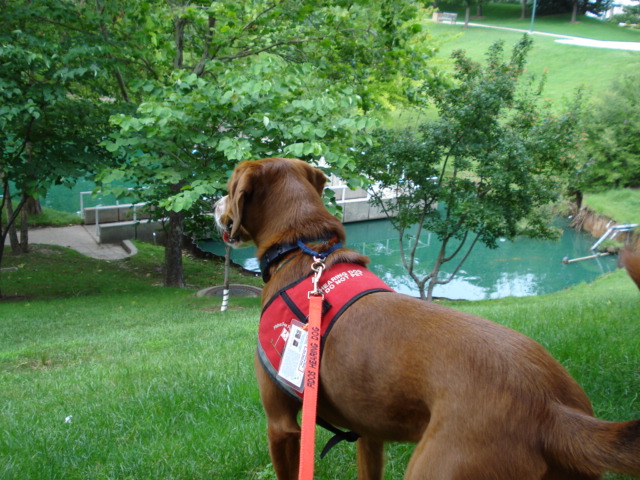
I quickly learned to pay attention to what has Chloe’s attention. Her hearing is not only much keener than my own, it is more sensitive than people with normal hearing. I can now even recognize when she hears something if she is standing in front of me (with my only seeing the back of her head). Chloe has a modified “heel”. “Heel” position is when the dog’s shoulders are parallel to their partner’s left leg. However, I do not have peripheral vision on my lower left. So we taught Chloe a modified “heel” that is slightly forward of a true “heel”. I had to learn how to observe the BACK of her head. Thankfully she has these wonderful hound ears that perk up and she “points with her nose” in the direction from which a sound is coming. She will even cock her head to the side to really tune in.
Look the neighbor came out...Look at that family over there...something is in the bushes...
If the sound is something she thinks I should hear, she’ll come and get me – phone ringing, door bell, someone calling my name, kitchen timer, etc. These are all trained alerts. However, I have been in situations where I could tell a sound had completely distracted her yet I could not hear or place what it was. When this happens, I ask “Chloe… what is it? Show me!”
Chloe will start to wag and TAKE me to what is making the sound. I have to be careful about this. I don’t want her to take me to every single sound she hears. She may hear the kid’s arguing and cock her head as she listens. I do NOT want her to take me to where they are arguing because they are old enough to work out their own problems! She seems to understand when it is a sound that I need to pay attention to – such as a cat locked in the laundry room, the low-battery sound on the phone in the bottom of my purse, or “Daddy” hollering from the bathroom because there isn’t any toilet paper!
A Word of Caution
I believe that individual’s with hearing loss should get the attention of every person they wish to speak to – even if that person has normal hearing. Do you know how many conversations I have interrupted because I walked up to someone and started talking without hearing that they were talking to someone else? I try to make it a habit (and still sometimes fail) to make sure I have the attention of someone before I begin speaking. This eliminates the likelihood of my talking over someone already talking.
I suspect all of us can improve our communication skills. If you have someone in your life who has a hearing loss, I encourage you to sit them down and ask them in what ways you may better communicate with them. If you have a hearing loss (whether a veteran of deafness or a “rookie” – new to coping with hearing loss), try to sit folks down and have a “heart to heart” about ways they might better communicate with you. This may include family members, co-workers, or even supervisors. Don’t think, however, that once you share with them how to better communicate with you that they will always do “right” from that point forward. I have learned that the people in my life need occasional (positive) reminders.
“Could you put your hand down please? You are covering your mouth”.
“Do you mind looking my direction when you speak?”
“Could you get my attention before you begin speaking? I’m afraid I missed all that you said prior to my looking up and seeing you standing there!”
Stay positive. Few people will put any genuine effort into communicating with you if you belly-ache and whine about it. If you get angry, it may cause resentment and defensiveness. Keep your cool! Smile… be positive! In the end, you are actually helping them better communicate with ALL!
Approximately 1 in every 8 Americans experience some degree of hearing loss (Binder, 2011). This is approximately 36 million people – just in the United States. While to some, this number may seem overwhelming or unfortunate. For me? I have to admit to a small “thrill” – for you see… I’m a part of this “family”. I am one of those “1 in 8”.
What is “family”? The obvious definition includes those to whom you are related. I’m very grateful for my immediate family, for in many ways they fall into the “family” of which I am writing today as well. For the purpose of this post, “family” consists of individuals who understand by direct or indirect experience, a life that may be different as the result of disability – whether it be congenital or adventitious.
Hearing Loss Association of America
I recently had a couple of wonderful weekends that helped solidify this feeling of “family” for me. The first was when I went to one day of the 4 day national convention for the Hearing Loss Association of America. This year it was in my area, so I could not pass up trying to go at least one day. I was able to attend a number of workshops, all of which had CART. The rooms had terrific amplification, so I was able to hear the speakers of each workshop very well thanks to my cochlear implant. However, there were a number of people in each workshop who used the CART. On a large screen next to the speaker, every word spoken was also typed by a trained captionist. Those who had never experienced CART before, and therefore had never experienced workshops such as these that were truly accessible, hung on every typed word! As I looked around, nearly every ear had a hearing aid or cochlear implant – sometimes BOTH. I counted six hearing assistance dogs in attendance at the convention on Saturday. I was surrounded by “family”. Even those without hearing loss knew someone who did, were family members, or professionals that worked with our population. Between workshops old friends and new friends often crowded around talking. I couldn’t get over feeling like I knew these people. There were no snide comments or competition over who had the better cochlear implant or hearing aid. We were all “family” – with an intimate knowledge of what it means to live with hearing loss.
I attend a local chapter of HLAA, but being at a national event has no equal. The Internet has allowed people with similar disabilities to contact, share information, and get to know each other in a supportive environment. Some of the people I met I had only known online. However, these national conventions allow us to meet face-to-face! What a treat to literally hug the neck of some of my “family”!
This past weekend, I was able to hang out with a wonderful friend who has bilateral Nucleus Freedoms. She lives in North Carolina and since my husband and I were going down to visit his mom and dad, I took the opportunity to spend the morning with her. She took me to one of her favorite places – the North Carolina Zoo. I hadn’t seen the zoo in at least nine years – not since I had moved away from the area in 2002. We have so much in common in addition to hearing loss. No – we do not have similar backgrounds or childhood experiences. But we both are advocates and do all we can in our own small realm of influence to make a DIFFERENCE. She is a sensitive soul who sees much more than a normal set of eyes can see. It shows up in her photography and in the simple things she points out. A whispered, “L o o k“, usually yields a treat of catching LIFE in an unexpected way. I consider her “family” although we are not related.
Fidos For Freedom, Inc.
At Fidos For Freedom, clients include those with mobility issues caused by numerous types of disability or illness, and people with hearing loss. I cannot count the number of different types of disease, invisible illness, and disabilities present in our “family” at Fidos. The fact we are there for the same reason makes us “family”. Whether client, trainer, puppy raiser, volunteer, or DOG… we find a bond and sense of “family” that cannot be found in other groups in our lives.
I am thrilled to share information and get to know people all across the U.S. who are partnered with assistance dogs. Our disability or invisible illness may be different… but we are the same. Some have partners from organizations like Fidos and some are owner-trained teams. Regardless, we are “family” and I feel a loyalty towards these teams that defines the kind of “family” we are.
Sometimes FAMILY are not “Family”
My readers share with me sometimes that trying to get family to understand what it is like to live life in “their shoes” is quite difficult. For those who acquired disability or invisible illness later in life it may make more sense that family members such as parents and siblings seem incapable of grasping who you are now. However, there are others who have shared that even though their own challenges began at birth, family members are unable to fully understand (or perhaps cope?) what it is like to experience life with additional challenges. I truly believe that people with disability and invisible illness are more capable than those who are “normal”. Learning to adapt, and seeking support, information, and techniques create a malleable, strong individual. Oh sure! There are times we flounder. Change is never easy. But the end result yields a person who is extremely ABLE – not disabled. It is unfortunate that many people to whom we are related are unable to really connect with us once change takes place. Perhaps our peers often become “family” to us because they help us stay connected to life in a more positive way. They understand. Relatives often lose contact with us or only see us once in a great while. These individuals who offer daily support, information, and “family” literally evolve into a close knit community and family. I have had some readers share that they are closer to those in their peer group (disability group) than they are to siblings, parents, and other relatives. They have shared that not only do these “real” family members not understand – they don’t want to understand. I was recently reminded that my own siblings do not really know who I am anymore. After something rather tragic occurred in a relationship I find now broken, I wailed to my mother on the phone how terrible it all was. I shared some things with her that I had never shared before… and she responded, “You never shared these things with me when you were going through this”. So I am (painfully) aware that sometimes our family members are unaware and out of touch because we withdraw.
I am blessed to have family who are also “family”. My immediate family have been a safe haven of support throughout all of my adult life. My children have never known me without hearing loss. Mom’s favorite word growing up has always been “huh?” My husband held my hand both literally and figuratively throughout the process of losing my hearing over 12 years. When I became profoundly deaf, he was my biggest cheerleader in seeking other technology that would help me hear again. My family willingly sacrificed so that I could attend trainings and eventually receive an assistance dog so that I could be more independent. My immediate family members advocate for those who have any type of special challenge. They have participated in TBI (traumatic brain injury) camps, hearing loss conventions, local HLAA chapters, Walks for Hearing, cancer awareness walks, and much more. They know and realize that disability or invisible illness does not define the person. They have always seen the PERSON first. Because they understand what it means to live with disability or invisible illness simply because they LOVE someone who does have challenges, they are “family” as well as family. I hope that many of you have family members that are also “family”. People who support you without hindering you. People who cheer you on and look forward to your eventual success.
Look for – and BE – “Family”
If you are currently adjusting to acquired disability or invisible illness – please know you are not alone. Find a computer and Internet access. It won’t take you long to discover you are not walking this road alone. As you reach out, look for ways to connect and be “family”. I promise you that there is no other feeling like finally… belonging.
Binder, M. (2011). Hearing. The Ear Man: Hearing Aid Service. Retrieved June 28, 2011, from http://www.theearman.com/hearing.html
My daughter was home for Easter weekend so the family enjoyed a rare night out to the movies. The movie “Soul Surfer” had been recommended to us so we chose to attend on Sunday afternoon. I was in a bit of a huff when I arrived due to some family conflict, missing the first part of the movie while I sat and fumed. (Yup… I definitely need to learn to fume a little quicker).
Once I started paying attention, however, I really enjoyed the movie. When you “hear again” with a cochlear implant, you really do have to make the concentrated effort to PAY ATTENTION as listening is no longer a passive exercise – rather an active effort. On occasion, I’m lucky to snag a movie we are attending that is open captioned. I do not have to focus with nearly the same concentrated effort when the movie is open captioned. As it was, I finally TUNED IN and really enjoyed the movie. I won’t spoil it for you in case you haven’t seen it, but basically a teenager learns to live life differently due to circumstances that were neither predicted nor expected. She learned that “in spite of” she can continue to make a difference in the lives of others… to touch souls.
Individuals with acquired disabilities of any kind have to do the same, don’t they? I mean the alternative is isolating yourself and giving up. That isn’t a life I’d wish on anyone. (Believe me I know, because I tried it for a short time!) It takes a lot of courage to persevere and learn to do some things differently when life throws you a curve ball. I’ve always been a lousy “catch”, so wouldn’t you know when my own disabilities took hold and changed my life that I was totally unprepared?
I was at a Fidos For Freedom training with my assistance dog one Saturday and a fellow client that I have come to know quite well wasn’t at all surprised by a blunt question. We had learned to be “straight” with each other early on because we discovered that by doing so we could learn from each other. She is a client who has been matched with a service dog trained to assist her with mobility tasks. Having experienced a recent “wet week” due to spring showers in our area, I asked her how she found the wherewithal to come to trainings after having a “bad week”. She has had to learn to do things differently because of her disability and must prepare well in advance when attending trainings that other people may be able to spontaneously decide to attend! She said, “I simply remember that by coming I have opportunities to encourage someone else. I don’t want to miss those opportunities so I get my butt out of bed!”
I’ve never met anyone that was not able to MAKE A DIFFERENCE in the life of another. I don’t care who you are or what your circumstances are. The only necessary ingredient to successfully touching the life of another is BEING WILLING. If you aren’t willing, it will never happen. People with acquired disabilities have learned to maximize technology. We have learned to perhaps do something DIFFERENTLY in order to accomplish a task. We have also learned when to cut ourselves some slack. People with acquired disabilities have learned to ask for help at times. We are malleable, persistent, and BRAVE. No worries. I’m not “tooting my own horn” here, I’m simply pointing out the obvious having met numerous people with acquired disabilities.
Surfing for Souls
There are numerous ways individuals can make a difference. My “short list” is below. Feel free to leave comments and add to this!
1. Join online support groups and be active in the group. Reach out to others who are perhaps struggling with a new acquired disability.
2. If possible, participate in local support groups or chapters that meet physically each month. Go prepared to learn, but look for opportunities to serve.
3. Be open and honest. Don’t hide the fact on your Facebook. Don’t make your disability invisible. Visibility allows others to see you active in your community, doing things others do without thought. Shopping, church, or GOING TO THE MOVIES are all activities we can still accomplish. Welcome questions and be prepared to be a positive advocate.
4. Have business-card sized cards available to give to people who stop to ask questions about the: Cochlear implant bling, service animal, hearing aids, wheel chair, walker or bright purple cane! In this way they can contact you at a later date and ask questions in a more controlled, confidential way. They may need the information for themselves, or for someone they care about who struggles with their own acquired disability.
5. Don’t apologize for being different. Celebrate it!
6. Advocate, advocate, advocate! When the support groups and organizations to which you belong do annual fundraisers, DEMOS, or community service appearances, do not hesitate to get involved and advocate! At times you will be called upon to write local or state government officials. Take the time to do this!
I remind myself as I encourage you to do the same. I need to be be aware on a DAILY basis. I can surf for souls to touch. I can make a difference!
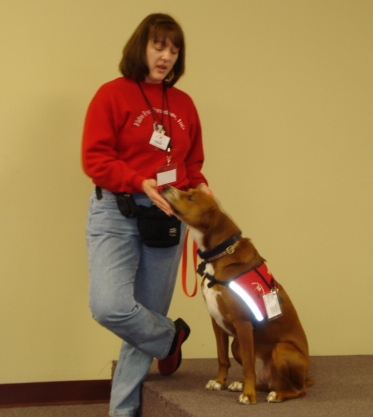
Denise and Chloe at a dAP for HLAA-Frederick County in 2009
Disability (grimace). There is a small part of me that cringes when I hear that word, for often it is heard with real (or imagined) inflection that denotes a negative meaning. Occasionally, I get some “flack” from some of my readers about using the term “disability” so freely. Some folks hate the word and avoid it all costs. Others embrace it freely, caring not what the “label” may be since they are struggling to simply cope with WHAT IS. Recently, a fellow client at Fidos For Freedom used the term “differently abled”. I like that! That is the first time I’ve heard that particular variation. At Fidos For Freedom (where my hearing assistance/balance assist partner comes from), numerous programs are designed to carry the maximum “punch” in creating awareness in our community. One program is the dAP (disABILITY Awareness Program). Demonstrations are given at schools, churches, community groups, fairs, and much more to inform and teach the public about the different types of assistance dogs available, partnered with people with various disabilities. The program focuses on the abilities of all people and how an assistance dog can provide independence to people who do things “differently” as a result of chronic disease, invisible disabilities, hearing loss, mobility challenges, and much more.
Personally, I use the word ‘disabled’ freely for it is the wording in the Federal law that protects my rights as an individual who happens to have disabilities. As long as the law uses the term, I will continue to use it in order to identify with my freedoms – not my actual disability. I’m all for changing the term “disability” to something less negative, but until that happens on the federal level – I’m sticking with the term that protects my rights. Labels are awful aren’t they? I actually prefer “person with disabilities” for it identifies me as a person FIRST, and the disability second – as a descriptor, not a noun. I’ve been a member of the American Association for People with Disabilities for a number of years. They have done a lot of terrific work in laying the foundation for future laws that protect Americans who happen to be “differently abled”. Do I hope the word is eventually abolished and changed to something more politically correct? Well sure I do… but in the meantime I will continue to use a word that represents my freedom as an individual with disabilities.
Why is the Word So Negative?
Many people who hate the word “disabled” explain that it reminds them they are different. Yet we are. Acceptance of that is key IMHO to truly becoming independent in spite of a “disability”. One reader explained, “the word makes it sound as if I’m broken, or flawed”. It’s a shame society (and sometimes our peer groups) create this false picture of what a disability is. Often these negative connotations are the result of interactions with people who do not live with physical, mental, or emotional limitations that require a “new way”. People can be uncaring and mean (and you don’t have to be in junior high to experience this!). Sometimes the most hurtful things are said by people who actually care about us and are struggling to understand. Ignorance (not stupidity) is often to blame. It’s very difficult – but when you have the opportunity to correct and inform someone who doesn’t get it, do so in a proactive (not reactive) way. I try to remember that what I say may influence how this person interacts with someone else who has a disability in the future.
I believe that those who are born with a disability have the hardest time accepting the term. For example, I have met culturally Deaf people who really despise the word. (The culturally Deaf are identified with a capital “D” to identify a group of individuals who use ASL as their primary means of communication). I’ve often wondered if deaf people (lowercase “d” to identify adventitious deafness) are more accepting of the word because they experienced “normal hearing” for a time and now understand the difference because they are living WITHOUT a sense they once had? I had a Deaf friend at CSD complain that the word “slapped them with a label that meant they couldn’t do something”. I have struggled to understand that. Deaf (and many deaf) people cannot hear. What is wrong with that? Perhaps their thinking is that by accepting that label it requires the adoption of a number of other labels such as “slow”, “dumb”, “broken”, “reject”, “mistake”, and “different”. People who cannot see well without corrective lenses don’t fear being labeled with other words! Why do people with hearing loss fear that? I don’t hear in a normal way. So what?
I’ve heard others mention that the word makes them remember there are things they cannot do. I recently watched a YouTube video of a young Deaf lady who was “going off” on the fact that the only thing she cannot do is HEAR. Anything else she wanted to do she could, and she was not “disabled”. Yet the ADA protects her rights as a Deaf person to insure she has equal access to public events, education, doctor visits, and much more by requiring ASL interpretation so that she may interact on equal footing with those who use their voices to communicate. I suppose I’m a realist. I don’t understand the problem with being aware of what I cannot do. I understand that as a result of Meniere’s disease and hearing with a cochlear implant I will never:
Be a rollercoaster tester.
Wash windows on skyscrapers.
Be a DJ
Be a judge on American Idol
Swing on a swing set (until they come up with an adult size seat similar to the protective seats for toddlers!)
Tune pianos
HEAR without the assistance of my CI
So what? I don’t center my life around this knowledge, nor do I attach any value to “being able to” as opposed to “not being able to”. I chose to enjoy OTHER things. 1) When I go to amusement parks I’m the official photographer. I ride a great number of rides that do not go “around and around”. I can throw a dart that insures I come home with large, ridiculous stuffed gorillas. 2) I can wash windows on lower levels. 3) I can listen to music and “ad lib” as best I can, but if it is a new song I’m lost. 4) I can be a judge on other types of panels. 5) I can climb on jungle gyms. 6) I can PLAY the piano (took 8 years of lessons!). 7) I can hear SO MUCH now as a result of my wonderful CI!
I believe that problem is that OTHERS often attach other meanings to the word “disability”. When they choose to do that, it fosters an attitude of treating a person with disability differently, or of having different expectations of them. Is this where the word “goes wrong”? I welcome your feedback and comments. As long as you don’t swear at me – I’ll post anything even if it disagrees with my own personal opinion. After all, if my desire is that you respect my opinion I can only promise to do the same. So many of you write me to give me “thumbs up”, or “thumbs down” in response to a post. I still welcome feedback privately as well! However, this is a topic I really welcome your feedback for I really am trying to understand everyone’s opinion about this word. I believe voicing opinions about this may help others! So “voice yourself”!
We are a living, breathing, advertisement of “something”. How you choose to live your life, and how that choice is reflected in your daily interactions with others is so important. We don’t realize when someone is watching, listening, or studying how we live. I think it is so important that people with invisible and visible disabilities live their lives in a way that reflects how their disability doesn’t overshadow their abilities. I suppose being a mother I have always been cognizant of “who is watching”. But now that my kids are grown and in college, they rarely study mom and her life anymore. Others are watching, however.
I shouldn’t be surprised when people stop me to ask questions or make an observation. In spite of having invisible disabilities (“hearing again” with a cochlear implant, and Meniere’s disease), I try to make them visible so that I’m not taken by surprise by not hearing something or getting bumped by “I’m in a hurry” people. I wear “bling” on my cochlear implant to draw attention to the fact that I hear differently than folks with normal hearing. I am with the constant companion of my hearing assistance dog, Chloe. Let’s face it. Nothing draws attention to “something is different about me” more quickly than entering places of business with a service dog. But in spite of my own mom’s occasional teasing of “you’re such a drama queen”, the biggest reason I am visible about who I am is because I’m not ashamed of it. I welcome questions and curious people. Hearing loss is so misunderstood. People seem to understand the culturally Deaf. People born deaf and then choose to embrace American Sign Language as their primary means of communication seem to be understood better than those who are adventitiously deaf and choose technology, surgery, speech reading, and spoken language.
Baby boomers were recently cited as a fast growing “hearing loss” crowd. (Story can be accessed here). Yet young people are part of a new (and alarming) growing crowd of individuals with hearing loss as the result of iPods, concerts, and environmental noises. (Story can be accessed here). I am proud of my cochlear implant and proud that I am now independent thanks to the assistance of my service dog. I don’t have to worry about what I am not hearing thanks to her alerts, and I know if I drop something she will be right there to pick it up for me. Ilike being an ambassador.
It’s not always easy. Sometimes I’m in a hurry and do not really want to stop to answer questions. That’s why I try to carry my card with me so that people can contact me through email. I also carry information about my cochlear implant and information about Fidos For Freedom. (We discussed how to handle questions when in a hurry at a recent client chat at Fidos For Freedom!) In this way, even when I am in a hurry I can still be a good ambassador for people with hearing loss and people with service dogs. Am I always a good ambassador?
No. No one is perfect. You are going to have “bad days”.
In spite of those bad days, however, I encourage you to remember that people watch you. Some are people who know about your invisible or visible disabilities. Others may be folks who know nothing about you. I love meeting other “great ambassadors”. If we ever “meet up” in public, don’t be surprised by a HIGH 5 from me!
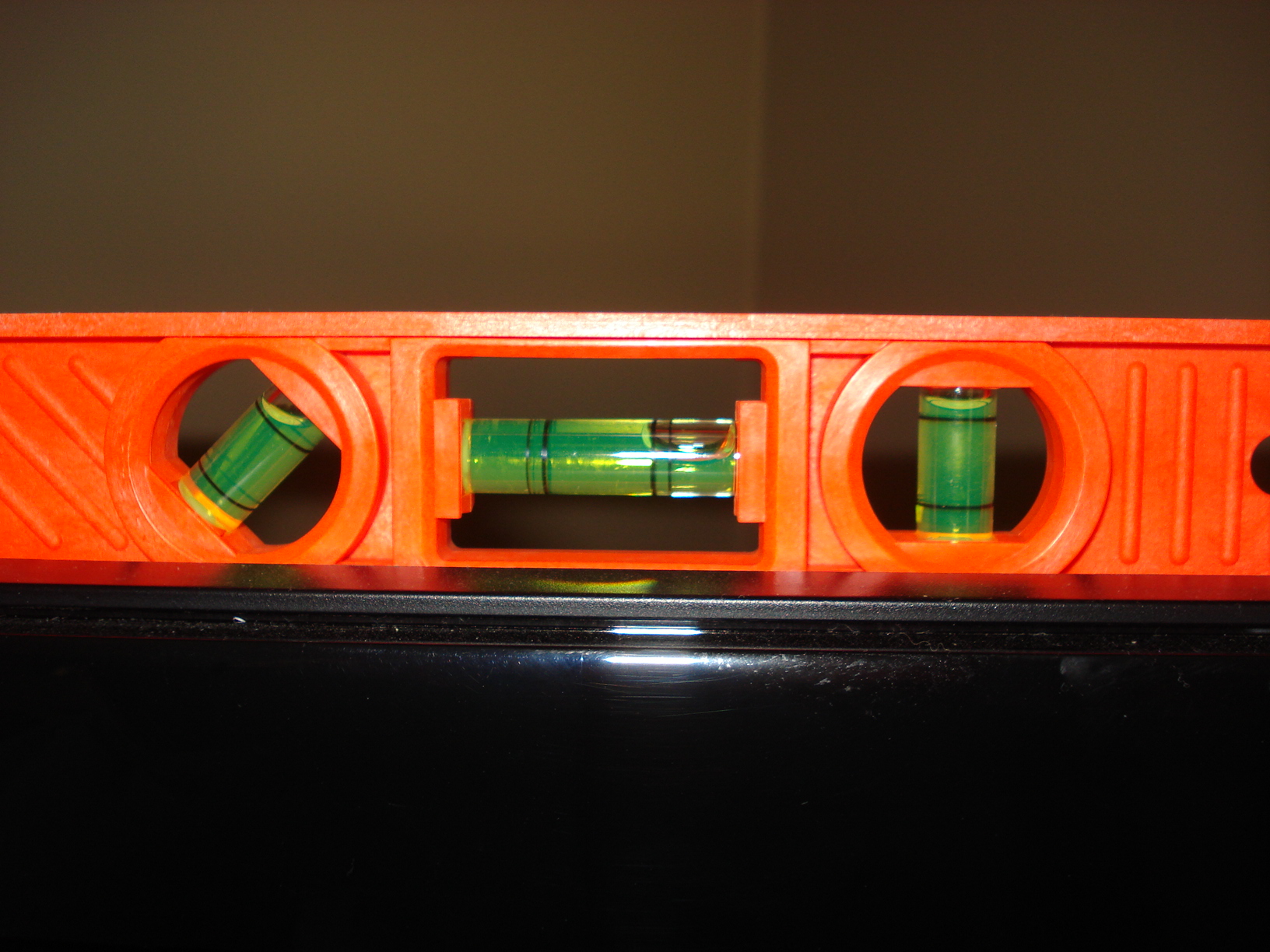
We recently moved to reduce my husband’s daily commute from 3 hours to 10 minutes. In moving, things are often “lost”. A phrase often heard in our house lately has been “It’ll turn up!” Although cheerfully voiced and repeated with conviction, over the last 6 weeks there have been some items that have not turned up. One such item was the “level”. It was a really nice level too – approximately 18 inches long and very well made. I know that Home Depot advertises these digital gadgets that use an infra-red beam to determine – “level” – but I want something I can wrap my arms around and move around as if I need a hard hat and knowledge of construction! I have neither… but I like the illusion!
Anyway – I digress…
In the move, my husband and 20-year-old son put together a new T.V. stand for our 42-inch flat screen. The first time I sat down to watch a taped “favorite” I knew something was wrong.
“Umm… honey? The screen is crooked” I announced with confidence.
Terry did get up to stand in front of the T.V. with a critical eye, but explained with some assurance in tone and stance that, “It isn’t crooked. It’s fine!”
I gave him one of THOSE looks. You know the kind where you don’t actually SAY anything, but yet SAID a lot?
“Besides”, he teased, “how can YOU say whether or not anything is crooked or straight?”
“My world may revolve, but it isn’t skewed,” I retorted.
Over the next 3 weeks I continued to insist the screen was crooked. I watch very little television and what I watch is usually a taped show. When I sat to watch a taped cooking show or “Bones”, I didn’t want to have to turn my head to watch it “straight”. I was starting to let my frustration show that I seemed to be the only one who noticed the screen was crooked. Determined to prove my own “sense of level”, I went in search of our – erm – level.
It’s very frustrating to go through every nook and cranny of a new home looking for something you clearly remember packing and not finding the item! While picking up a few things at Wal-mart this weekend I got my husband’s attention as I headed for the hardware section. “I’m getting a cheap level,” I announced with NO ROOM for argument. He rolled his eyes but followed Chloe and I to the hardware department.
Ignorance is Bliss
When we got home, Terry and I unpacked the Wal-mart bags. I was busy in the kitchen when I caught sight of him in the family room standing in front of the T.V. He was putting the level on the television stand and then the T.V., all the while looking very thoughtful. I walked over to see if my sense of “level” could be trusted.
“It’s crooked,” he admitted with some surprise.
I tried very hard not to crow, for I’ve never done “chicken” very well. “Yes, honey. Do you think you can fix it? It is driving me bananas!”
“Oh sure I can fix it, but I’ll need Chris’s help. I’ll get it done this week,” he promised.
Do you know that over the last 2 days I have caught Terry standing in front of the T.V. numerous times with his head tilted? Ignorance is bliss. Now that he KNEW it was crooked, it seemed to exasperate him as well. The T.V. hasn’t MOVED or been ADJUSTED, yet now it seemed to really distract Terry too.
What “Bugs” Me, May Not “Bug” You
If you follow this blog because you have an invisible disability or service dog you will recognize a theme that often shows up here. No two disabilities are the same. Even folks with hearing loss have differences that make their hearing loss – or “hearing again” unique. I have become “pen pals” of a sort with numerous people who have Meniere’s disease. Yet I have never discovered any one individual who has exactly the same triggers as I. Through Fidos For Freedom, I have met a number of individuals with Multiple Sclerosis, mobility issues, deaf or hard-of-hearing, suffer from fibromyalgia, or other invisible “enemies”. I have learned that what may “bug” me may have no influence on someone else who may have a similar disability.We are as unique as our disability and abilities. I for one, like it that way. Something may look “crooked” to me and in need of straightening, but it may actually be fine to someone else.
I think we have to be very careful about assuming that every individual with a similar disability lives life the same way – experiencing the same frustrations and triumphs. The late-deafened crowd can be very bad about this as hearing loss is not “one size fits all”. Frequency, pitch, and decibel levels are all experienced differently by folks with hearing loss. Those of us who use cochlear implants and/or hearing aids may not experience the same benefit as another whose audiogram may look very similar. A listening environment may be very difficult for me because of the level of background noise, but you may be able to tune out things very easily with a specific “map” of your own CI.
Yesterday in church I experienced a painful reminder that what is “level” for one person may not be “level” at all for me. After church, the organist plays a piece of music as everyone leaves. People do a quick “catch up” with those around them or greet newcomers. Can I be honest a moment and say that it is all I can do not to wince when the organist begins to play? I try hard to control my expression, but I found myself gripping my hands together as I tried to make out the voices around me while my CI picked up the organ music loud and clear and deciphered the sound as best it could. I felt the hair on my neck stand up and …
I didn’t even know I had hair on my neck!
A plan of action is needed… I’m going to turn my CI off immediately after the service and just read lips.
If I tried to explain to someone else with hearing loss, they may not understand what the problem is and do just fine in that listening environment. As a matter of fact, I have noted a number of hearing aids in ears around me in the auditorium. They aren’t snatching the technology off from behind their ears and running from the auditorium screaming like a maniac. As I inwardly “shackled” my own maniac I couldn’t help but wonder how they did it. How can this surround-sound, swelling noise be ignored while they focused on actual voices around them?
Easy.
What was “crooked” to me was “on the level” for them. No adjustment necessary! We really have to remember that. I think it all boils down to:
1. Learn to communicate your needs clearly so others may adjust to best help.
2. Respect another individual’s choices and decisions made to find true accessibility.
Sometimes not much can be done to “straighten” what is crooked. Then our responsibility changes. I hope I can be gracious and accepting about things that cannot be “fixed” or “changed” to best meet my hearing and balance needs.