We Make Do Somehow!

You know? When I find myself sitting around “counting my blessings”, it’s usually because I’m at a low point. Now a low point for me can simply be the result of a lack of sleep!

I was amazed at the results of an impromptu survey I took at the Omaha National HLAA convention several years ago. Ninety percent of those with hearing loss answered that they do not get enough sleep. Most admitted that they need between 8 and 10 hours of sleep a night in order to communicate well. If you think about it… those with hearing loss must be an active participant in “listening”. For most people, hearing and listening is a passive function of one of our main senses. Because I have a significant hearing loss, I know for a fact I burn calories trying to hear! Why doesn’t the scale show that proof? (smile!)

I have, however, had a hearing loss long enough to know that I have learned to “hear” in other ways… learned to “make do”. Oh sure! My cochlear implant, hearing aid, and assistive listening devices help a great deal! But I have also learned to use my eyes to hear better. Now before you think that means that I can speech read… think again. Speech reading is not an exact science! It use to be called “lip reading”, but the politically correct phrase is now speech reading. I use to love to watch the PAX television show about Sue Thomas, FBEye. The real Sue Thomas has the extraordinary ability to accurately speech read. She does so well as a matter of fact, the FBI hired her! But in reality, speech reading is not exact. It certainly HELPS... and combined with other things like technology, listening environment, attitude, etc., it can certainly help one with hearing loss “hear” better!

I do use my eyes to hear better, but it’s not necessarily to speech read. I “make do” somehow! I use my eyes to attempt to discern emotions, intent and attitude by carefully watching the facial expression and body language of others. I happen to have two individuals in my immediate family who can “tease” with a perfectly straight face! I fuss at them all the time! I search their expression to know whether or not something was meant in jest and to “hear” them better.

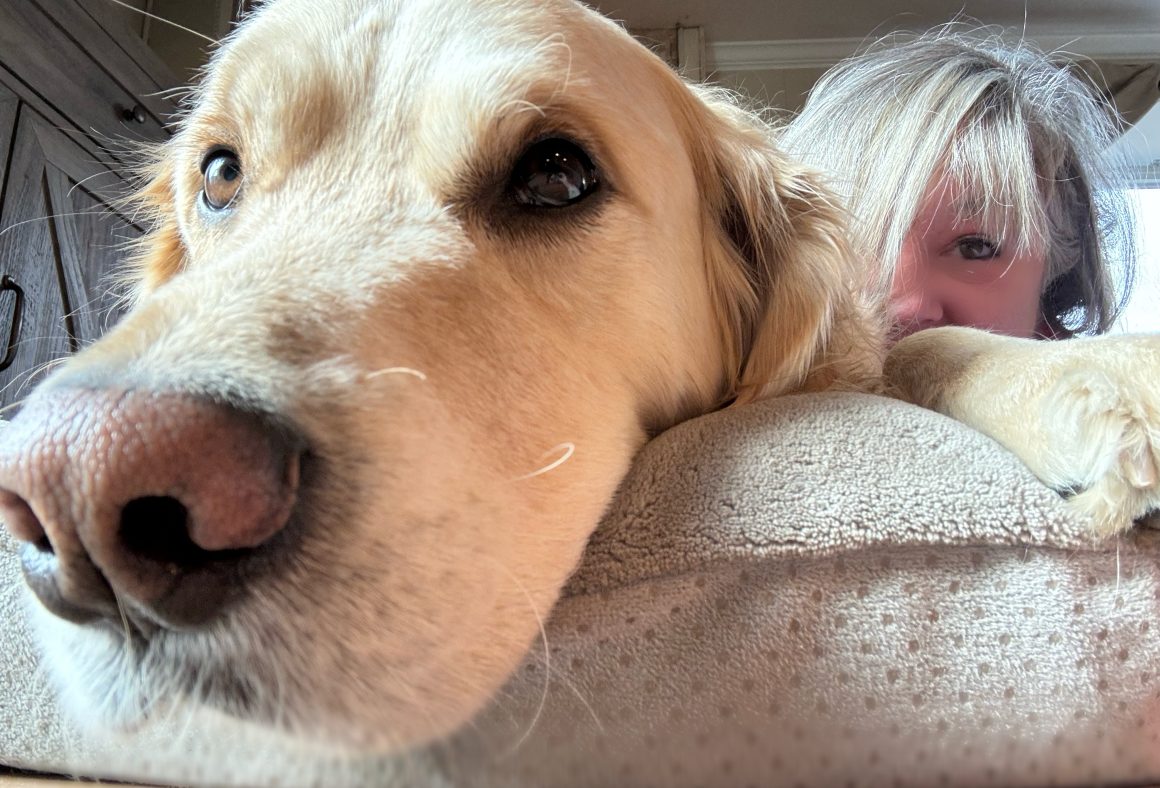
My assistance dog was sick the past couple of days. Chloe is not my “kid”, but I do love her a great deal! I’m very thankful that my hearing was still “manageable” when my kids were very small. For now that I am deaf… it was really difficult having Chloe sick and not being able to “hear” her. For two nights in a row, she bumped me and woke me in time to only comfort her while she got really sick! So by the third night, I went to bed with a flashlight. Now Chloe is better! Imagine how perplexed she must have been to have a flashlight shining in her eyes every 30 minutes or so! The poor thing hardly got any sleep for two nights… and the third night Denise is on pins and needles shining the light in her face every few minutes! At night I am completely deaf… no sound at all. Normally this means I sleep very well! But if I’m tense because I’m afraid I will NOT hearing something, the lack of hearing anything at night is not a positive! I needed to reassure myself that Chloe wasn’t going to be sick again. I needed my eyesight – with the aid of a flashlight – to “make do”.

Needless to say, I have always been in awe of two friends of mine who live in New Port Richey, Florida. They both have vision AND hearing loss. Yet… they have learned to “make do” too. It would take me 10 paragraphs to adequately explain all the things they do in order to live full and productive lives in spite of a disability X 2! They “make do” very well! (Their guide dogs are spectacular too!)

At Fidos For Freedom, Inc., in Laurel, where I train with Chloe, the clients all have various disabilities. Yet all “make do”. They train hard, and lead productive lives due in part from the assistance they now have from a canine partner. I love that one of Fidos numerous community service programs is called dAp. It stands for disAbility Awareness Program. The program’s intent is to educate others about disabilities, explain what it is like to be a person with a disability, and to increase acceptance of people who may be “different”. I really do believe that even people with disabilities can be very “ABLE”. It is right to capitalize that “A”! We “make do” somehow!

Denise Portis
©2007 Hearing Loss Diary

20 Things I Learned from My Hearing Assistance Dog

(Denise, Chloe and Kyersten at “Water’s Edge Putt-Putt in Lancaster County PA)

This past month, I typed up a quick list to turn in with my monthly report for Chloe. I didn’t realize I “learned” so much about her each month!

20 Things I Learned About Chloe

1. Never pour water out of a water bottle you were drinking out of into Chloe’s dish, unless you are willing to drink after her. She’s convinced it tastes better to lap up while it is pouring!

2. Hiding the timer under a couch cushion you are sitting on never works out to your advantage. To find it, and get the special “alert” treat, results in an unladylike, sprawled pile on the floor!

3. If I don’t put Chloe is a sit/stay when putting the wet clothes from the washer into the dryer, she’s convinced she’s suppose to help.

4. Don’t ever dump a gigantic bag of Eukanuba dog food into the storage container without someone other than Chloe to “spot you”. She will not yell out a warning that the bag is pouring dog food on the floor.

5. Always say, “here it goes” right before switching on the garbage disposal. Otherwise Chloe has to jump up to see what is making all the racket in the sink. (Chloe thinks the garbage disposal is called “here it goes”.)

6. Don’t turn to a slowpoke daughter behind you on a walk who is working and teaching a puppy to heel and say, “Would you HURRY UP?” Chloe will pee right where she stands!

7. Always close the piano lid or Chloe will play it when you leave the room.

8. Always put the cat gate up as soon as you open the cat room in the morning. Chloe knows right away when you forget it!

9. Do not reward Chloe with a tiny piece of canned chicken from the fridge if you have a bag of apples tucked under your arm. The open REFRIGERATED container of canned chicken slops right out in the floor when you are juggling apples, chicken and Chloe.

10. Do not ask Chloe to retrieve the toilet paper that rolled out of your reach when you are going to the bathroom and notice the toilet paper needs changed. She picks up the END of the toilet paper and trots over to you, not the whole roll!

11. Do not step on Chloe’s tail when you get up in the middle of the night to go to the bathroom. She screeches like a hyena and trips you up onto the floor. Needless to say you don’t have to go to bathroom anymore.

12. When arising from a sitting position on the floor WITHOUT Chloe’s help, do not raise your butt up first with your hands on the floor to steady yourself. Chloe reads this as a “classic butt in the air” let’s PLAY with each other dog language stance.

13. Do not reach down to absentmindedly pet Chloe when she has just turned to sniff one of your cat’s hind ends. The cat scratches YOU and not her.

14. Do not tell Chloe “settle” when you are trying to get her to return to work after playing, unless YOU have stopped laughing. If there is a smile in your voice, “settle” isn’t for real.

15. When in a public bathroom in a stall with Chloe, do NOT ask her “what is it?” if she cocks her head at a noise. She will try to dart under the stall to SHOW you what IT IS!

16. Do not scream DANG IT if you push your glass under the button on the fridge for water, and ice comes out instead. Chloe will come running and will “chase” ice cubes all over the kitchen floor.

17. When helping your daughter epi-lady her Chinese Crested puppy, do not turn to Chloe and say, “YOU’RE NEXT”. She’s difficult to coax out from under the bed.

18. If Chloe looks at you very…VERY still…like she’s waiting for a volcano to erupt out of the full load of laundry you are getting ready to pick up and take upstairs… always dig to find the cat that is hiding under the clothes!

19. Do not say “Hup” to Chloe when sitting in front of your brand new web camera when you call your mom for the first time using it. All your mom will see will be your legs sticking up in the air and Chloe sitting in the chair you just vacated.

20. Always check to see if it’s raining and storming BEFORE you ask Chloe “Do you want to go on a WALK?” If you are deaf and can’t hear the thunder, it’s a poor excuse to not go walking in Chloe’s thinking.

Denise Portis
©2007 Hearing Loss Diary

Let’s Start From the Beginning

So many times we think that people know how to talk to us. Different personalities prefer specific types of communication, and people with hearing loss require even a little more understanding. What most people with hearing loss do not understand, however, is that the burden of responsibility for communicating lies with US… not those around us.
Many think that those with normal hearing should know automatically how to best communicate with us. I am always amazed at this assumption, as even people with hearing loss vary in the degree of hearing loss they have! We need to start from scratch… and educate those around us how best to communicate. We should start from the beginning… and not assume that every person with whom we are in contact, will know how to communicate with a person who has hearing loss.
When I began my training at Fidos For Freedom, I was a “newbie” in every sense of the word. I’ve had dogs all of my life, enjoy dog kisses, and love to scratch an available tummy. (Terry doesn’t seem to mind this either – smile!) However, I didn’t even have a novice understanding of dog training when I began on April Fool’s Day, 2006! (No comments on that please – grin!)
I’ll never forget walking into the training center and being placed with my first “fido” to work. Her name was Tracy B., and she is a trainer – NOT a dog! They don’t ever put you with a dog at the beginning… that’s not fair to the dog or to the client! Tracy actually clipped a leash to her belt loop and handed me the other end of the leash. Imagine her chagrin when I looped my wrist through the leash and said, “Come on, Tracy!” (I had so much to learn!)
To give her credit she didn’t even shake her head and moan! I seem to recall that her mouth dropped open, but she hardly missed a beat as she said, “Ok Denise! You need to learn how to hold a leash!”
How to hold a leash? What’s the big deal about HOW to hold a leash?
The loop of the leash is to go over your thumb… so that a sudden pull cannot separate you from your dog. Who would have known, that all I would come to learn, would begin with… HOW to hold a leash?
I also learned that there are specific commands, and you don’t “make up your own”. My trainer, Pat, reminded me of this just this past week when she heard me talking to Chloe. No real commands were actually coming out of my mouth! You are to use your dog’s name, and you are to use specific commands.
Why do we forget this when communicating? I do it myself often enough, believe me! I am the one with a hearing loss, so I need to take it on myself to educate those around me. How I prefer to have people communicate with me, is not how someone else with a hearing loss may choose. I need to be specific, and not assume others know what I want and in what circumstances different ways work best.
If I’m in a noisy restaurant, I should say, “It would be great if you could hold the menu down. There is a great deal of extra noise in here, so I’m having to rely on what I see on your lips as well as what I catch with my CI”.
I was in JCPenney this weekend shopping with my daughter. I needed some “work clothes”, and I ended up buying only one small item for “me”. (Since we came home with a shopping bag full of things, guess what happened? Smile!) But as we were shopping she kept going to the other side of a rack of clothes to talk. I could tell she was talking because Chloe would prick her ears up and look at her legs on the other side of the clothing rack. I’d wait… and Kyersten would peek around with a “? mark” on her face.
“Excuse me? Sorry I knew you were talking, but your voice gets lost in this big place. Could you stay on my left please?”
Since she wanted to spend my money, she did so… and gladly! And remember… Kyersten LIVES with me! Few people know me better! However, it is still my responsibility to tell her WITH SPECIFICS how to communicate with me if I am having trouble.
How about communicating with people you rarely see? The cashier at Costco may only see me once a month. Several in there “know me” now because Chloe is hard to forget. However, when I get up to the register I politely inform them “how to hold the leash”. What I mean by that, is I carefully explain to them in two or three sentences that I have a hearing loss, and I need them to look at me and pause if they need to talk to me. They are always glad to do it, and aren’t at all upset about my disclosure. On the contrary, I am reasonably certain they appreciate it.
I have discussed with other chapter leaders of HLAA, how ironic it is that many times people with hearing loss are the worst communicators! We learn how to explain to others how best to talk with us, and yet when we are talking to someone else with a hearing loss we break all the rules! We loop our hand through the leash! We fail to face the person, forget to speak clearly and enunciate well, etc.
I have to “start from the beginning” a great deal. I often forget the very basics of good communication. Thankfully, I get a brand new day every morning. There’s nothing wrong with being reminded about what we should be doing out of habit. “Let’s start from the begining!”
Denise Portis
©2007 Hearing Loss Diary

Oh the view!

Over Memorial Day weekend, my family went to Harper’s Ferry… one of our favorite hang-outs. We always hike to Jefferson Rock, and in years past I have had to practically crawl up the numerous stairs on all fours. I’ve had balance problems all of my adult life, so I learned long ago not to be put off about doing something if it meant I had to crawl. No worries… I’ve not lost my marbles, as I do know there are some things I should never attempt. (Like roller coasters… I’m out cold the first dip down!)
Having Chloe with me this trip was fantastic! I could actually stand upright all the way up and down the stairs! With the hand rail on one side, and Chloe to counter-balance on the other, I could actually stop occasionally and enjoy the view! Wow!
Many people do not realize that adult onset hearing loss is often times accompanied by balance issues. Sometimes the problem actually develops into something more serious, like Meniere’s disease. It took me a long time to get to sleep when we got home from our trip. I kept thinking about how different this Harper’s Ferry trip was for me! Having Chloe with me, I could quickly determine where sounds were coming from, and hike up those stairs! Chloe just enjoys being with me and has fun no matter where she is. I don’t think she realizes how much freedom she gives to me.
Denise Portis
©2007 Hearing Loss Diary

What do you get if…?

chloebath1

What do you get if you take one hearing dog who has been practicing alerts to the Portis telephone all day resulting in very yummy treats, and put her resting near her partner who is snoozing ‘deaf’ in a bubble bath nearby…
and the phone “rings”?
Result? A dog with a very wet paw, and a partner with bubbles up her nose!
Denise Portis
©2007 Hearing Loss Diary

Discriminate

Discriminate

Ok! Time to whip out the ol’ dictionary again and read the definition of a word we’ve all used, and think we know!

Discriminate: to mark or perceive the distinguishing or peculiar features of, distinguish, differentiate, to distinguish by discerning or exposing differences, to distinguish from another like object, to make a distinction, to make a difference in treatment or favor on a basis other than individual merit.

So? Did you think of these particular definitions? Or have you only used the word in order to point out unfair treatment? I have to admit I have probably over-used the word before.

My trainer at Fidos For Freedom (http://www.fidosforfreedom.org/) is actually the Director of Training. She has probably seen it “all”, in regards to discrimination against those with assistance dogs. She has not only trained hearing dogs, like my dog Chloe, but also service dogs for clients with mobility limitations. On training outings, she has made the comment that she is surprised I haven’t been confronted by store personnel trying to deny access to me with a hearing assistance dog. I think the trainers would like for that first confrontation – which is BOUND to happen – to happen when they are present. Heck! I’d like that to be the case too! But we have used “what if” scenarios at the training center, too. Hopefully, I will be prepared when I am confronted and “discriminated” against by way of my having a hearing assistance dog.

However, sometimes discrimination comes from the least expected source. One would think that the culturally Deaf and those who are oral, late-deafened would always get along great. Unfortunately, both on the local levels and national levels there are differences of opinion. I think that MOST of the time all the groups work well together. However, sometimes there are misunderstandings.

Imagine my surprise when a culturally Deaf organization thought little about discriminating against a local oral late-deafened group here in Frederick. Even though space was reserved by the local chapter of HLAA here in Frederick, we were told that we would have to share the room with a culturally Deaf meeting. Granted… the room is huge, but it has about 12 foot high ceilings, and the room divider is 6 foot high. So the HLAA chapter in which I am involved in would have to share space and deal with the “noise”. People who are late-deafened and oral, ideally need a quiet room with little to no distractions. Background noise does not usually affect the communication of those who are culturally Deaf. Our chapter is a “baby” chapter and we do not have the funds available for CART. So any added noise will guarantee that some present will not hear as well. I did my best to explain the situation to the point that I was forced to be pretty blunt. It wasn’t until I got the national Director of HLAA involved (smile) and he wisely expressed that it was like asking the culturally Deaf to meet with the lights out, that we were finally given leave to have the reserved room for our meeting.

The culturally Deaf are often discriminated against. I’ve seen it happen time and again in public places, and even government meetings. Terry works with the leaders of many of these groups and is simply astonished at some of the things they have to put up with to “level the playing field” for the culturally Deaf in important meetings at places that SHOULD KNOW BETTER. These leaders only need equal access to the meetings.

I’ve also seen some HLAA people literally turn up their noses at some late-deafened people at the national conventions who have chosen to use sign language in order to facilitate communication. When I hear rude comments about an HLAA member who uses sign, I put that person in their place immediately. “Whatever works” has always been my personal mantra!

However, all of these stories have to do with only the very last definition given by Merriam Webster! It was: “to make a difference in treatment or favor on a basis other than individual merit”. Scroll back up and read the other definitions!

It is my opinion that there is nothing wrong with distinguishing differences. By noting the differences, I am able to appreciate the courage and discipline other clients at Fidos For Freedom have as they train for their own assistance dogs. Perhaps their hearing is worse than mine, but they communicate great thanks to the interpreter and people who simply care enough to try to talk to them. They laugh along with us at our signing mistakes… and advocate for themselves in a very positive way. Those with mobility limitations may get tired more easily or can’t do certain commands exactly the same way. They use variations that the trainers help them with to allow them to be able to do what they need too in order to participate in the training exercises.

I’ll never forget one of the training exercises last year where we were split up into two groups. Every single person on each ‘team’ had a different disability or limitation. No two were alike. We had to join hands and complete certain tasks together. Those in wheelchairs and/or walkers were the ears for those who could not hear. Those who could not hear, helped others around obstacles. It was a great lesson in appreciation of differences.

Some people think that if you identify differences you end up overlooking similarities. I disagree. I believe that by identifying differences, you still can easily recognize similarities. I enjoy meeting people who are different than I am. Especially people in various disability groups. I think folks in disability groups are the most “able” of all.

Denise Portis
©2007 Hearing Loss Diary
DIRECTION

Direction. I love to look up definitions to words I already know. I am many times surprised by finding a definition or variation of the word’s use that I had not been aware of before. I looked up the word “direction” this morning and really liked what I found.Direction: guidance or supervision of action or conduct, assistance in pointing out the proper route used, the line or course on which something is moving or is aimed to move or along which something is pointing or facing.

This weekend I had my first of three “overnight” stays with Chloe, my hearing assistance dog. I hear voices so well with my cochlear implant, and can even hear various environmental noises depending on the level of background noise. However, only getting “sound” in one ear makes it difficult to “place” where the sound originates. Many late-deafened people call it “loss of directionality”. Chloe’s ears work really well. That is why she has this job. She thoroughly enjoys alerting me to the direction of where the sound began.

If I pay attention to where Chloe looks, I can then pin point from where the sound is coming. She even looks up for airplanes! I have heard some jets flying overhead and have identified what the sound is – thanks to my kids! But Chloe looks up right to the location of where the jet is, allowing me to find it immediately. The White House sends 4-5 choppers up this way occasionally when President Bush is headed to Camp David. Helicopters make a very strange sound and it’s even hard for my kids to locate them even though they fly low. The sound doesn’t “match” where their actual location is as there is a distortion of sound. We sort of make it a race to see who can find them first. I have a feeling I now have an advantage with Chloe!

But you know? Direction is much more than finding from where a sound originates. To a late-deafened individual, direction can be “guidance or supervision of action or conduct”. When a person first loses their hearing they go to their doctor, and/or an audiologist. It is unfortunate that there are not very many doctors who can help us with more than testing and diagnosis. I have met only a few individuals who had a doctor who cared enough to discuss coping skills with them, or to tell them about wonderful organizations like the Hearing Loss Association of America. Few offer any help for the HoH (hard of hearing) person’s family, or ways to work more efficiently, etc. Few warn HoH people that there will be “hard days”… and that depression is common.

Thankfully we live in a day of the internet, and information, support groups, and “community” can be found very quickly if one simply “googles” hearing loss.

Call me a dreamer, but I really do believe that in my lifetime audiologists will have recognized that hearing tests and the fitting of hearing aids is only a small part of what they do. I think it has already begun to change in some parts of the country. Think of how wonderful it would be if in those terrifying moments after having been told:

“You have a hearing loss and it is likely progressive. I don’t know why you have a hearing loss. It’s called a sensorineural hearing loss… a common diagnosis”.

… that we next feel a comforting hand on our shoulder and are handed information about a local HLAA chapter! Better yet, our audiologist is actually actively involved in the chapter because they care about the “human aspect” and emotions that accompany living with a hearing loss. Advocacy is important to them, they want us to feel connected and to know we aren’t alone. Am I dreaming? I don’t think so.

As important as a community of my peers have been to me, I still meet people when I travel the U.S. that take me aside to ask, “Why are you so darn happy about your hearing loss? How can you even smile about the things you speak about?”

Given the opportunity, I gladly explain how God has brought me through all of this! I don’t ever try to gloss over those “dark days”, or pretend that it has all been a wonderful journey. As a matter of fact, there have been some days that I really did not WANT to go on! There were days that not one person’s words really made a difference. I have a very wise husband who recognized that there are many needs he cannot meet. He reminded me to read, and specifically my Bible. He points me in the direction of God when I’m at a place no one “this side of Heaven” can help me. My relationship with God is not dependent on hearing. Only “listening” is involved. So given the opportunity… I’m glad to point people who ask in His direction!

Denise Portis

©2007 Hearing Loss Diary

Four Legs and a Tail That Wags

My trainer, Pat, sent me this picture of Chloe in her backyard. Chloe is standing next to Sophie, a Norwegian Buhund. Sophie and Chloe do not look at all alike at first glance. Sure – they are both dogs and have four legs and a tail that wags! However, their differences seem more obvious than their similarities when you first look at the pair of them.

Chloe and Sophie look different. They have different personalities and breed tendencies. Their exercise needs are different, and they have different nutrition requirements. Both are groomed a little differently than the other, and both have a different place in the “pack”. In spite of all of those differences, however, they both respond well to praise and rewards. They both understand correction and eagerly aim to please. Both have four legs and their tails wag.

I went to the training center at Fidos For Freedom in Laurel, MD on Saturday. (http://www.fidosforfreedom.org/index.php) I did my ADI (Assistance Dogs International) public access test with Tracy, one of the trainers, and then went to the training floor to practice with the rest of the clients. While practicing, it struck me how different all the clients were that were present that day. Some of the clients in training are there for mobility assistance dogs and some are there for hearing assistance dogs. Not one person present had the exact same need in a canine partner; not one had the exact same disability. Even those of us with hearing loss had completely different needs. Some have hearing aids and/or cochlear implants, some depend on sign language to communicate. Some of the clients “hear” voices better, while others hear environmental noises more clearly. Some of the clients are in wheelchairs or use walkers, and some have balance problems or limited use of their fine motor skills. In spite of all of these differences, however, we have become a “family” and seem to understand each other very well! We all know what it means to live with a disability. We understand the challenges, frustrations, and lessons learned from living life fully by doing things a little “differently”. I think we respect each other and our trainers in a very unique and “family” kind of way. Our differences brought us together to a place called “Fidos For Freedom”. Our similarities have knit our hearts together to form a unique community of wonderful people! Our differences are many, yet we all seem to “have four legs and a tail that wags“.

Denise Portis
©2007 Hearing Loss Diary

People Who Get It

Hearing loss is often referred to as the invisible disability. Some will argue that it is NOT a disability. I think people who think that however, do not have a degree of hearing loss in which their life is different because of it. If hearing loss does not cause you to miss out on what is being said, and has not directly affected your communication, it really isn’t a disability – yet. If you have a progressive hearing loss, you eventually scrape together the money to buy a hearing aid, and then assistive devices, and perhaps eventually a cochlear implant. You recognize the fact that you have a disability and learn to live with it.I have people in my life who do not “get it”. It is unfortunate that these people are close to me – or at least use to be. When they question why I wear my cochlear implant coil where everyone can see it, and even decorate it with “implant bling”, I realize they believe I’m drawing attention to the fact that I have a hearing loss. Recently partnered with a hearing assistance dog, Chloe, I have learned that instead of being proud of all of the hard work I have put into my training they question why I would want to have a dog partnered with me in public.

Sometimes I think that I have done them a disservice in that I was not very open about how my progressive hearing loss affected my life. I did not let them see the pain, the isolation, the depression, the eating disorders, and the suicidal thoughts. I survived all of that, and am a better person for it. Perhaps if I had been more transparent, they would rejoice with me in what I am hearing with the cochlear implant. Instead they continually forget what my implant is even called and refer to it as “that thing”. If they had seen how I was “then”, perhaps they would see how independent I have become and embrace assistive listening devices, and hearing assistance dogs.

The people in my life who “get it”, are my immediate family as my hearing loss has affected them as well. Knowing that one day my “empty nest” will have a dog to alert me to our alarm, the phone and the door when Terry is out of town gives them stability and relief. “Mom” is going to be ok.

Other people who “get it”, are people who also have hearing loss or someone in their family does. They “get it”, because they live it. They understand. I receive not only emotional support, but even spiritual encouragement from so many of them. They know what hearing loss can do, and they also know how strong it can make you with supportive people around you.

I do have one person in my life; a dear friend named Sandy. I am her only link to hearing loss. Everything she has learned about hearing loss has really been from my family and I. She was my “cheerleader” all through the research I did for the cochlear implant, and she has been supportive of every assistive listening device I have purchased in order to teach better. She also knew nothing about hearing assistance dogs, and yet greatly supports the fact that I will have my partner with me next school year… in her school. Because I know so many people who “don’t get it”… even some very close to me, I don’t really understand why Sandy “does”. However, I am grateful for it!

I think the internet is a fantastic thing. I have “found” people just like me all over the country… even the world. I have access to wonderful yahoo groups like bhnews, and Hearing Dog Teams, many HLAA chapter/state groups, and message boards like myhearingloss.org. I receive digests via email from superb newsletters like HOH-LD News (Hard-of-hearing/Late deafened) and some Google groups related to hearing loss. As members voice their concerns, and questions, other members rally and respond. I believe it has revolutionized the hearing loss community. For you see, we understand this invisible disability… and realize its ok to make it visible. Through education, advocacy, and support we shed some light on a disability that was once in the dark. I appreciate my association with people who “get it”.

I’ll always have people in my life who “don’t get it”. I can try to educate them and respond to them in a positive way. I can do this because of the support I have from people who do “get it”. However, those people who do not no longer have any influence or power over who I am or who I will be.

http://groups.yahoo.com/group/bhNEWS/
http://groups.yahoo.com/group/hearingdogteams/
http://groups.yahoo.com/group/txhll/
http://groups.yahoo.com/group/HLA-LA/
http://www.nchearingloss.org/
http://www.myhearingloss.org/forum
http://groups.yahoo.com/group/HOH-LD-News/
http://groups.google.com/group/hearinglosshaven

Denise Portis
©2007 Hearing Loss Diary

COMMUNICATION – Part One

FIRST STEPS TO GOOD COMMUNICATION
Part One

“Communication” is something I’ve had the opportunity to discuss with people from all over the United States. Whether face-to-face, or on numerous message boards on the internet, “communication” is always a topic that comes up at some point.

I don’t believe communication is only important to the population I now find myself a member of due to my hearing loss. Certainly communication is problematic for us, but even people with perfect hearing can find that they are poor communicators.

Divorce, childhood background, personalities, and personal tragedies can all influence our ability to communicate effectively. However, I am convinced that unless one has an open and vibrant relationship with God, they will always struggle with communication. It boils down to the fact that if you “can’t talk to God, you can’t talk to anyone”.

Especially true if someone who has an acquired disability is also a Christian. If their relationship with God is “not working” due to bitterness, anger, denial, depression, etc., then how can they even begin to communicate effectively with other people? I would think that their relationship with God must be “made right” where communication is again open and meaningful before they can even attempt communicating with others.

Denise Portis
©2007 Hearing Loss Diary