See — Look — Watch

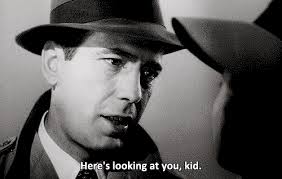
here's looking at you

Last week I was in a different building with Milo, my new service dog. Early on, he was not a big fan of elevators. When you are a service dog trained to help mitigate mobility and balance issues, this is a serious thing. His trainer worked very hard with him to get him over his fear of “the moving box”. He now enters elevators with a tail wag and is confident and alert. Unless…

… he enters a new elevator. I forget to take things a little slower when we get into a brand new elevator. To Milo, “different” is not good, and should be approached with extreme caution. I suppose that is why when I entered the library elevator on campus, and Milo immediately dropped to the floor trembling, I was taken by surprise. I spoke to him with confidence and calm tones, and he was eventually standing by the time we reached the correct floor. Some students on the elevator with me said, “You are doing such a good job training him! I could never do that though… train a dog only to have to give it up after training”.

The elevator door was opening and everyone was filing out. I didn’t take the time to set the students straight because it wasn’t really important. However, as I walked around trying to find the study room my students were meeting in, I was thinking, “Didn’t they see my cane? Can my bling be any more noticeable? There isn’t any way I can make my invisible conditions any more visible. AAARGH!”

… and yeah. I think in pirate-speak at times.

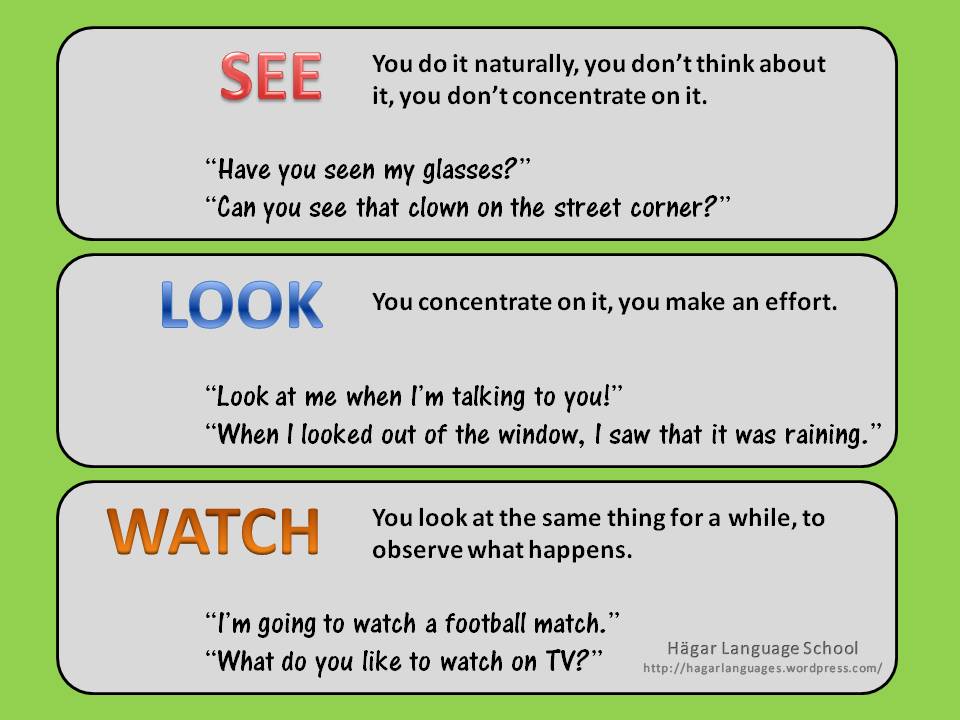
I have to remind myself that we are all guilty of only SEEING sometimes. We forget to LOOK instead. Worse, we often do not take the time to WATCH.

See — Look — Watch

see-look-watch

So often we go throughout our day only SEEING. I’m guilty of this. I believe SEEING people is the equivalent of saying, “How are you today?” with the expectation of hearing the response, “I’m fine, how are you?” SEEING is going through the motions with our eyes. SEEING is inactive. We SEE, but we are not doing so with deliberation. We are not concentrating. The students in the elevator were seeing me, but they were not looking. Well… that isn’t altogether fair as they were likely LOOKING at Milo, but only seeing me.

LOOKING means you deliberately concentrate… you notice. LOOKING is active. I suppose it is a little bit like being in “search mode”. When we are LOOKING, we ignore distractions, and recognize more than the superficial “window dressing”. My friends Deb and Ruth are photographers. I’m trying to learn to LOOK when taking pictures and not just seeing something pretty.

I love teaching. However, everything I really love about teaching has little to do with the subject I teach. I love teaching because I really feel like I’m making a difference. Somewhere along the line I learned to LOOK at my students instead of SEEING my students. Perhaps I had good role models. Perhaps it is because I have felt invisible myself. Do you know in my head I say, “Here’s LOOKING at you, kid”… with my best Bogart impression? I don’t just SEE you. I’m LOOKING at you.

I remember reading Blume’s book, “Are You There God? It’s Me, Margaret” as a kid. I can’t tell you the number of times I have asked God this same thing… only I insert Denise. There have been times I have been angry and added some things like, “Do You even CARE? Do you really see me?” I don’t always deal with my “new normal” in a positive way. I struggle with depression. I get angry–even at God. I need constant reminders that He looks at me. He is watching me; that He does care.

My husband hasn’t been looking at me lately. I don’t mean this as a slam, and I’m not telling you something that I haven’t shared with him. He signed me up to go to a banquet/game night/workshop for Valentine’s day at our church. Many couples and singles will be there. I don’t go to things like this… at least not with people who do not understand disabilities. Three weeks ago I told him I wasn’t going… that he shouldn’t have signed me up. He asked me (nicely) to go… “I rarely ask you step outside your comfort zone“. We argued. I pleaded. Two weeks ago we repeated the conversation. One week ago we practiced redundancy. Yesterday, I said I would go, but I told him, “You aren’t looking at me. You see me, but you aren’t looking at me. If you were, you’d know that I’m suffering from panic attacks. If you were, you’d recognize the sleep walking I’ve been doing as anxiety“. Sometimes we see right through the people we love the most. We aren’t looking at them. (Because I recognize that being a chicken can isolate me from others, I’m trying to find my courage…)

Please know that I understand we cannot have our LOOKING eyes on all the time. That level of concentration is impossible to do during every waking hour. However, I do believe that we can do more LOOKING than SEEING.

Yes. It takes a little more time and perhaps more effort.

No. We don’t burn calories for our trouble (darn it!)

Do you ever WATCH others? It goes beyond looking and does take the sacrifice of time. In a world of “time is money”, few people perceive that they can afford to take the time to WATCH. I believe we cannot afford not to take the time to do some WATCHING. Our very soul depends on it.

WATCHING changes you. WATCHING often changes the world. It is only that level of concentration and taking precious, valuable moments to study what your eyes see, that any connection is made to your heart–where all change is born.

See — Look — Watch

Be deliberate in how you exercise your eye muscles.

Denise Portis

© 2016 Personal Hearing Loss Journal

Cowlicks and Compromise

cowlick

Cowlicks and Compromise

I have a cowlick. I remember the first time I noticed the little tuft of hair—likely no more than 20 hairs total, in my bangs. I was at my grandmother’s house who lived on the farm 1.5 miles west of our own farm. I was washing my hands at the sink, and could just barely see my face and head in the mirror above the sink.

<SIGH> “Lookit this hair! It won’t lay down! It points the wrong direction”.

My grandmother informed me that it was a cowlick. Astonished and more than a little bit worried, I gnawed on my lower lip as I contemplated this new information. Demanding to know the “when and where”, Grandma calmly informed that it happened when I was a baby. I remember thinking, “Who would let a cow lick their baby’s head?” Either Grandma was tired of my questions, or she could see that this greatly concerned me. “It’s like a blessing. Even the cows knew you had great potential. You can do ANYTHING!”

I know she thought she was encouraging me, and later it actually WAS the source of encouragement when I recalled her words. However, she likely would have cracked up if she’d known how often I struggled to wash the cow saliva off my head after that.

Dreams, Goals, and Aspirations

I was a lucky little kid. I grew up in a small town, surrounded by really good people and warm, supportive family members. I was always told that I was really going to be something one day… I was going to make a difference. Whether it was the school counselor assisting me with college applications, or individuals in my church, each time it was said I thought, “This cowlick is coming in handy!”

Obviously, I grew to realize the cowlick had nothing to do with my “can do” attitude, but that seed planted as a youngster, certainly added to my determination. I already had a hearing loss in my left ear as I headed off to college. I would have one more surgery during Christmas break of my Freshman year. I never considered my hearing loss an issue as I had perfect hearing in my right ear.

Compromise

I know that I am a little bit stubborn. It’s not just because I’ve been told that I am, I recognize that it is hard for me to compromise. I’ve learned to compromise, which has only helped my relationships and even my marriage. I think in the beginning I saw compromise as “caving”. Because I was raised to be a strong, independent woman, I didn’t see how compromise could be a valued characteristic. I think compromise is actually misunderstood a great deal; perhaps even, considered a weakness.

My favorite definition of compromise (because there are a lot of them out there depending on the context in which the word is used), is from Chen (2004), when “a person has to give up something less feasible and achievable in order to accomplish career goals and projects that are more practical and obtainable” (p. 17).

After losing the rest of my hearing (ages 25-30), and discovering that what I thought was a natural “clumsiness”, earning the nickname of “Accident Prone Portis”, was actually Meniere’s disease, I learned to compromise simply because I was forced to do so. I learned to use adaptive devices, technology, and even learned to ask for help. I learned that to be realistic, I needed to cross some things off my my “to do” list. There are some things I just cannot do. That’s ok. It doesn’t mean I’m giving up or “settling”. I do get tickled at folks sometimes when they email me to say, “You are so inspirational!”

I’m not.

Huffingpost Post did a terrific piece on this topic. “When we think about inspiration, what inspires us most are ordinary people who have done extraordinary things. We appreciate when someone has the ability and willingness to be selfless, creative, innovative, or just dares to be different” (Green, 2013, para. 1). I’m not this person. I have no more talent, will power—or even COWLICK POWER—than anyone else. I have really good days. I have really bad days. Just this last week I found myself doing a little “soul cleansing” in the shower (the only safe place to bawl my eyes when you have service dogs in the house who cue off your mood).

I was crying because I was mad. Mad, that I’m forced to change the way I do my make-up. (I know… right?). I’ve always thought my best “feature” was my big, brown eyes and dark eye lashes. When my Daddy finally allowed me to wear make-up I learned early on how to highlight what I thought was one of my best features. My husband told me when we were dating that he just loved my eyes and wrote poetry about my peepers.

With progressive illnesses, one discovers that it is just that.

Progressive.

It sucks. Between my poor balance, shaky hands, and neuropathy in my fingers, it is impossible for me to use eye make-up now. I’ve had to change—to compromise HOW to wear and apply make-up of any kind. This… THIS is what reduced me to tears for a solid week! Some of the folks who write me and tell me that I’m “inspirational” also say, “I find that I spend too much time feeling sorry for myself!” Y’all? I’m crying in the shower because I can’t wear eye make-up!

I’m not very hospitable, but one of the great parties I know how to give is a PITY PARTY. I think most people who live with special challenges and illnesses find that they spend an inordinate amount of time feeling sorry for themselves. One quickly learns not to whine out loud because others frown on that. Both God and my husband know that I’m a whiney-baby. Trust me – I get feeling sorry for yourself. If your “differently-abledness” has you feeling sorry for yourself, you aren’t alone.

Weiner, Graham, and Chandler (1982) did some fascinating research on pity, anger, and guilt. Anger and guilt are associated causes perceived as controllable, while uncontrollable causes of negative events trigger self-pity (Weiner, Graham, & Chandler, 1982). I didn’t choose any of the challenges I deal with on a daily basis. You likely didn’t “sign up for” the challenges you face as well! When things happen outside of our control, it is natural to have feelings of self-pity. Charmaz (1983) explains that the medical field tends to “… minimize the broader significance of the suffering experienced by debilitated, chronically ill adults. A fundamental form of that suffering is the loss of self in chronically ill persons who observe their former self-images crumbling away without the simultaneous development of equally valued new ones” (p. 168).

All of us grew up with dreams and aspirations. Some of us read books about having one year goals, five year goals, and ten year goals… working hard to lay the groundwork to make sure the goals were attainable. Instead, life happens. You may feel as if your life has been de-railed as you struggle to stay on track on a journey you had all mapped out.

The key is to compromise – but not give up. You may have to change the way you do things. I threw away all my eye shadow and purchased a magnified mirror and set up a means to steady my hand so that I can at least wear mascara. Other compromises are more worthy of being called “growth”.

Finishing school through distance education instead of doing so through a brick-and-mortar institution.

Using a cane and service dog to avoid running into quite so many walls each and every day.

Asking a student to follow-up with an email because I cannot hear them over the “buzz of sound” after class, and the acknowledgment that if they speak loud enough for me to hear them, everyone will hear.

Letting someone with normal hearing take the minutes of a committee meeting, even though my desire is to take notes.

Sitting on my caboose during the music in church because I cannot stand when the words are on a screen with lights, movement, and flashes. (Remember the good ol’ days when we used hymnals?)


Asking a family member to chauffer me around if I have to be out after dark (oncoming headlights trigger vertigo).

Using a cutting board ALWAYS, since not being able to feel your fingertips is dangerous when wielding a sharp knife.

Asking my service dog to fetch clothes out of the dryer so that I can fold them, even though I occasionally have to wipe doggie drool off of clean, dry clothing.

The KICKER compromise that many of us have to learn as a result of our new normal?

Asking for help to do something when we once did it all by ourselves.

When Do You Choose Not to Compromise?

A tough lesson in living a differently-abled life, is learning how to compromise by your own volition and to accept your own reality, and learning when NOT to compromise for others. Having a long-term blog on disability issues, invisible illness and chronic conditions, I have received one type of letter more than any other.

“My _______ (family, spouse, friends, co-workers) want me to stop using ________ (a cane, walker, service dog, assistive listening devices, medication) because it _________ (embarrasses them, makes them uncomfortable, makes me look bad).”

I wish I could reach out and SMACK UP ‘SIDE the HEAD, the folks who are saying this to you. They don’t realize all the compromises you’ve already made in order to successfully navigate your life and accommodate your new normal. (That’s right… you’ve resorted to mascara ONLY).

My friends? Don’t ever compromise… on chosen means of compensating just to make someone else feel better about your challenges. That isn’t compromise. That’s caving to a bully. Compromising by doing something differently in order to continue DOING means you are in control. Buckling to the pressure of someone who doesn’t live what you are living, will only yield bitterness, brokenness, and an unhealthy dependence. Do we need to ask for help sometimes?

Yes.

However, having a means of independence and being asked to give it up to help someone else deal with your issues is detrimental to your mental health and relationships. There are plenty of people who care about me that I have learned to not “talk out loud” around. They misunderstand the reason I’m belly-aching and offer selfish advice.

“You get so mad when people interact with your service dog. Why don’t you stop using one and find some other means to cope with your disabilities?”

This from a peripheral family member who:

  1. Is never around for me to ask THEM for help because they are in absentia nor have any meaningful intersection in my life.
  2. Is able-bodied (though mean spirited)
  3. Hates dogs

If using a service dog has enabled you to be more independent, then:

  1. Be more careful of whom you belly-ache too. Contact a fellow SD partner or a trainer.
  2. Find a way for the “drive by petting” interactions to become a positive advocacy channel.
  3. Join some face-to-face or virtual support groups with individuals who mitigate their disabilities with the partnership of a service dog.

I was recently contacted by the wife of a guy I graduated high school with in 1984. He’s coming up on the BIG 5-0, and she was looking for pictures “from way back” that we had so that she could use them at his birthday party and celebration. I took out some old yearbooks and began flipping through them. My senior yearbook had some great pictures of “all those from the class of ‘84”. In one section, the class voted on and selected one male and one female for specific “categories”. I was selected as “friendliest” and also “most likely to succeed”. (Don’t get any grand ideas… my graduating class boasted of 22 students). I sat there a couple of minutes wondering…

“Am I successful?”

“Did I waste my cowlick?”  

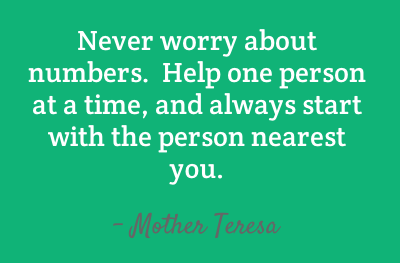
What I find valuable is making a difference, even if in only in one person. I have good days and bad days, but ALL days are lived where I look for and try to make a difference in at least one. It’s an adopted attitude that has really helped me adjust to being a person with invisible disabilities.
never-worry-about-numbers-help-one-person-at-a-time-2

Denise Portis

2016 Personal Hearing Loss Journal

Charmaz, K. (1983). Loss of self: a fundamental form of suffering in the chronically ill. Sociology Of Health & Illness, 5(2), 168-195. doi:10.1111/1467-9566.ep10491512

Chen, C. P. (2004). Positive compromise: A new perspective for Career Psychology. Australian Journal of Career Development. 13(2), 17-28.

Greene, R. K. (2013). What is the true meaning of inspiration? Retrieved February 1, 2016, from http://www.huffingtonpost.com/r-kay-green/giving-back_b_3298691.html

Weiner, B., Graham, S., & Chandler, C. (1982). Pity, anger, and guilt: An attributional analysis. Personality and Social Psychology Bulletin.  8(2), 226-232.
Where the People Aren’t

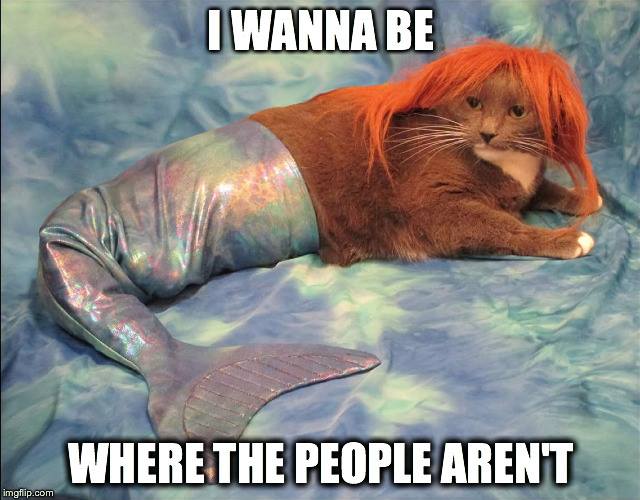
"I Wanna Be Where the People Aren't"
“I Wanna Be Where the People Aren’t”

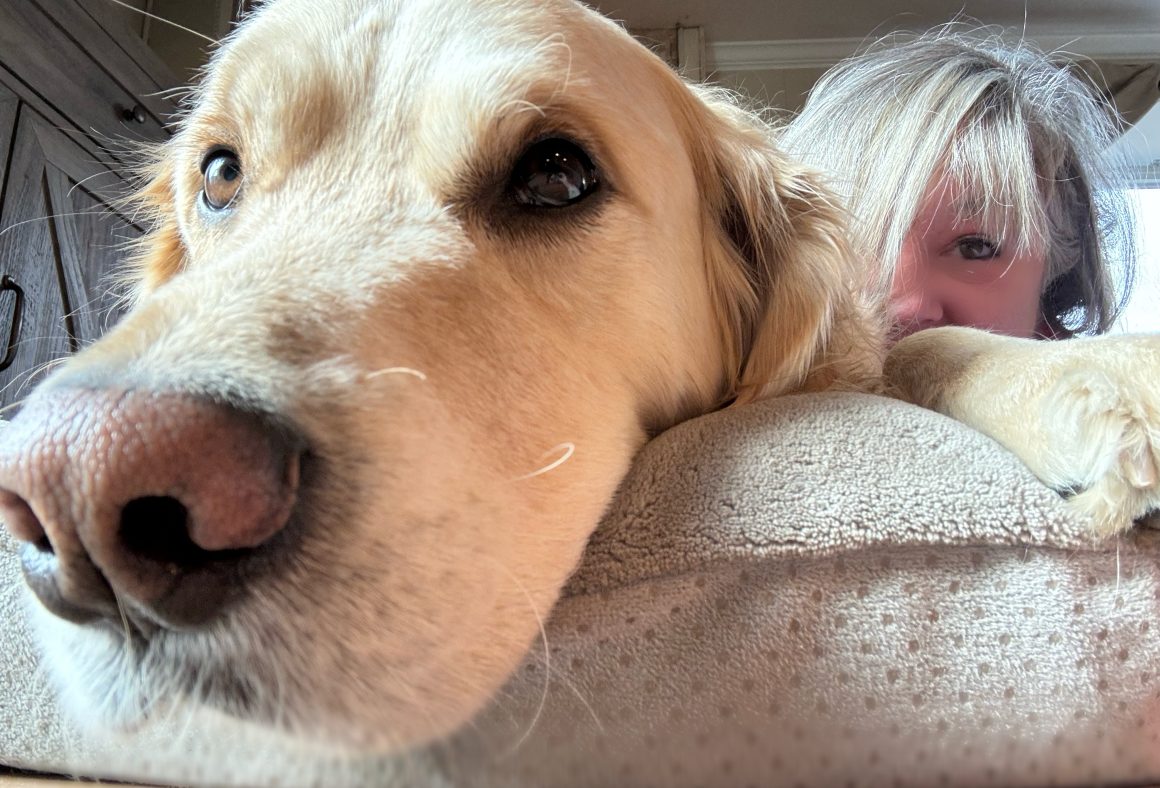
I recently saw the above picture on FaceBook, and since I love “The Little Mermaid”, (and because I know cats can be SO “offended”), I found this VERY funny.

As an Introvert, I often want to be where the people AREN’T. I, and most Introverts, love people. However, folks misunderstand what an introvert, and extrovert are.

Heck.

There is even a newly labeled “blend” for those who exhibit both introvert and extrovert tendencies (lest others think we have multiple personalities, or Dissociative Disorder). Evidently an Ambivert, is one who has both characteristics, often in dependence on their role in that specific environment.

The difference between an Introvert and Extrovert, however, is simply how a person prefers to RECHARGE. It has nothing to do with whether or not they like people. Extroverts recharge by being around others. Introverts recharge by being alone.

All this thinking about “versions” had me contemplating how each dimension is effected by acquiring a disability. As a person who is differently-abled, my mind just “goes there” automatically when I think about personality characteristics. Who copes “better” with acquired disability? An Introvert or Extrovert (or Ambivert)?

“Version” affect

Interestingly, research shows that people who are extroverted are more likely to acquire a disability that limits mobility or results in chronic pain (Malec, 1985). Evidently extroversion can be equated with higher risk behavior and decisions that may result in injuries associated with motor loss/coordination or chronic pain. Introverts, too, are diagnosed with acquired disability, but often with diagnoses that are “non-traumatic” (Malec, 1985). This doesn’t mean Introverts are not involved in motor-vehicle accidents, or risky behavior that results in injury. The research simply shows that extroverts are more likely to choose activities that could result in these types of disability. Frustrated in my search for information regarding “version” types and acquired disabilities more like my own — those that are the result of genetics and/or “unspecified contributors” for deafness and Meniere’s disease, I continued searching the research databases.

I came across an interesting study by Noonan et al., (2004), called, “A Qualitative Study of the Career Development of Highly Achieving Women with Physical and Sensory Disabilities”.

BINGO.

I figured I hit the jackpot with this search and find! What I discovered, however, has nothing to do with a connection between “version” types and successful coping with acquired disability. According to Noonan et al., (2004), successful coping includes  “developmental opportunities (education, peer influences), family influences (background and current), disability impact (ableism, stress and coping, health issues), social support (disabled and nondisabled communities, role models and mentors), career attitudes and behaviors (work attitudes, success strategies, leadership/pioneering), and sociopolitical context (social movements, advocacy)” (p. 68). The difference between those who successfully cope and are extroverted and those who successfully cope and are introverted, centers around social support. An extrovert is more likely to identify and ask for help from any peers or individuals within their environment and in so doing actively engage in demonstrative advocacy. Introverts are more choosy about who they enlist support from, but are often “background” advocates. This is supported by research from Ellis (2003) in findings that include the difference in how extroverts and introverts enlist support, openly or privately – respectively.

“Version” Types and Assistive Technology

Having lived with special challenges for more than 31 years, I have had the (privileged) opportunity to meet hundreds of individuals who are differently-abled. Networking through organizations such as Fidos For Freedom, Inc., Assistance Dogs International (ADI), the Hearing Loss Association of America (HLAA), the American Association of People with Disabilities (AAPD), and numerous other organizations, I have met both extroverts and introverts who cope well — and some not so well — with acquired disability.

Some discouraging research does suggest that extroverts are more likely to use assistive technology and devices (Johnson, 1999).

This sucks.

I struggled for so many years with invisible disabilities and challenges, that my “epiphany” moment of changing that… making the invisible very visible, still gives me psychological goosebumps. My introverted life changed when I determined that I would embrace technology and assistive devices. I use bright canes, an assistance dog, bling up my cochlear implant and have informative brochures with me wherever I go. You’ll notice I didn’t say my introverted self became extroverted. I’m aware of and fully accept who I am – an introvert. Yet, using assistive technology and devices (and canine) has dramatically improved mitigating my own disabilities. Extroverts are more likely to seek “tools” early on in a diagnosis that incorporates an acquired disability (Wressle, Samuelsson, 2004; Kintsch & DePaula, 2015). Once introverts determine that the benefit of using assistive technology and devices improves quality of life, they, too, are able to embrace tools that improve life with the downside of making them (perhaps) more noticeable.

In closing, can I just say, “I LOVE PEOPLE”? We are different yet, are alike. We react to things differently and yet similarly. We all love dogs. 

Cuz… well, that just makes sense.

Denise Portis

© 2015 Personal Hearing Loss Journal

Ellis, A. E. (2003). Personality Type and Participation in Networked Learning Environments. Educational Media International, 40(1/2), 101.

Johnson, D. (1999). Why is assistive technology underused? Library Hi Tech News, (163), 15-17. Retrieved from http://search.proquest.com/docview/201534320?accountid=14872

Kintsch, A., & DePaula, R. (2015). A framework for the adoption of assistive technology. Retrieved on November 24, 2015, from http://citeseerx.ist.psu.edu/viewdoc/download?doi=10.1.1.124.3726&rep=rep1&type=pdf

Malec, J. (1985). Personality factors associated with severe traumatic disability. Rehabilitation Psychology, 30(3), 165-172. doi:10.1037/h0091027

Noonan, B. M., Gallor, S. M., Hensler-McGinnis, N. F., Fassinger, R. E., Wang, S., & Goodman, J. (2004). Challenge and Success: A Qualitative Study of the Career Development of Highly Achieving Women With Physical and Sensory Disabilities. Journal Of Counseling Psychology, 51(1), 68-80. doi:10.1037/0022-0167.51.1.68

Wressle, E., & Samuelsson, K. (2004). User satisfaction with mobility assistive devices. Scandinavian Journal Of Occupational Therapy, 11(3), 143-150 8p.

Polygamy and Practice

polygamy and practice

Do you know how many times polygamy has cropped up in my conversations? It’s super easy for me to hazard a guess because I have NEVER had a conversation about polygamy. I don’t watch “Sister Wives”, and know very few Mormons (and those I do – do not practice polygamy). So why… WHY would I bring the word up in a chance encounter? *shaking my head at myself*

I’m a creature of habit. I go to the same stores and the same restaurants. I’m super scheduled and my electronic calendar is near and dear to my heart. I’m color-coded. I’m organized.

Therefore, it’s no surprise that I tend to run into the same people at the places I frequent. I have shopped at the same grocery store for almost four years. You tend to run into some of the same people when you frequent a store. When you go everyplace with a service dog, it makes you rather unforgettable, especially with children. It’s no surprise that I see some of the same children in stores who have been curious about and thrilled with Chloe as I shop.

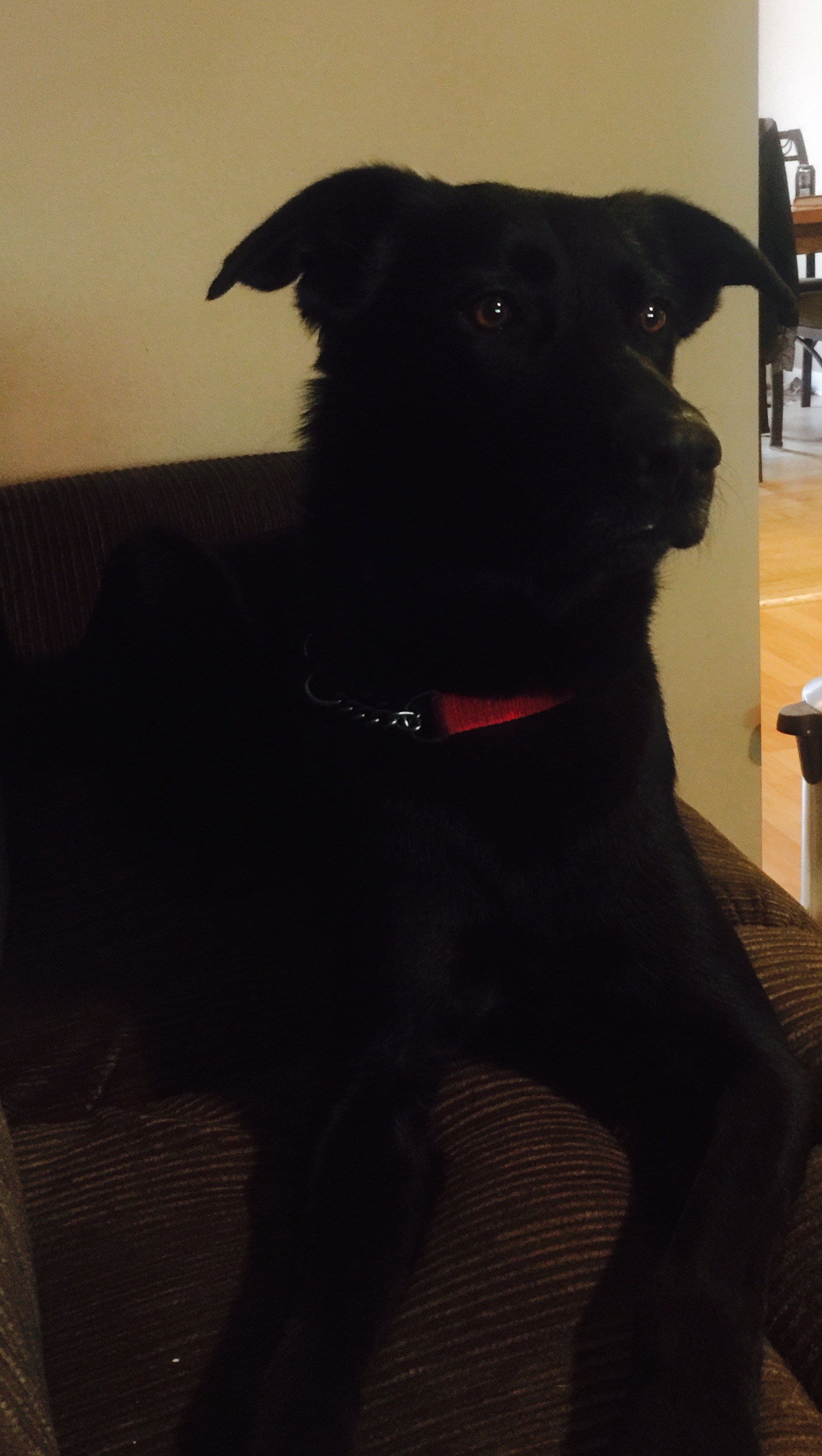
It shouldn’t have surprised me that a little boy I have seen a half a dozen times or more stopped me to ask about my dog. My new partner is Milo, a black shepherd/lab whose appearance is completely different than that of Chloe. Here is a recent photo of both Chloe (retired) and Milo (current). The picture isn’t that great which reminds me I need to work on getting some more “3 musketeers” shots!

Service Dog Bookends

This little boy that I see occasionally (whose name I DO NOT know – which embarrasses me as he knows my service dog’s name), looked at me with big eyes and said, “Where is Chloe and WHO IS THAT?” (Ya gotta love kids)

I replied, “Oh, this is my new service dog, Milo. Chloe is retired now and is at home sleeping on the couch”.

He looked very solemn and said, “So she still lives with you?”

“Oh yes“, I said. “She will always live with me. It’s just that Milo is my new partner!”

He was quiet for a second or two and said, “So it’s like you are divorced and Milo is your new service dog?”

I was so astonished by the seemingly change in topic I stuttered out, “Well… ummm…. no, not at all. Chloe and I aren’t divorced. I guess it’s more like polygamy and both dogs live with me now!”

The little guy look TOTALLY CONFUSED, and I glanced up to see the HORRIFIED LOOK on his mother’s face. Ever want to just slap your hand over your mouth? I knew as soon as I said it that it was 1) totally inappropriate, 2) would take the mother all day to explain to her son, and 3) completely “off the wall”.

I made a mess of trying to back peddle (for people with balance disorders can do precious little BACKWARDS), and hurriedly made my way down the next aisle.

I stood in the international food section fussin’ at myself and nearly in tears for using such a poor analogy around a 6-year-old. I determined then and there I needed to PrAcTiCe PrAcTiCe PRACTICE what to say in response to “where’s Chloe and who is THIS?”

Part of Good Advocacy is Practiced Responses

Being a good advocate and representative of “whatever ails ya” means you have good responses when someone asks questions. I have learned the HARD WAY, that these responses need to be rehearsed. When you are taken by surprise by either well-meaning, curious people or rude, snarky trouble-makers, you want to have a measured, helpful reply so that you advocate in a positive and helpful manner. I have found that if I don’t have a “canned response”, I tend to match the tone and demeanor of the person asking. This means that sometimes I am pleasant and in “teacher mode”, with great responses that educate and advocate on behalf of the disability community. However, other times I’m waving my cane in a curmudgeon’s face and informing them in no-uncertain terms how horrible they are.

At Fidos For Freedom, Inc., (where I trained for now – TWO – service dogs), we practice how to respond when encountering access issues. If you have a service dog, it is not a matter of IF you have access issues, rather WHEN you have access issues. It is easy to get flustered. It is easy to get mad. It is easy to say the wrong thing. Practice makes it much easier to respond with something that will actually help you and others like yourself.

Doesn’t it Suck that Many of the Rude Ones are “Kin”?

What is even harder is when the person acting incredulous and skeptical is someone you know well or are even family. I’m lucky that I have a very supportive spouse and adult children. Even so… it is hard to love someone with a chronic condition. Once in awhile, my husband (or kids) do not filter what they are saying, because they, too, are sick and tired of Meniere’s disease. I’m 100% certain my husband has rehearsed responses to commiserate appropriately so that he doesn’t spend the night on the couch.

(Holding an ice pack on my cheek, or head), “I’m so tired of falling and staggering around! What I wouldn’t give for just one day of no vertigo!”

“It must suck, honey!” is the rehearsed response so that “Yeah, I’m getting tired of taking off work to take you to the E.R.” doesn’t slip out.

It can really hurt when someone who knows you better than others “opens their mouth and inserts foot”. I recommend that even support people practice and learn how to deliver sympathy and encouragement.

You Will Still Blow It

Even if you practice measured, helpful responses to personal questions, you are still going to blow it from time to time. A couple of Sundays ago I was ticked off at myself for not responding kindly to someone and was thinking, “Denise! You’ve had this diagnosis for 2 decades! Exactly WHEN is it gonna become HABIT?”

I sit during the worship service. It isn’t because I cannot stand. Folks are surprised when they learn that at work, I stay standing for very long periods of time. I actually MOVE very easily and with very little wobble. It’s standing still that is the problem. My world turns… counter-clockwise when I’m standing still. I love my church. They are very supportive of people who are differently-abled. We have a loop system in the auditorium for people with hearing loss. We have fully accessible bathrooms and classrooms. We have an elevator and a lift for people with mobility issues. In spite of this, I’m forced to sit during the worship service. My church puts the words to the songs on the wall using a projector. We have a beautiful stage and lights as well. The song lyrics are in a multi-media slide show with patterns, colors, movement and lights. Everything is color-coordinated and changes song to song. The freaky OCD person in me is in awe every Sunday. It’s gorgeous! But… I can’t stand. If I do, I’m fighting consciousness. It isn’t a problem, for I don’t mind sitting. I’m comfortable and SAFE. I learned that not everyone understands why I’m sitting, however.

An elderly person came up to me at the beginning of the service and asked me how to access the hearing loop in the auditorium. I removed my cochlear implant and hearing aid and demonstrated how to switch to t-coil. I get this question about once a month and I’m always glad to educate. I love the hearing loop and it has dramatically transformed church for me. I love answering questions to help others access this wonderful technology. So wasn’t I surprised by the encounter, but totally floored by the follow-up question:

“So why are you seated during the music? I’m way older than you and even I can stand!”

I don’t know if it was the environment, the timing, or the unexpectedness of the question, but can I tell you … I really took it wrong? I could FEEL the tension creep up my spine and I was mentally counting to ten and trying to diffuse the explosion about to spew out of my mouth. THIS ONE I hadn’t practiced for. I hadn’t run any scenarios through my head and out through my heart filter to answer a question like this appropriately. So I didn’t.

“Wow. That was really, really mean. We’re done,” I said. The person looked startled, then uncomfortable and walked away. I think the last action was because I’m certain my look was murderous. I mean… I was MAD. (I later apologized).

Folks are gonna take you by surprise once in awhile. You will hear an insensitive comment from someone you weren’t expecting it from and it will just shock you into silence (if you are lucky) or cause you to say something you regret. It is best to be prepared.

Ummm… WHY SHOULD I?

Maybe you are thinking that if people are going to be insensitive and inconsiderate, that “why should I temper what I say in response?”

Since we are on the subject… here are some “canned responses”:

1. You don’t want to sink to their level.

2. You need to be the mature one.

3. Kill ’em with kindness.

4. In the end, you advocate for all of us.

5. Honey attracts more bees than vinegar.

Well.

I happen to love vinegar. I mean… don’t get me started on pickles. There are few things I love more. Let’s be honest though… from someone who is differently-abled to someone who may also live with acquired disability, chronic illness, or invisible issues, “WHY should we be careful in our response?”

(sigh)

Because it’s the RIGHT thing to do. Sucks, don’t it? I can tell you from experience though that it is much better to answer correctly and watch someone else squirm, than to have to apologize for “going off” on someone. Go practice, my friends! You’ll be glad you did!

Denise Portis

© 2015 Personal Hearing Loss Journal

Through the Eyes of a Newbie

Milo Cade - Fidos For Freedom, Inc., Service Dog.
Milo Cade – Fidos For Freedom, Inc., Service Dog.

Many of Hearing Elmo’s readers know that I retired my service dog, Chloe, this year. Since May 1st, she is enjoying retirement and still does some hearing alerts at home. She is happy, spoiled, and we believe well-deserving of all the naps and belly rubs she is currently receiving. I was recently matched with Milo, from Fidos For Freedom, Inc. Milo is a shepherd/lab mix and I am enjoying the process of being partnered with a mobility/balance service dog versus a hearing/balance assistance dog. We determined my primary needs are mitigating issues with Meniere’s disease and not hearing alerts. I love my cochlear implant, and feel like I have adjusted to the world of “hearing again” very well. My balance is, and will continue to be, a major issue. I suppose in a way, this is an introduction of my new partner, Milo.

One thing I have enjoyed is experiencing MY world (work, church, walks, etc.) through the eyes of a newbie. For Milo, everything in MY world is new. He looks at everything in awe. If he isn’t looking in awe, he is sometimes in “investigation mode”.

Is it scary?

Is it freaky?

Is it edible?

Is it alive?

What does Denise think?

At a training session with my trainer a week or so ago, I brought Milo to one of my classes. I had allowed enough time to exit the service dog safely from my car. I had allowed time for a short potty break. (Honestly, Chloe hasn’t been at home long enough for me to get out of the habit of some of these things. I found myself at a potty area recently and realized I didn’t have a dog by my side!). I allowed enough time. Not.

I did not allow time for all the new things my newbie partner was seeing. The grassy area was new. The trees and picnic bench were new. The ramp into the building was new. The automatic door push-button was new. At least… it was new to MILO. For just a brief second, I was mildly annoyed. I had not allowed time for appraising all of these new environments. That was MY bad, not Milo’s. I want my dog to be confident and aware of his surroundings. I was almost late to class, but the time I took “extra” was time worth taking. Newbies need some extra patience from those of us who are veterans to the schedule and environment. We owe it to them. But you know something?

Blowing It BIG!

I really know how to blow it. I mean, I don’t do anything half-way. This isn’t always a good thing. I recently became extremely exasperated with someone relatively new to “hearing again”. I try hard to be a positive advocate for people with disabilities, and chronic and/or invisible illnesses. This blog is, in part, a way that I try to raise awareness and encourage people to talk about tough subjects.

I see this lady about 3 times a month at the grocery store. Over a year ago she saw my CI, asked about it, and eventually had surgery herself. This individual was relatively new to hearing loss. She was still struggling to help the people important to her understand that the CI did not “FIX” her hearing. Instead it was restored to a type of hearing (bionically) and  she would still be in environments occasionally where she would need others to understand that she needed to 1) see their face, 2) slow them down, and 3) find a quieter spot. After listening to her for about ten minutes – really distraught about not feeling accepted –  I felt myself becoming impatient. We had this conversation before and I felt as if we were “beating a dead horse”. Remorse and shame immediately washed over me. I stuck my finger in my own face and preached, “Really, Denise? Really?” (Y’all are trying to figure out how you stick your own finger in your face, aren’t you?)

As I had (thankfully) kept my mouth shut, I continued to listen and realized she was now apologizing… “I’m sorry I keep bringing this up. I just can’t seem to help them understand that the CI was not a CURE. I’m so frustrated!”

I realized then and there that I needed to put myself in newbie shoes more often and remember how difficult those early years were. Advocating and educating take time. Families and friends do not just wake up overnight and suddenly “get it”.

I told her that I often forget how hard those early years were, and that she had to keep at it… eventually some of it would start to sink in for her family members.

As a person of faith, I believe everything happens for a reason. We may not always like the purpose behind God allowing something to happen, but there is always a reason. I’m also (gulp) old enough now to know that we may not EVER completely understand why something happened this side of Heaven. I have ALWAYS felt like that the acquired disabilities I have were allowed so that I could help others… or at least try to do so. I blow it. I blow it BIG. However, I think those of us that have lived the life a few years, owe it to the newbies in our lives, to lovingly coach, encourage, cheerlead, advise, and HUG often.

You are going to have newbies in YOUR life. Unless you are isolating yourself, you will have folks new to whatever “ails ya”. People will look to you for understanding and advice. You will be able to empathize much better than their doctor, their families, and their co-workers. Of all people – YOU get it.

Are you looking for a way to invest your life in someone with similar challenges? There are opportunities everywhere. You simply need to know where to look. Urban areas often have face-to-face support groups for various illnesses and disabilities. There are numerous online support networks, discussion forums, and peer supports. Many doctor’s offices and rehabilitation specialists have contacts to support personnel. Invest yourself in the life of a newbie. Remind yourself while investing how difficult those first years were! It shouldn’t surprise you to discover, sometimes by accident, the student becomes the teacher. Always, always be teachable.

Denise Portis

© 2015 Personal Hearing Loss Journal

NOT “The End” – Turning the Page on a New Chapter

"Hanging it Up"
“Hanging it Up”

I’m a reader. Perhaps it has something to do with having a mother who was an English teacher. Maybe it is because both my parents are readers. All I know, is that I can’t remember not having books. I lived in a rural, farming community and as it was before the “age of the Internet”, much of what we did in our free time was reading. Thanks to my mom, I have read all the “great classics”. I also grew up reading series such as “Trixie Belden”, “The Bobbsey Twins”, “Nancy Drew”, “Hardy Boys”, “Sugar-Creek Gang”, “Agatha Christie”, and “Little House on the Prairie”. I remember being SO BORED one summer that I started reading my dad’s favorite series, “Louis L’Amour” and discovered they were actually OK too!

I always felt a little melancholy when coming to the end of a good book. If it was a series, I fretfully waited for the sequel to come out. It was especially hard when the author ended a book with a “cliff-hanger”. I think that is when I started biting my nails.

I’ve had an emotional roller-coaster kind of 2015. I have been slowly easing my service dog, Chloe, into part-time work. I have already started training for a successor dog at Fidos For Freedom, Inc. In the past week, Chloe has gone from part-time working dog to “when hound dog feels like it”. I always ask her if she wants to “get dressed” and more often than not she flops her tail at me and gives me a sweet hound-dog look. “See you later, mom! I’ll be here when you get back!” 

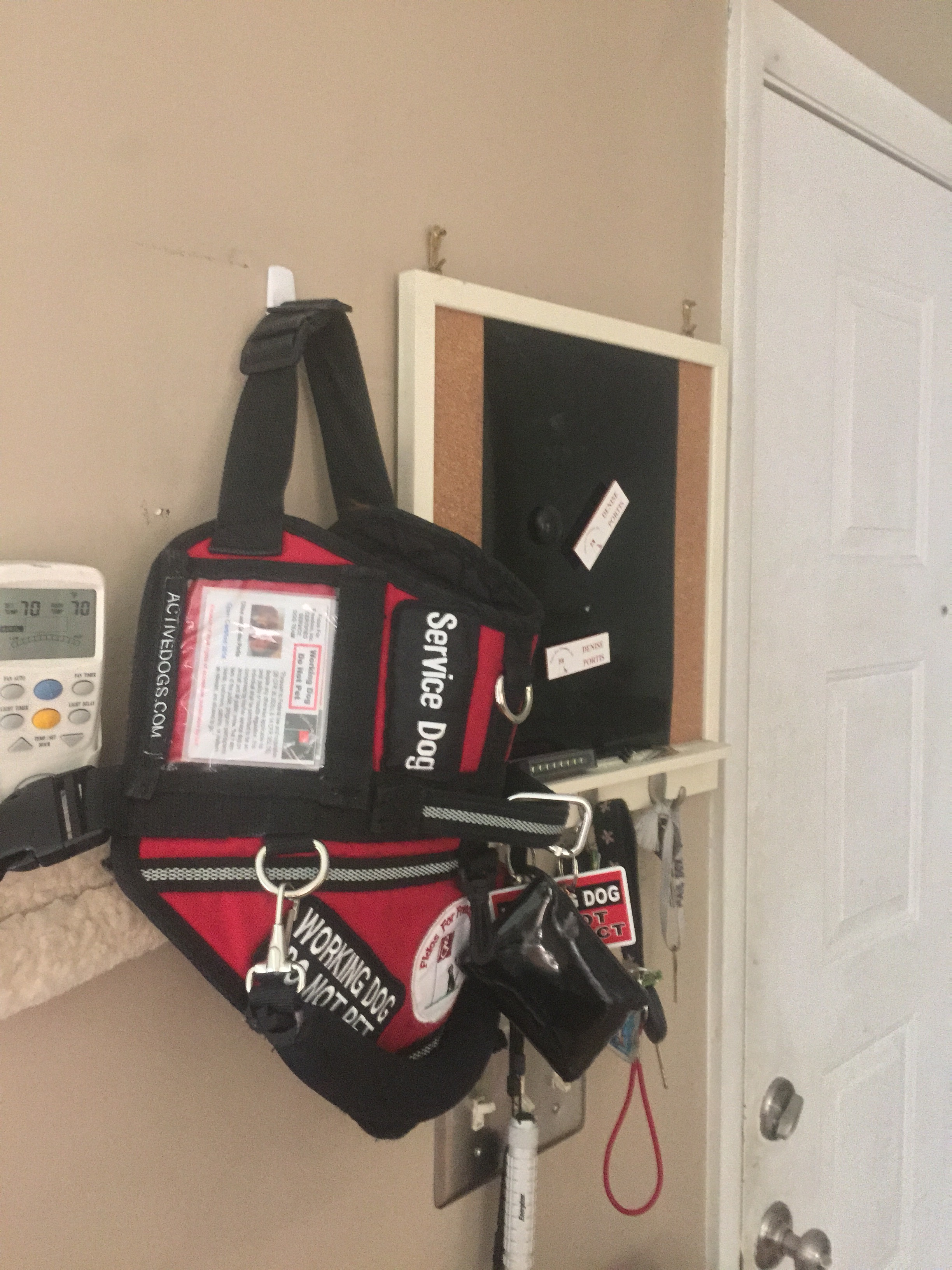
Her vest is more often hanging on its hook, than it is being worn by faithful service dog. It has been a harder transition on me than it has been on her, and frankly? That’s the way I want it.

People notice that Chloe isn’t with me now. I suppose when you are thought of as a team, when the “cute red head” is missing, people notice. I’ve answered these questions dozens of times:

“You get to keep her, don’t you?”

“What will she do all day?”

“How will a new partner and Chloe get along?”

At first, it made me really sad to see her vest hanging on it’s hook as I walked out the door. I had an overwhelming feeling of finality. I know I’m making the right decision, but for awhile I felt like I was facing the end of a book–“The End“.

However, I realized that just like in OUR lives, finishing one chapter in life doesn’t mean the book is over. We plan to ease Chloe into therapy dog work if it is something both my husband and I can work into our schedules. If she doesn’t transition that direction, she will continue to be a beloved furry member of our family.

When the Life You Had Is Over…

One of the most disconcerting things about acquired disabilities or invisible, chronic illnesses, is that at some point you may not be able to do everything that you once were able to do. I’ve heard some people say, “Don’t ever say you CAN’T. Just find a new way of doing it!” But friends? That isn’t always realistic.

Take roller-skating for example. I love to roller-skate. I was actually pretty good at it, too. I could skate backwards, do a single axle, speed race, limbo on skates, and much more. Post balance/vestibular disorder, I can no longer skate. Sure, I could probably find various devices to prop myself up, or skate with a walker on wheels. But, I won’t be skating like I was. This doesn’t mean that I stop doing ALL extra-curricular activities. There ARE some things I can still do and do so safely. I simply started a new chapter in my book, “This is My Life“.

Some people find that after acquired disability or diagnosis, they can no longer work. Their “new normal” includes chronic pain, debilitating fatigue, or other symptoms that make it impossible for them to work “9 to 5”. However, they may find they there are some things they can do to continue earning a paycheck. There are a variety of things one can do to earn money while working at home.

Some people become volunteers and do a number of things that yield personal satisfaction and allow them to “give back”; however, the activities are not dependent on a set schedule. I know some people who no longer work due to a diagnosis, and likely do TOO MUCH as volunteers. There are so many opportunities! There are so many ways people of various abilities can do to benefit others.

If your life took an unexpected turn after a diagnosis or acquired disability, your book isn’t finished. You are just starting a new chapter.

BUT… YOU DON’T UNDERSTAND. Everything in my life has changed! I cannot successfully reach goals I made a long time ago before this diagnosis. My friends have changed. My relationship status has changed. My book really is approaching “The End”. 

Perhaps your life really did experience a 180 change in direction. Some of my favorite books are part of a SERIES. The book may have ended, but there is a sequel. Set new goals. Make new friends. Do new things. I have found that some of the most rewarding experiences I have had were the direct result of my embracing my own “new normal”. I stopped trying to be the Denise I was before hearing loss and Meniere’s disease. The people I have met, the job that I have, and the organizations in which I am involved would have never been a part of my life if I hadn’t been forced to start a new chapter, or even a new book in a part of a series.

Hanging your vest up? Have major changes happened in your life? Your story isn’t finished. The chapter may be done. The book may even be finished. Your story is NOT complete.

Writer’s block? Network with others who have similar diagnosis as you do. See what they do to volunteer, serve, or even jobs and careers they may have. It’s never too late to go back to school! Many older adults sit in my classrooms taking classes to earn a degree and prepare them for something new. Gone are the days where all my students were 18 and 19 years old.

From an editorial review of “The Story of My Life” by Helen Keller: “Many of her later works were largely autobiographical, but there was always an emphasis on the inherent power of the individual to journey through life with hope. The Story of My Life is the first chapter in such a journey.”

If your life has significantly changed, it is simply the end of a chapter. Your story – your journey continues.

Denise Portis

© 2015 Personal Hearing Loss Journal

Tree Hugger

2015-04-11 19.08.33

The weather is finally feeling “Spring like”. The trees are all budding out and blooms galore, decorate my neighborhood. It ain’t all good. *achoooo* – but allergies seem a small price to pay for such pretty walking weather.

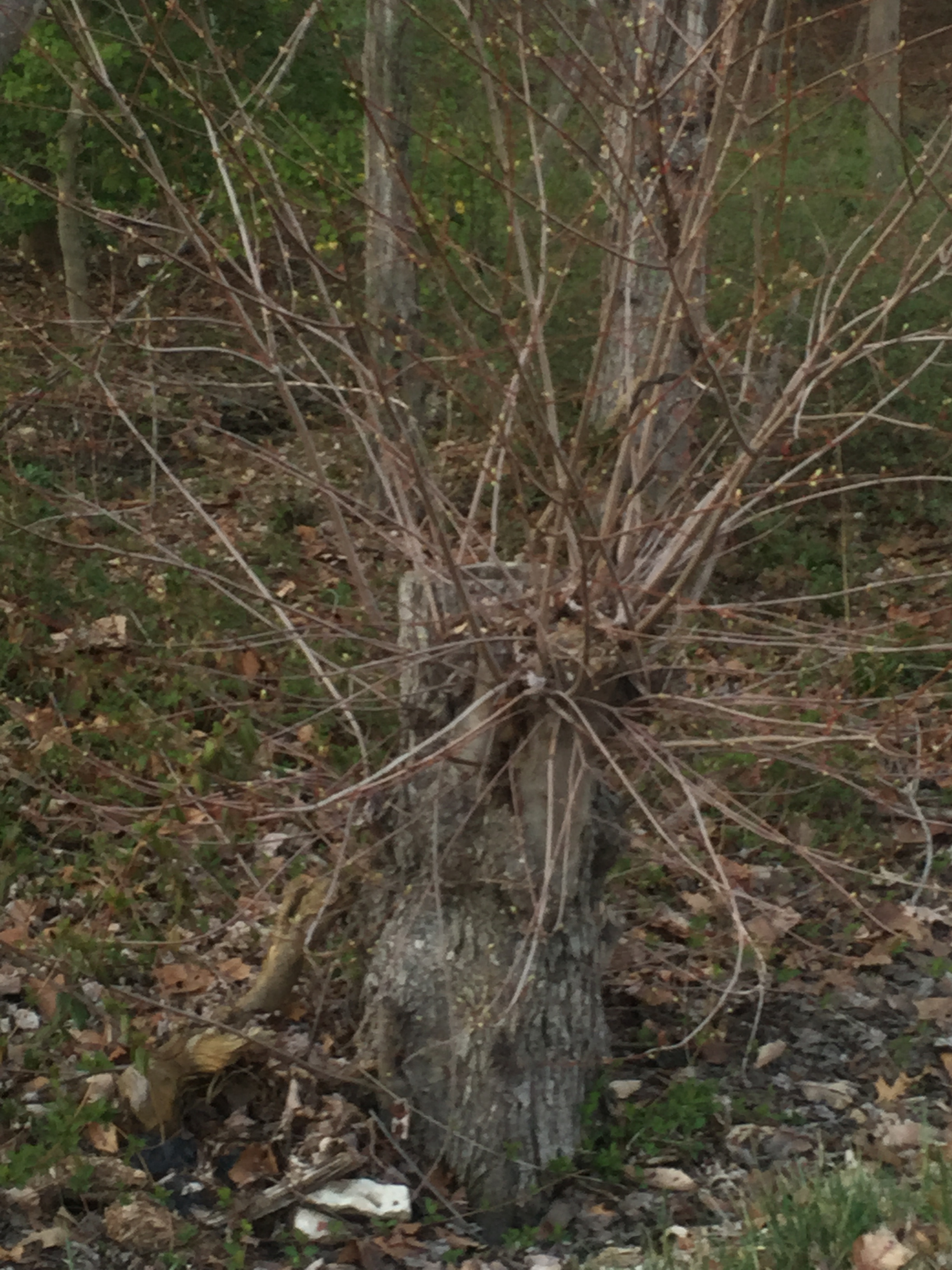
A couple of days ago, I ventured out of my immediate neighborhood and down a nearby walking trail. I’ve posted about beavers and bullfrogs in other posts as the path stretches along the perimeter of a small pond. At “the bend in the path” where the trail takes a sharp right turn, a huge tree was cut down. This was supposedly done to insure the path remained semi-straight. When I first saw it last year after this section of the trail was finished, I grieved a little seeing that this huge tree was chopped down and for the apparent reason it was hauled away. I haven’t been down this path in months and months. When I got closer to the remains of this giant, I looked for the scarred stump. I was surprised at what I saw. Every which way, new growth and small branches, sprouted from the stump.

I almost became a “tree hugger“. Not in the traditional “activist” sense, but I was so excited to see that it had persevered! I even took a few steps off the path to see how to approach for a hug. Seeing no great way to latch on and SQUEEZE, I instead reached out and calmly high five’d a small branch closest to me. I stood and silently celebrated the fact that this tree was still alive, determined to continue in spite of being chopped down!

Have You Felt the Woodsman’s Axe?

I turn 49 this year. Honestly, growing older doesn’t bother me in the least. Yet, because I have acquired disabilities, I have to admit that where I am is NOT where I thought I’d be. Don’t get wrong.

I feel good about me. I still have goals. I strive to make a difference. I love what I do. I have good days and bad days. There have been days I have really felt cut down.

AXED.

For many with acquired disability, chronic illness or invisible (or visible) conditions, much energy and focus is geared towards being independent. We don’t want to be a “bother” or put people out. I stopped trying to “fit in” a long time ago. I don’t hear normally. I don’t walk or stand normally. As I have become comfortable in my own skin, others have learned to accept me just the way I am as well.

But sometimes? Well, sometimes someone comes by with a wicked, sharp axe and hacks away at me, chipping away at who I am. Do you know what sucks? Sometimes the woodsman is someone I know well. Do you have people in your life who tell you “for your own good” to suck it up? “If you didn’t go around making a big deal about your disabilities, you would fit in better!” “Well aren’t you the DRAMA QUEEN?” “I’d never know something was wrong with you if you didn’t go around with a service dog!” (As if it never occurred to them I’m independent BECAUSE of the service dog).

There will be times we feel “cut down” because it is JUST ONE THING AFTER ANOTHER. I have some friends (those I call family, really) who have significant challenges. A few of them have really had a tough year. One took a significant fall in a store and is STILL recovering as the injury fall out was compounded by her MS. I have another friend with MS who is a stroke survivor. Her husband is now dealing with significant health issues. A young woman I got to know through Fidos For Freedom (who also writes) has a terminal illness and things seemed to go from bad to worse for her this year. These warriors have been chopped away.

Yet people with disabilities and chronic illness are stubborn. We persevere. If anyone “keeps on keeping’ on” it’s us! There is not any person with ANY challenge that cannot explode with new growth in the Spring. Winter is harsh. Axes are sharp. Bad stuff happens. But friends? Life isn’t over. Good can come from this.

Spring is here. Have you had a tough Winter? Did someone take an axe to you? You still matter. You can still make a difference. You are important. It’s Spring. Time to bust out in blooms or branch out in new growth. Don’t make me come fertilize you. 🙂

You meant evil against me, but God meant it for good in order to bring about this present result. Genesis 50:20 (NASB)

Denise Portis

©2015 Personal Hearing Loss Journal

Accepting Help ≠ Dependence

This service dog took full advantage of a holiday vacation in Florida.

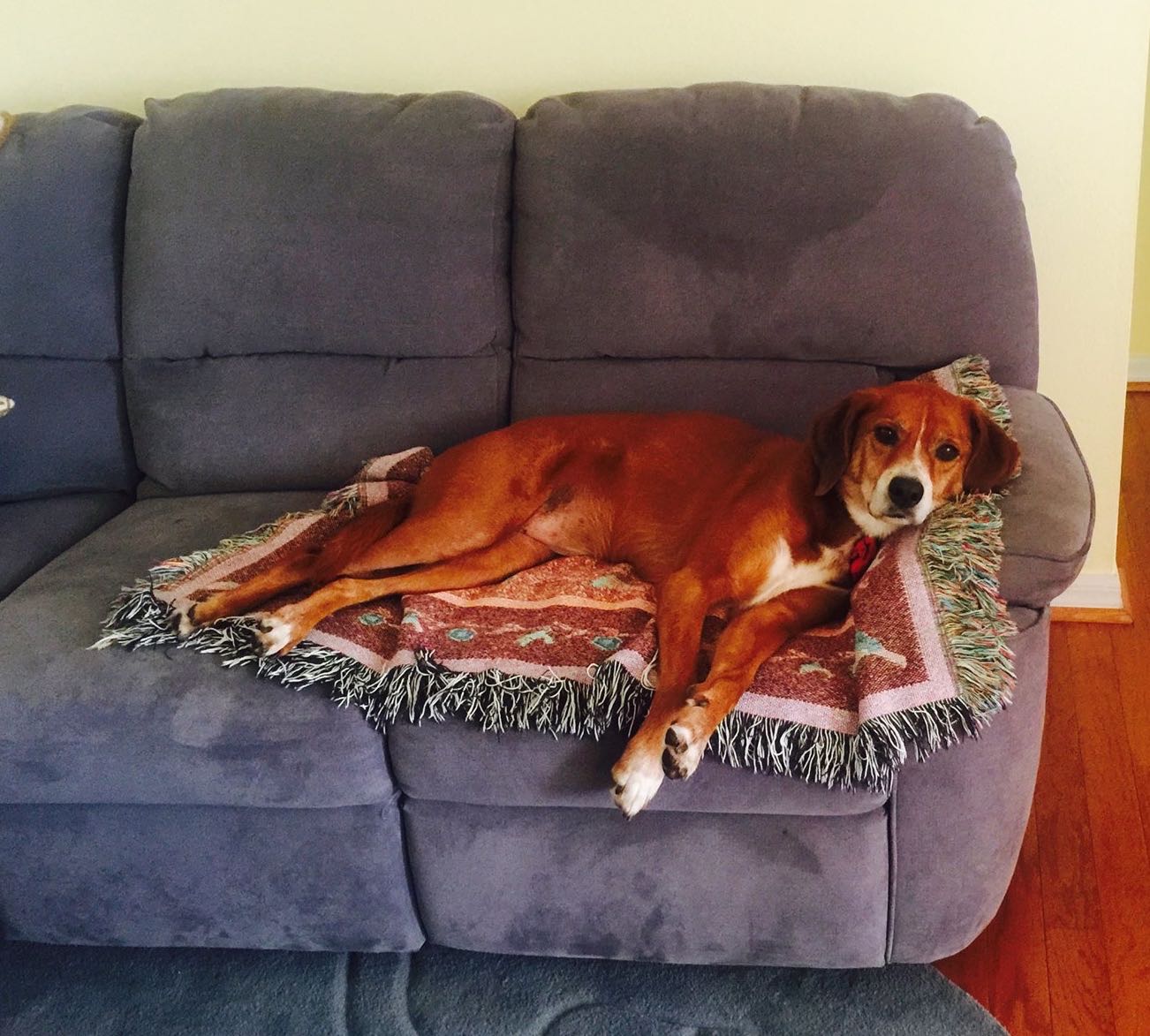
My Christmas holiday was a blur. They can be that way sometimes. I flew to Florida with my husband to be with my parents for Christmas, but I had a TON of homework. Chloe, faithful service dog, at least got the opportunity to really chill out. When I got home, I headed to an academic residency for 4 days.

Even being super busy, I still learned a few things. I learned some things about myself, about other people, and about acceptance. I began to lose my hearing and balance at the age of 25. Now that I am 48-years-old, you would think I have learned all that one can learn after living with hearing loss and a vestibular disorder for 2+ decades!

Ungracious Acceptance

Acceptance of my life as it is, seems to be an ever-evolving concept. Sometimes I take things in stride. Progression of the toll my diagnoses have, a new “timber – down goes Denise – fall”, having to switch out cochlear implant batteries mid-conversation, taking the elevator instead of escalator or stairs, and having to wait for an empty handicap stall in public bathrooms so that my dog and I BOTH fit, is really second nature for me now.

But sometimes? Sometimes I am WITCHY about it. (Feel free to put another first letter there as it probably fits from time to time). Maybe it’s hormones? Perhaps it is a lack of sleep? It may be I just had an unpleasant encounter with someone who was condescending towards me when my being differently-abled became apparent. For whatever reason, at times when someone asks if they can assist I must look…

S c A r Y

I assume this because their eyes get big, they throw up their hands in an “I surrender!” pose, and they take two full steps back. I don’t MEAN to put off that vibe, but I know there are times I must do so. I work SO hard at being independent. I love the color purple, but that isn’t why I carry a bright purple cane. I love dogs, but that isn’t why my 24/7 partner is a service dog from Fidos For Freedom, Inc. I love dangly earrings, but I don’t wear “bling-bling” on my cochlear implant because I’m a drama queen.

(OK, OKAY! I’m a drama queen, but in THIS instance it is not why I have bling-bling on my cochlear implant! Yeesh!)

I do all of these things to be independent. I yearn for independence and inner strength. I forget sometimes that the latter is the result of a “thinker” and “feeler” in sync in the body of a person who is differently-abled. Part of it, I actually HAVE caught the exasperated looks on faces when I do ask for help with something. It can be fleeting, but it’s there. I’m deaf, not blind. (We can debate if differently-abled people are far too sensitive about this and see things that are not there later).

Yeah, so? Let’s Go!

While in Florida, amidst homework and research, I did insist on going out to eat every day. I did a little bit of shopping at a place we don’t have in Maryland. Bealls was a very cool place! We also do not have a Belk. So yup. I did a little shopping.

When we went out on the town to do these things, we had to borrow my parent’s car. It is a big ol’ SUV and Chloe had to sit in the back compartment. It gave her plenty of room to stretch out and seemed like a great option for four people plus one service dog. The problem was that my parent’s SUV sits very high. Chloe is 10+ years old. She is retiring in May of 2015 (unless she lets me know it needs to be before then). The first couple of times I gave the “Chloe… OUT” command, she jumped from the back, only to have her front legs collapse and do a hound face plant in the parking lot. The first time it happened, I gasped. The second time it happened, I’m pretty sure I yelled. OK, yeah. I don’t yell. I have a hearing loss. I SCREECH. Ask me to demonstrate sometime, but bring the ear plugs.

Because my husband, Terry, didn’t want to see what a third time would trigger, he suggested, “Let me lift her out of the back and set her on the ground!”

I said, “Ok, but do it in a way you don’t embarrass her. Make it quick and don’t make a big deal about it.”

Perhaps I should explain that I disagree with those who say that dogs don’t exhibit or feel some of the same things humans do. I have seen dogs excited. I have seen them pissed. I have seen dogs pouting (do I have some stories about my grand-dog, Pegasus, or what?). I have seen dogs embarrassed. Point & laugh and dogs will duck their heads in shame/embarrassment.

Chloe’s weight ranges from 59-62 pounds. Needless to say, we don’t carry her around. I wasn’t sure how she would respond to being lifted from the back and set on all fours on the pavement; nor, did I know how she would respond to being lifted up into the back of the SUV.

The first time we opted to lift the service hound out, I held my breath. Terry reached into the back, hooked his arms under her and locked his hands over her spine, and carefully picked her up and set her on all fours.

PUH.

I exhaled rather noisily, and watched as she wagged her tail and moved to heel position, looking up at me as if, “Yeah, so? Let’s go!”

I was stunned. I had a treat in my hand to cajole her back into a good mood. Instead I went into the store as if nothing out of the ordinary had happened. I watched Chloe from the corner of my eye. (Ummm… explain to me how oval shaped things like eyeballs have corners?) I digress…

I fully expected Chloe to act, I don’t know… WEIRD for awhile. However, she took it all in stride. She needed the help, being rather fond of her own face, and didn’t even miss a step in going on about her job after accepting assistance.

Do you know where I’m going with this?

WHY???????

Why do we act so weird when we need help? Maybe it is just a little help.

… like picking up the dropped blue tooth device I spotted in a hallway that I could not bend to get, and didn’t want Chloe to destroy by enthusiastic fetching.

Maybe it was a lot of help.

… like helping me dislodge my wedged rolling briefcase from the elevator door as it was stuck solid. I struggled with my butt holding the door, cane braced, and dog freaking out as I tugged on a very STUCK wheel.

Sometimes? Sometimes, we just need a little help to continue doing our thing. We need a helping hand. We aren’t signing an I.O.U. If we truly want the world to be a kinder place, then why are we prickly when someone asks if they can help? By accepting help we are not sticking a “I’m WEAK” note on our forehead. We can accept help and still be independent. We aren’t waving all rights to an independent life should we accept help once in awhile. For most people, helping another is done so with no strings attached. They don’t even think twice about it. They may never think about it again, while WE sit there perseverating on it and making a huge deal about it. Why can’t we just say, “thank you!” and our attitude be, “Yeah, so? Let’s go!”

PRIDE.

Pride can be a good thing. There are good types of pride, and crippling types of pride. Learn the difference. Learn to accept help. It doesn’t mean you are signing on to a life of dependence. It means that you are SMART. You know your limitations and are making wise choices to do what is best for YOU. Face plants on the pavement aren’t fun. All you will have for that type of stubbornness is a skinned chin. (Ask Chloe…)

Denise Portis

© 2015 Personal Hearing Loss Journal


But, Butt, Buttocks and Butte

Isn’t the English language crazy sometimes? Did you know that it is actually one of the hardest languages to learn? (Oxford Royal Academy, 2014). Since most who are reading this likely know and use English as their first language, that may come as a surprise to you. We bellyache about how difficult it is to learn Spanish, French, German, etc., because most of us were born into English speaking households. Yet, many scholars argue that English is quite difficult to learn.

Take homophones for example. “Butt” can mean to “be adjacent to” or it can be your hiney, your buttocks, your butt, your behind, your gluteus maximus, your CABOOSE. Talk about confusing! You have to look at words in context to figure out the meaning. Then… we have acceptable shortened versions of words. For example BUTT is an acceptable, widely used word in the place of BUTTOCKS. However, BUT is not short for BUTocks. As a matter of fact, that isn’t a word! Add an “e” to BUTT and it even changes the pronunciation of the word. Now it is BUTTE (pronounced \ˈbyüt\). However, you don’t ever add an “e” to BUT. The word BUTE is not a word (unless you mean the derivative of the medical word phenylbutazone). You just ran screaming from the room, didn’t you?

Get it Right

But ya know something? Sometimes we use words and think we know what they mean when we do not. It is my opinion, that those of us who live with disability, chronic illness, or invisible diagnosis, should know our own SELF very well. I have Meniere’s disease and am late-deafened. I sought to learn everything I could about both conditions. When I later developed extremity peripheral neuropathy, I learned all I could about this condition as well. However…

I cannot expect everyone I meet to be experts on what is wrong with ME.

Aren’t we guilty of that sometimes? Heck, even with our loved ones we really can expect too much from them. So we have to be careful about our expectations. If I tell a colleague that I’m late-deafened and they respond with, “Oh… OH! I know some sign language!” (and they start to slowly and painfully finger spell their name)… don’t have a COW. (Besides… that is just MESSY!) Not everyone knows that the vast majority of people with hearing loss are late-deafened and do not use ASL. Try gently educating instead.

I told a student who was walking down the hallway and then into an elevator with me, all the things Chloe does for me. She asked about my condition, so I tried to explain Meniere’s disease in layman’s terms. When we exited the elevator, she helpfully took my elbow, and said, “Here… let me help you“. I stopped (after making sure hound dog and my bags were on the right side of the closing elevator door) and dug in my heels. I looked at her in astonishment. I had just walked down a hallway with her, wheeling my bags behind me and juggling leash of faithful service dog not five minutes before! After helpfully disclosing and explaining Meniere’s disease now I’m incapable of walking on my own? Because I knew she meant well, I didn’t scream, spit, or throw a hissy fit (*pats self on back for rhyming so nicely right there*).

I said, “I can walk on my own. Chloe helps me“. She stared and then said, “But… But you are WOBBLING“.

I cheerfully retorted, “Yup. Welcome to my life!” and walked off.

Everyone’s an Expert!

Another problem you may encounter if you have a long-term or permanent diagnosis, is that helpful folks sometimes act “the expert”. I’ve tried to explain that I am late-deafened and hear again with a cochlear implant, only to be interrupted by the person exclaiming, “Oh yeah. I have to turn the volume up now that I’m in my 40’s!” (I’m like… whaaaaaa…?)

I told an employee of my favorite grocery store a little bit about Meniere’s disease. Chloe and I always meet him stocking bread in the same aisle almost every week. After hearing my brief explanation of Meniere’s, he said, “Oh yeah, I walk into things after I’ve been drinking even just one beer!” I stood there trying to determine if my brain heard what I thought it heard. Ever been taken by surprise before and your mouth just blurted out what you were thinking before you had a chance to filter it through your state-of-the-art “Maturity Meter”?

I said, “That’s the dumbest thing I have ever heard“. He stared and then stomped off. We only see the tail end of him leaving the bread aisle when we go to the store now.

All my buddies who are late-deafened joke about this response after telling someone that they are late-deafened: “Oh yeah, I have an aunt who is death“.

Rest in peace, auntie.

Cut ‘EM Some Slack

Just as our English language can be confusing, so can your explanations of who you are to others. Even invisible conditions such as mental illness are so misunderstood. Many folks who try to explain a mental illness diagnosis are then treated like:

1. Fragile porcelain that may break under pressure

2. They are suddenly contagious

3. They are more dangerous than Freddy Krueger

All we can do, is do our BEST. In the end, we need to work hard at trying to understand that others – even those who may care about us the most – may not completely understand your new normal. That’s OK. A healthy acceptance and ability to BE GOOD TO OURSELVES is not dependent on the understanding of others.

Denise Portis

©2014 Personal Hearing Loss Journal

Oxford Royale Academy (2014). Why is English so hard to learn? Retrieved on October 27, 2014, from http://www.oxford-royale.co.uk/articles/learning-english-hard.html

By Association…

by association

You’re gonna think this is off topic. Hang with me, I promise this is a “typical Hearing Elmo” post.

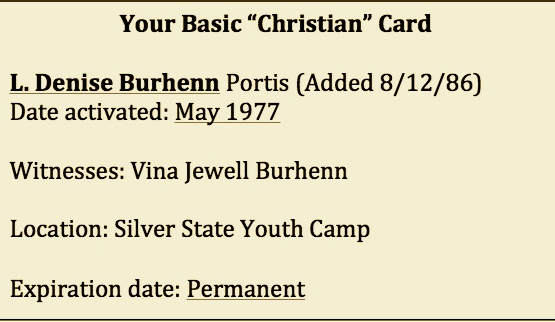
I’m turning in my “Christian” card. 

I’ve been so aggravated with “Christians” over the past month, that I decided to shred my “card”. Being a “card carrying Christian” doesn’t mean anything anyway.

It matters how you live and Who you put your faith in… at least that is what I believe. Sometimes I get extremely annoyed on FaceBook. But…

I stay because the disABILITY community is alive and well, thriving and connecting on FaceBook. In the last month, however, I have seen folks post a couple of things in the name of God, that made me shred my card. Carrying a card doesn’t mean squat. I’m going to live what I believe and ignore some folks that choose to make the “real deal” look bad.

1. The suicide/death of Robin Williams

Some things I actually saw posted:

“Shame on Robin Williams for causing such grief and forcing his family to shoulder this for the rest of their lives. No way is he in Heaven”.

“A Christian cannot commit suicide. It keeps them from Heaven. Guess we know where Robin Williams is”

“It’s is so sad he (Robin Williams) didn’t get help for his depression. Had he known God, that would have helped”

“Disgusts me! Suck it up and be a man. Seriously, the coward’s way out”.

All these from folks who regularly post things making it clear their faith-based beliefs. Yet this erases all of that in my opinion. They only show their stupidity (I mean… try doing some real research on what clinical depression is, would ya?) and judgmental attitudes. Yeah. That will win others to Christ.

2. The ALS Ice Bucket Challenge

Some people who have made it clear what “card” they carry when it comes to personal beliefs and faith, reported that they could not accept the challenge because ALS research conducts stem-cell research. It doesn’t seem to matter that stem-cells can be harvested from a number of different procedures – only one that is from embryos. Couples with frozen embryos can:

  • simply discard the embryos
  • can store the embryos indefinitely at their own expense
  • can give the embryos to other infertile couples. (More information about that option is available through the RESOLVE: The National Infertility Association)
  • can donate the embryos to general research or stem cell research (CIRM, 2014).

Stem cells can also come from adults, however, and umbilical cords of newborns. Scientists and researchers have even learned to induce pluripotent stem cells – alter adult stem cells to have the properties of embryonic stem cells (Mayo, 2014). But wait, let me guess. You have issues with genetic research, too?

Let’s say stem cell research goes against your personal beliefs and world views. So you do not support infertile couples seeking help in order to conceive? So if stem cell research is done and embryos are used… and a cure or viable treatment is found for diagnosis such as: spinal cord injuries, type 1 diabetes, Parkinson’s disease, Alzheimer’s disease, heart disease, stroke, burns, cancer, osteoarthritis, and ALS (Mayo, 2014), you would not participate in this treatment or cure if diagnosed with one of these, right? Or, if someone you love is diagnosed with one of these debilitating diseases you will let them suffer? Do you know how many relatives I have that would not be alive if not for diabetes/insulin research?

OKAY!

Ok.

ok… I will calm down. After all, you are allowed your opinions and biases. This IS (still) a free country. But I don’t have to buy into that, nor drink your proffered kool-aid. I read some posts about rejecting the ALS Ice Bucket challenge that made me weep.

I mean I cried buckets (though not ice buckets).

Because people who have this disease or love someone who does may have seen your post. And heard your excuses.

Hey. Most of us have limited incomes and must choose what we do with our discretionary monies. There are only a handful of places I give to each year because they are causes and non-profits that I am passionate and convicted about. If you choose not to accept the “challenge” that is your choice. Maybe say, “sorry, I give to other foundations/charities but I salute those of you who are giving to ALS”. Just please don’t make excuses about why you aren’t going to give to the ALS foundation and say it is because of the “card” you carry. Worse… explain that you are going to give your donation directly to a patient with ALS instead of the evil foundation. Because that person wants your money and not a cure.

Who Am I – by Association?

So all of this has made me think. (Can ya tell? LOL) Some of my associations I am very proud of and gain physical, emotional, psychological, and spiritual benefit from participating. Others make me keep my distance though. I may even shred my “card”. It doesn’t change who I am – merely my associations. I am a person of faith, but I want to be transparent, compassionate, and a friend who makes a difference.

What are your associations? (Other than those that are faith-based)

I am associated with groups who have bionic hearing. I have a cochlear implant. Sometimes we disagree on “best company” or hearing health strategies, but we don’t judge or behave holier-than-thou. We agree to disagree when needed.

I am associated with groups with vestibular disorders. There are SO MANY different specific diagnosis that are vestibular disorders. Meniere’s disease is a fickle pickle. Few have exactly the same symptoms and triggers, and what program works for one may not do anything for another. However, we work hard to accept that “whatever works” for each sufferer.

I am associated with groups who advocate for the rights of those with service animals. Fidos For Freedom, Inc., radically changed the course of my life. I don’t agree with all training practices and at times am rubbed wrong by certain personalities. However, I proudly wear the mantle of service dog “mom”.

Yet at some point in my life I had to dis-associate with the culturally Deaf. My reasons are a long story, but it is my story and I shoulder the responsibility of that choice.

I chose to dis-associate with my undergrad alumni. Again a long story, but one I stand by.

I chose to dis-associate with people who don’t like Greek yogurt. They can’t be trusted.

These are my choices, and YES. I “get” that you have the choice to “dis” Robin Williams, individuals who took their own life, and depressed people who have lost hope. I respect your choice. Doesn’t mean I can and will choose to associate with you. I understand that your conscious will not let you give (one time or regularly) or support (by posting a video and challenging others) the ALS Foundation. But if you choose to voice that opinion and choice in such a way that it harms others, I don’t have to associate with you.

There are numerous organizations in our great country that I do NOT support because of ethical concerns and personal choice. But you will never see me posting things in a public venue something that may cause harm to someone else – even peripherally. I have the freedom to express my opinion one-on-one to close friends and my husband. Believe me… I do this regularly when my ability to cope with those who hate Greek yogurt overwhelms me.

Y’all? Go be nice to others. 🙂

Denise Portis

© 2014 Personal Hearing Loss Journal

CIRM. (2014). Myths and misconceptions about stem cell research. Retrieved September 2, 2014, from http://www.cirm.ca.gov/our-progress/myths-and-misconceptions-about-stem-cell-research

Mayo Clinic. (2014). Stem cells: What they are and what they do. Retrieved September 2, 2014, from http://www.mayoclinic.org/tests-procedures/stem-cell-transplant/in-depth/stem-cells/art-20048117