Acceptance is…

Have you ever had a time in your life where you realized that accepting the way things are is all you can do right now?

The advocate in me chafes at what acceptance means. There is a part of me that yearns to be instrumental in change; that other late-deafened adults will be encouraged and helped by the things I do. In the public arena I try to be a good example, a positive influence that stimulates change in access, communication strategies, and coping mechanisms.

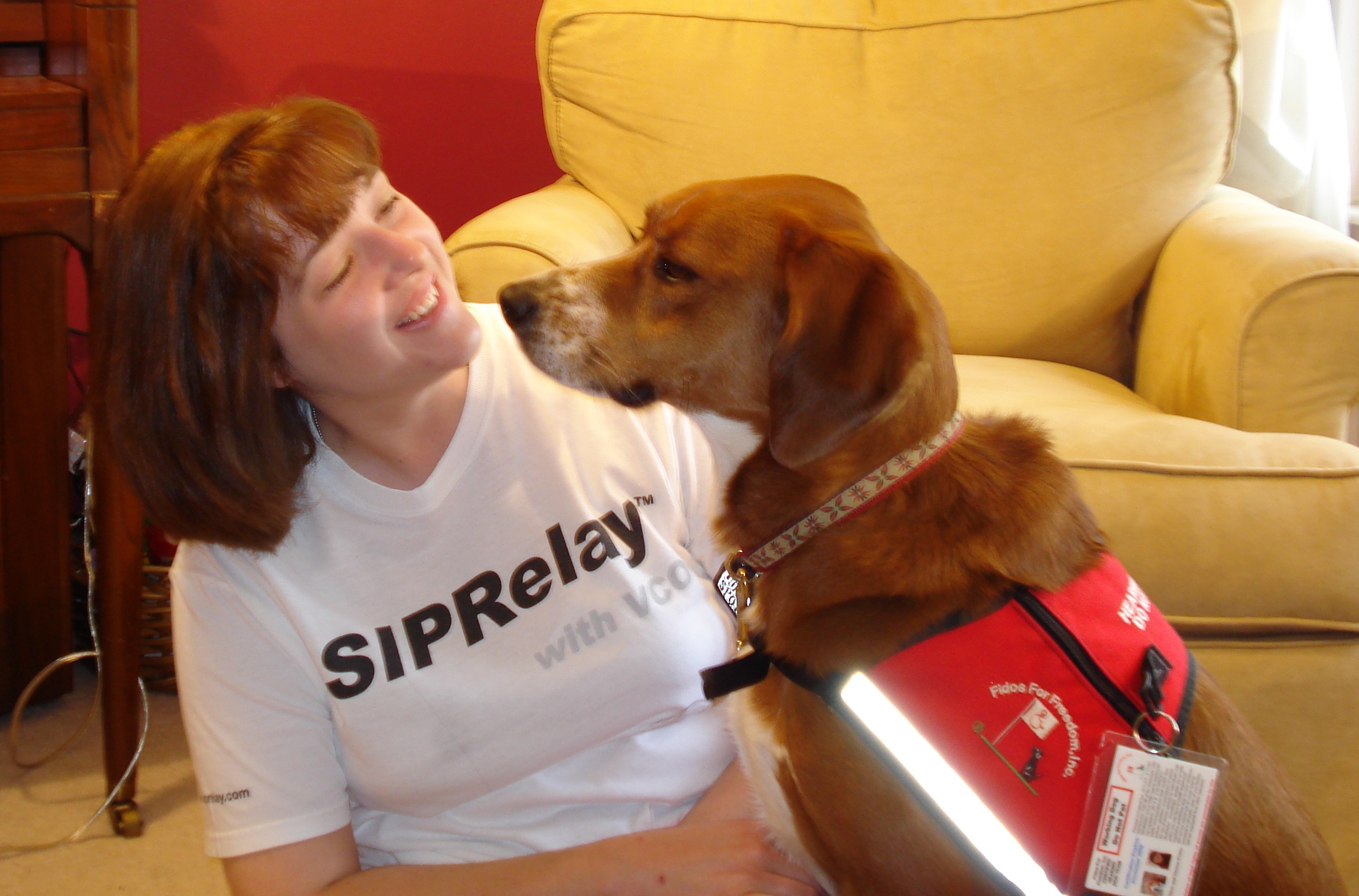
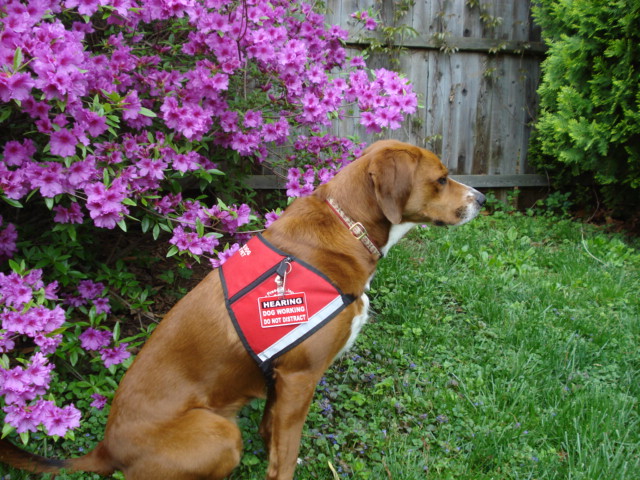
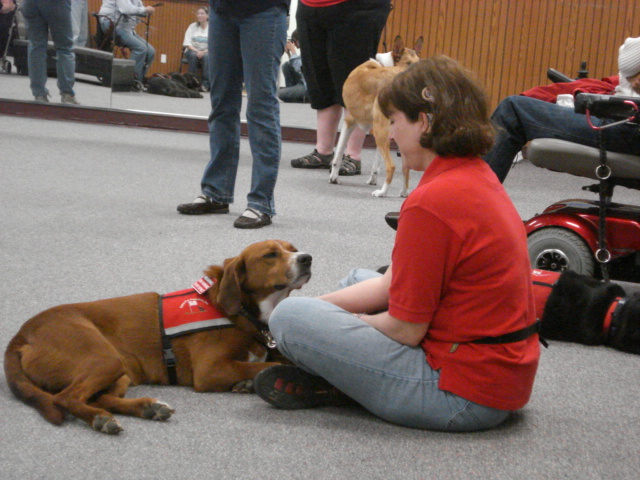
As a person with a working dog and one who has carefully counted the cost of what that means, I want to be a good role model. I hope to help create an awareness that there are other types of working dogs that are not guide dogs for the blind. I want to be instrumental in other’s acceptance of other types of working dogs.

It is much easier for me to “go to bat” for others. If it means a sacrifice will help someone else, I do so with little thought about whether or not I should. However, exerting emotional, mental and physical efforts in which the end result helps only me? Well… that is much harder!

When I first began losing my hearing, I lived in North Carolina. I had a friend who had a great deal of experience in working with people with hearing loss. Thoroughly exasperated one day, she put her hands on her hips and exclaimed, “Denise! You are the most difficult person to HELP! If and when we can, would you just sit down and LET US?” To this day, it is still something I struggle with each and every day. I want to “help”, but don’t help me!

I hope that I’ve mellowed with age, for in truth it is pride that keeps me from humbly accepting assistance from others. I’ve actually learned to ask for help! That’s GROWTH in my opinion! (grin)

Acceptance can be difficult to embrace. I accept that I have a hearing loss. I have a disability that at times makes communication difficult. I accept that I will need to ask for help at times in order to clarify, and that I will need to clearly communicate my needs.

Sometimes, acceptance means that right now… nothing can be done to improve your situation. My family and I are members of a really wonderful church here in Frederick. Our church is “big” on “small groups”. It is a way for the members to really get to know one another and to become involved in each other’s lives on a more personal level. Without going into a lot of unnecessary detail, there is no place for me in any of the current small groups. I’m encouraged that there are “plans in the works” to create a small group this fall that will be in a quieter setting with no children, etc. For now, however, I accept that there is not a place for me. Acceptance can mean to be brave and smile right through the feelings of loneliness. Acceptance does not mean that you “give up” emotionally and wrongly convince yourself that “this is the way it will always be”.

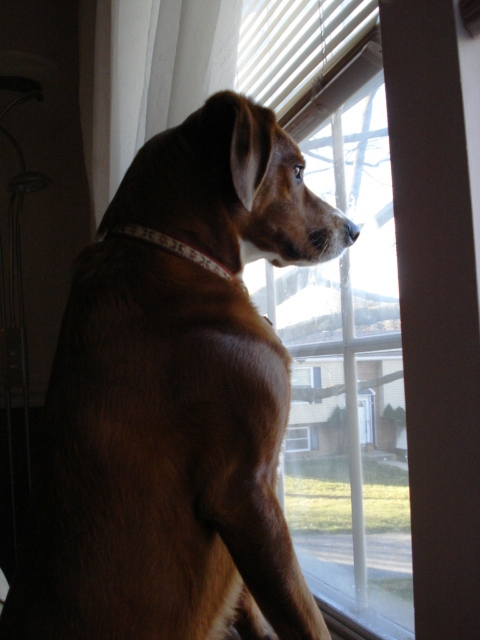
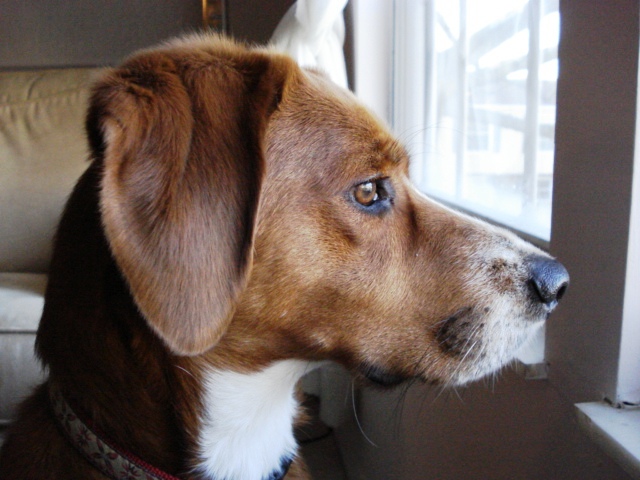
I am in a tough situation with my assistance dog, Chloe right now. A new person in my life has a very severe allergy to animals with fur. It is actually a life-threatening asthmatic reaction to pet dander, and she is unable to be near me if Chloe is with me.

Chloe isn’t a pet. As an assistance dog, her job is to be with me even if I do not immediately need her ears to hear or her “steady stance” to balance. To leave her at home in her kennel on occasion is not a problem. But to do so regularly, affects our bond in a negative way. It’s tough when a “new person” enters your life that you want to get to know better, but you must limit getting together with them because you cannot leave your assistance dog at home a great deal. I must accept that sometimes I can’t get to know someone like I would hope, as I cannot undo all the work and training I have gone through in order to live a more independent life.

Acceptance isn’t always an easy, “feel good” choice. At times, one must courageously determine that you can “accept” the way things are for the present. Right now, “acceptance” has actually caused a lot of heart break in my life… it has caused many a heated argument, frustration and sleepless nights. I can, umm… (BIG SMILE) accept that!

Denise Portis
©2008 Hearing Loss Diary

Third Year Anniversary

Today I went for my 3rd year mapping at Johns Hopkins. I haven’t been to Jennifer, my audiologist, for one full year. One of the first things she asked me was “How is everything going, Denise? I guess since it’s been a year, things are good?”

I hadn’t thought of it in quite that perspective before, but I guess I have had a very good year since I’ve not emailed nor called her begging for a new “map”! Actually, it is a little unsettling to go in to have your cochlear implant checked and “tweaked” when you feel like you are doing great! I always remind myself that Jennifer doesn’t push me to change anything if I don’t like the new maps.

First stop… the sound booth. (a.k.a. “the torture chamber” if you listen to some late-deafened folks!) The orientation of “the chair” was different this time, and I had Chloe (my hearing/balance assist dog) with me. I got kinda tickled a couple of times, as my audi would sometimes “pop in” with her voice and say, “Denise… this time we are going to…” Chloe’s head would jerk around and stare at the speaker. I could tell she was trying to see if my name was repeated for a genuine “name call alert”. One of the tests (my favorite – NOT!) is a man who says… “Ready? and then a word” It goes on for what seems like FOREVER, but actually I’m sure it’s only several minutes. I missed “when”, as I thought it was “whim”, and I missed “nice” thinking it was “mice”. As there is a “white noise” as well, I was pretty proud I only missed two! The sentences given are harder, but they are more indicative of actual conversation I believe. I didn’t miss any of these! (patting self on back…) The only thing I would change about these tests is that I believe two more options of “noise” should be used as well as the “white noise”. I think “traffic noise” and “restaurant noise” would be wonderful options for the audiologist to track how well their patients are hearing in “real life” situations.

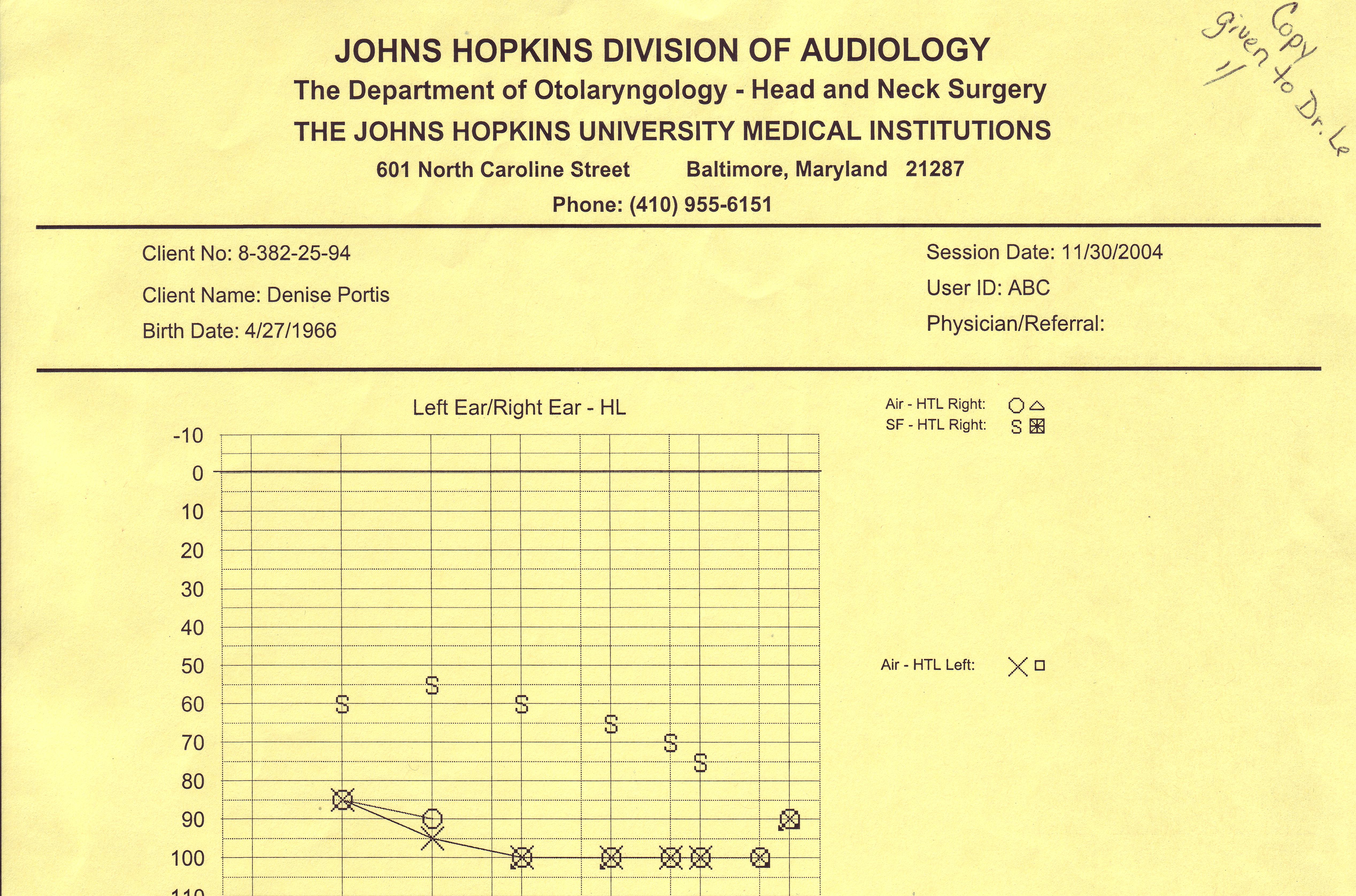
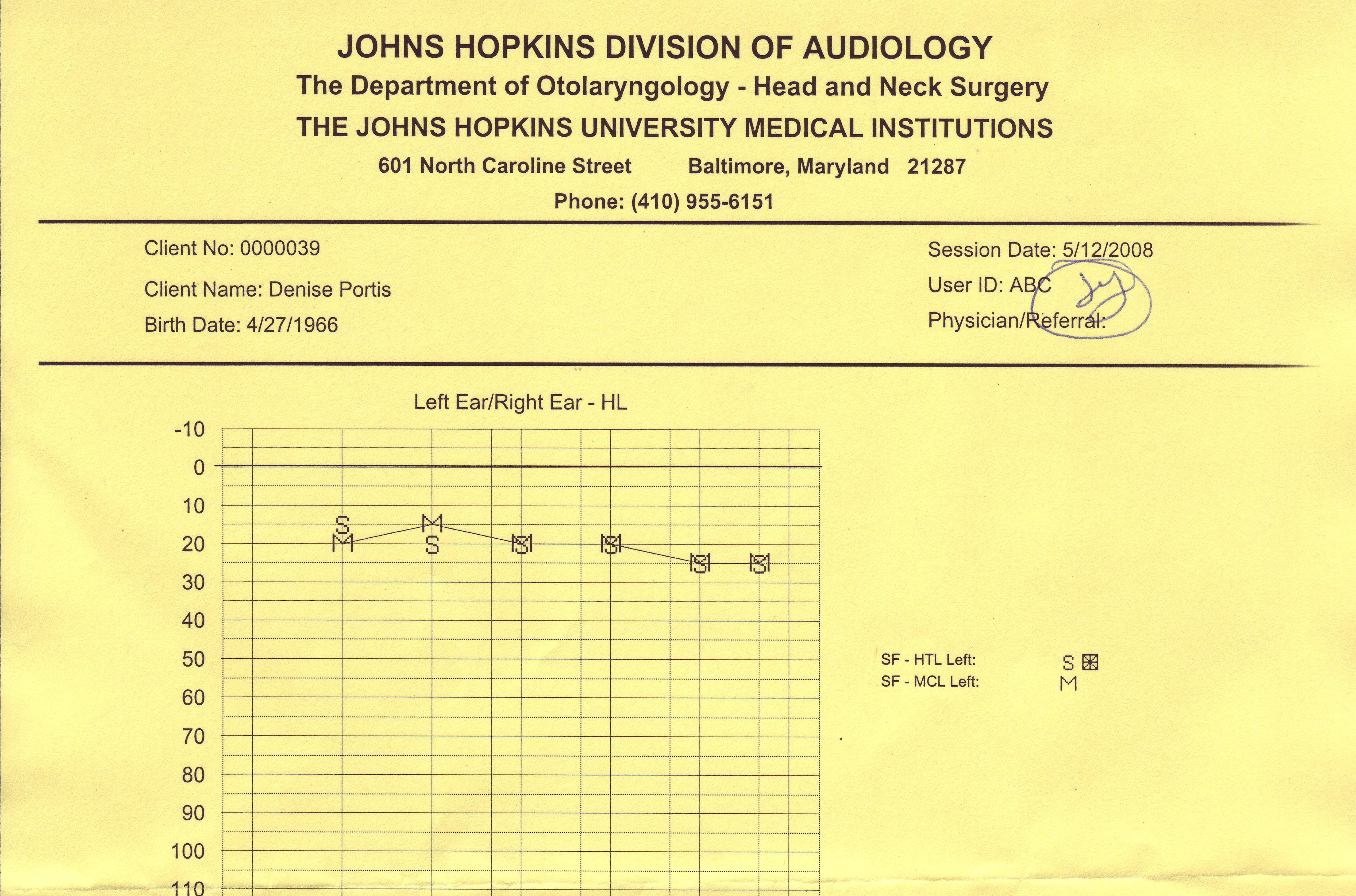
My audi then took me back to her office and showed me a printout of the test results. I’m always amazed to see the scale, as it seems such a short time ago I could hear very little. Below is an audiogram from a couple of months before my surgery in 2005 (on the top), and below it is one of today. The up-to-date audiogram is labeled with “M’s” for the implant and “S’s” for both the implant (on my left side) and hearing aid (in my right).

She then hooked me up to her computer and gave me four new maps, carefully explaining what each were.  We then “sat and talked” so that I could “listen” to the new maps and be able to give her feedback.

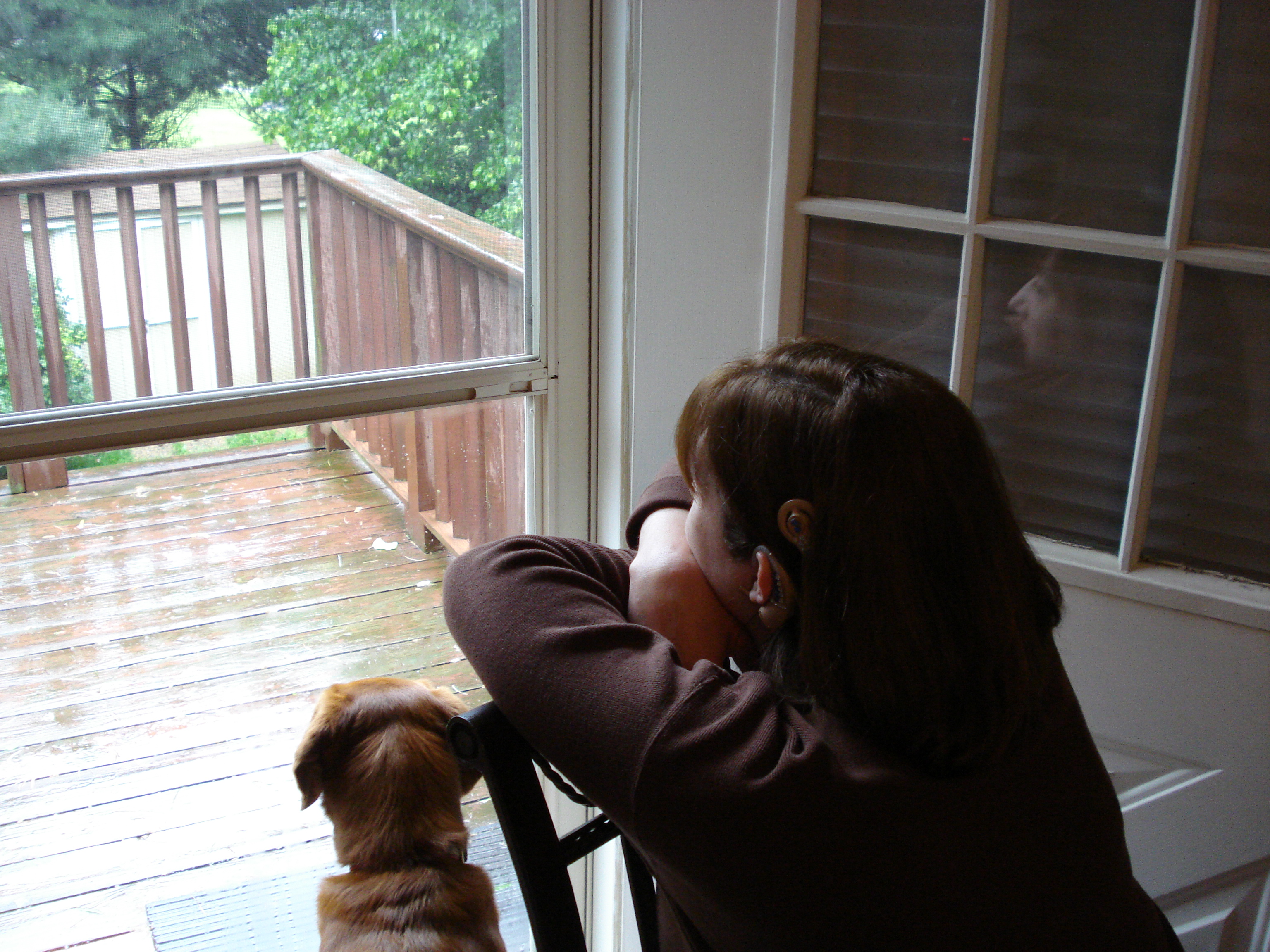
When I got home, my plan had been to go right out to Wal-mart. The list from my family had gotten longer and longer over the past week. However, the sound of the rain, had me lingering at home.  For over a year now I have enjoyed the sound of the rain on the roof of the van, or on the roof of the house. Funny how something you now think sounds TOTALLY GRAND, was something you don’t remember registering as “sound” prior to becoming deaf. It most certainly wasn’t something I thought was a spectacular sound! The map I am now using as my primary, mixes both ADRO and ASC. (That probably only means something to folks with the Nucleus Freedom!) I am amazed at how wonderful the rain sounds with my new map! And it sounds… different than it did twenty-four hours ago! (It’s been raining for four days, so I very easily recall what rain sounded like yesterday!)

All thoughts I had of rushing off to Wal-mart with shopping list in hand went right out of my mind! I couldn’t help but pulling up a seat and just listening. It’s amazing how the rain sounds as it hits the wood on our deck. It’s amazing… when you are “hearing again”. Wal-mart? It can wait until tomorrow!

Denise Portis
©2008 Hearing Loss Diary

Ah… Spring!

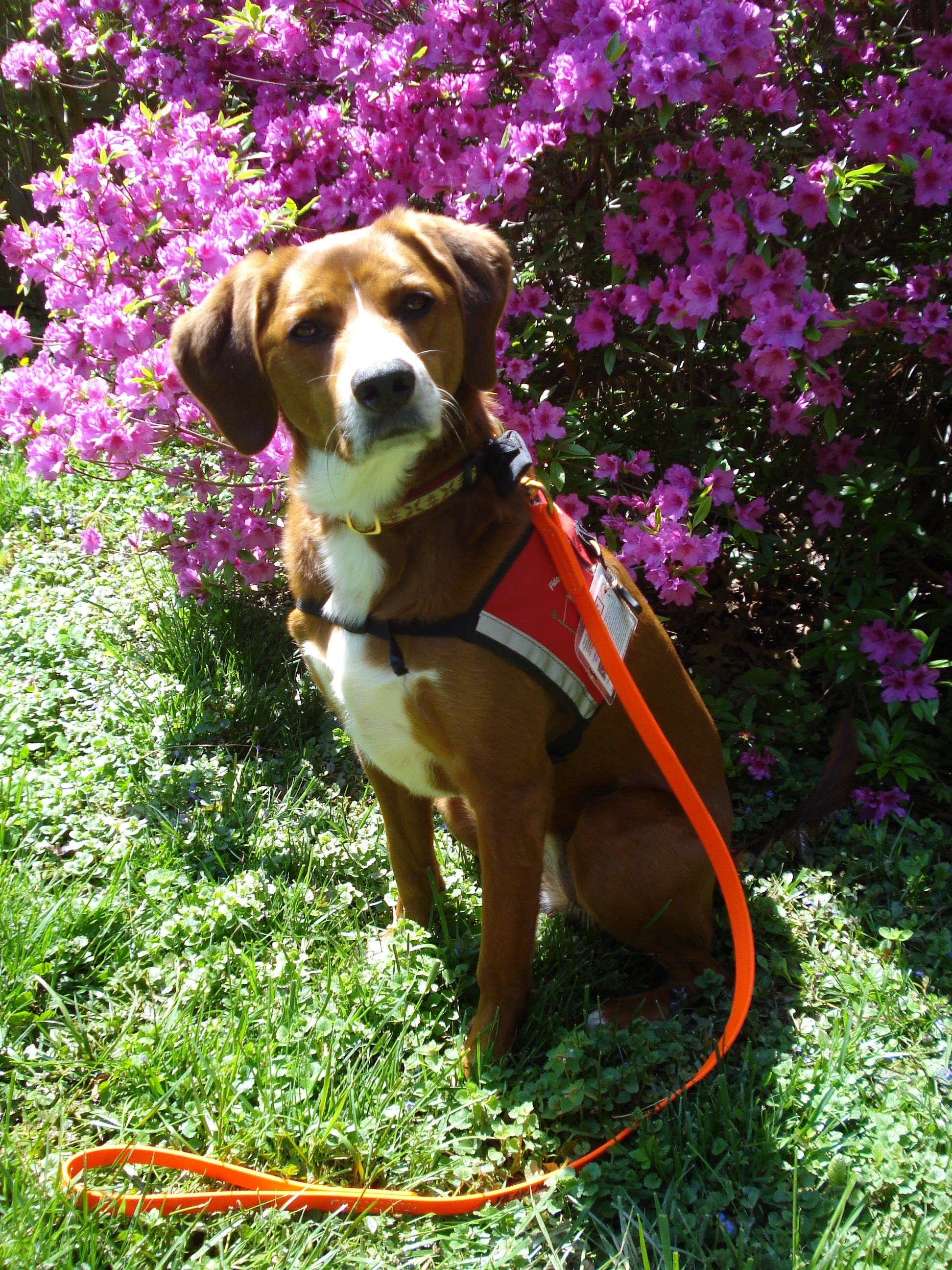
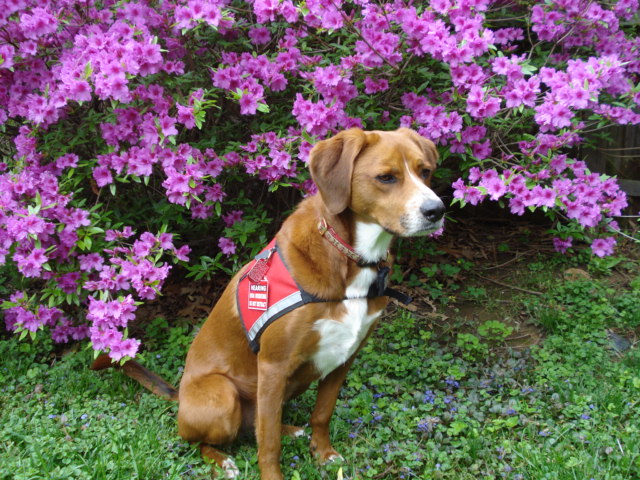
After a really rainy Monday, we finally saw some sun.  I took advantage of the fact by snapping some pictures of Chloe.  My husband bought me a gift certificate for my birthday for a “Snap Tote”.  You put a picture of something on the side of the bag… so I wanted one with Chloe.  (I figured I could use it in place of the backpack I’m carrying.  It’s killing my shoulders!)

I turned 42 on Sunday.  Someone asked me how old I was.  I had to think:  “Let’s see it’s 2008 and I was born in 1966.  So 2008 minus 1966 is….” I realized that it just doesn’t matter anymore how old I am!  As a matter of fact I’m SURE someone asked how old I was several months ago and I said, “I think I’m 42…!”  (and I wasn’t yet)

Our annual certification day is Saturday!  I know Chloe will do great on her skills test… it’s ME I’m worried about!  I have to remember responses to access questions and challenges, plus take a written test.  Yuck.

More pics:

Denise Portis
©2008 Hearing Loss Diary

Why I Don’t Use Sign to Communicate

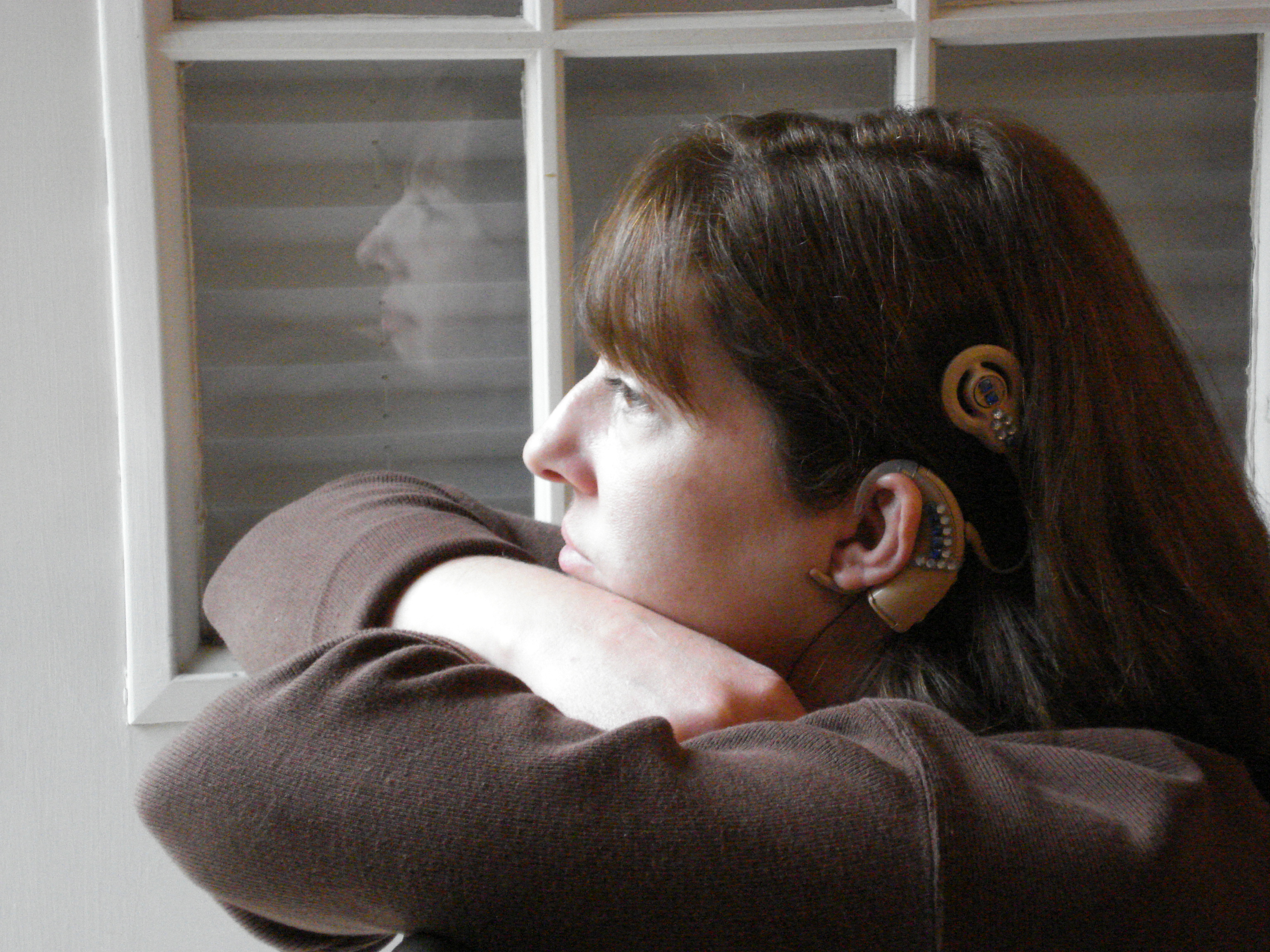
A hearing loss is often referred to as an invisible disability. Even though I wear “bling” on my cochlear implant, and have a bright red/orange ear mold on the hearing aid in my other ear, one can’t look at me and tell I have a hearing loss.

The reality is, I’m deaf. But… I’m not culturally Deaf. (The culturally Deaf usually identify themselves with a capital “D” for Deaf). Without my cochlear implant, I can hear less than 5% of consonants from only certain individuals. I could go into the nitty gritty details of what my audiogram shows without my implant, but as it’s almost “Greek” to me, I’m sure it would be “Greek” to you.

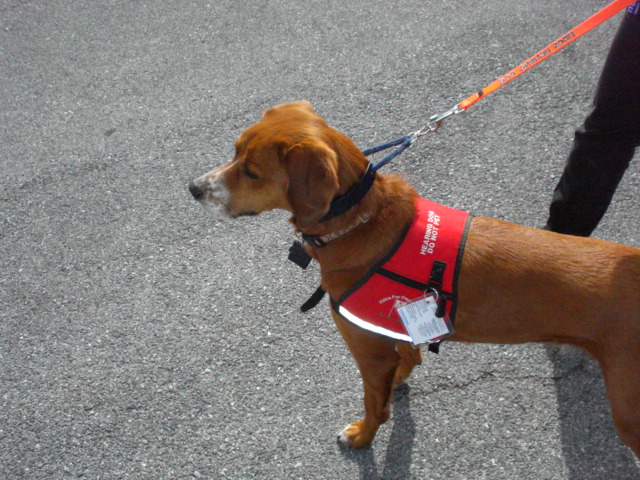
I needed an assistance dog for a variety of reasons. Although I was warned by my trainers at Fidos For Freedom, Training on April 5th at Fidos I was unprepared for how visible Chloe made my hearing loss. It’s not every day you see someone come into a store, post office, or restaurant with an assistance animal that is very obviously not blind. Chloe makes my implant bling virtually non-existent in the way she so quickly brings to attention the fact that I have a hearing loss!

It’s funny to see people creep closer to read her vest, and then look at me quizzically until they spot the cochlear implant and/or hearing aid.

At Costco this past weekend, I had several strange encounters. Not “strange” like the “X-Files”, but strange in that it was really weird how different people responded to my hearing loss.

The folks at Costco know me well… they should as I spend a small fortune there each month! They know Chloe even better, and sit on their hands so they don’t reach out to pet her wiggly hello. But the customers are all usually “new” to seeing this bright red hound come into the store with her “deaf” partner.

I had a man/wife couple tip-toe up to me and enunciated very clearly (and with extra exaggeration to the point I almost laughed),

“Doooezzzzzz yourrrr dooooog….. hearrrrr…. fooor…. youuuuu?”

I smiled and said, “She does indeed do that! She has the best ears! She helps me with my balance on rainy days too!”

After they picked their lower jaw up off the floor, they talked to me at length about what Chloe does for me and how I came to be matched with such a wonderful companion. I noticed after about 7 or 8 minutes, that the husband was bi-laterally fitted with hearing aids! No wonder they were so curious… and he talked as clearly as I do with no hint of sign language, etc. (I say that carefully, as I do not mean to infer that those culturally Deaf cannot speak clearly… some do so amazingly well… and it’s not a language that is their own! Many Deaf are able to speak well! But those who do… often have a “Deaf accent” for lack of a better way to explain it. Hey! If I spoke a 2nd language, I’d have an “English” accent for sure!) We parted ways after I deposited pamphlets and brochures about Fidos into their eager hands.

I also ran into a fellow Fidos For Freedom volunteer! Small world!

I rounded the corner of the dairy section… and wouldn’t ya know? I ran into a group of teenage girls. They squealed and came rushing over to Chloe. (I wasn’t about to think they were rushing ME!)

One of the girls… likely around 16-years-old or so, began to painstakingly introduce herself to me in sign. “Hi. My name C-r-y-s-t-a-l”. (This took her about 5 minutes to complete). I patiently waited, and then dropped Chloe’s leash, stepped on it, and used both my hands to sign, “Nice meet (you!) Name-mine, D-e-n-i-s-e, This (pointing to Chloe) ” ” hearing-dog, mine. Name C-h-l-o-e”

They squealed and excitedly tried to figure out what I said for about 30 seconds. Then they got nervous. So I put them out of their misery, and voiced in English:

“Actually, I don’t use sign language to communicate. I am “oral” and use English just like you! My name is Denise and this is my hearing dog, Chloe.”

The sweet young lady who had been brave enough to sign blurted out, “Oh! Well WHY? If you can sign, why would you speak English?”

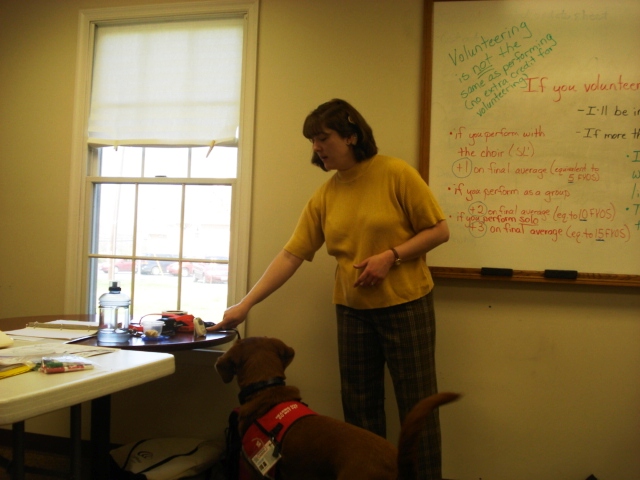
Chloe alerting to the timer in the classroom so I know class is \As a teacher of ASL (American Sign Language) I had one of those moments… the kind where you hear yourself speaking in a lecture that you did and it echoes in your mind during the moment it actually hits you! Of the 34 million Americans with hearing loss, less than 2% sign. Yet, hearing loss is almost always equated with sign language.

I took a few minutes to explain that everyone in my life has normal hearing, and everyone uses oral English. My daughter’s boyfriend, Mark, has normal hearing. (How can I get to know HIM if I can’t speak English and and use my bionics to hear his responses?) I am the only person with hearing loss in my family, the only one in my church, and the only one at work. I know and teach sign language, because I made a very dear friend in college who was Deaf. The college just happened to have a “College of Deaf studies” as well. I learned sign language to talk to her, I later used it in my church to serve in a Deaf ministry… and then I lost my hearing. If I only signed and didn’t choose a cochlear implant, hearing aids, and reading lips to communicate… I would not have very many people to talk too. Sure… they can learn sign language, but I’ve never been convinced that my world would do anything other than become a lot smaller. (Besides… my husband is truly manually dyslexic! He’s tried to learn for years!)

I teach sign language because I do love the Deaf. I have numerous Deaf friends still! I hope to instill a passion for the language in young people who will go out and make a difference to someone who is Deaf. They may be interpreters or teachers of the Deaf, or… they may only have a one-time opportunity to be a blessing to a Deaf person. I love sign language! It’s beautiful, and many times “says” what spoken word cannot. I “sing” in sign… (I am after all – deaf! Truly, and fully “tone deaf”!)

I realized I had begun to ramble as I saw the girls’ eyes glaze over. TMI!

I know sign language, and can teach it as well. I don’t use sign language to communicate 98% of the time. (Likely, one of the reasons my receptive skills are so poor).

Having Chloe with me 24/7 is like putting a spot light on my disability. And… I’m OK with that! I love to talk about hearing loss. I love to talk about assistance dogs! Heck! I love to talk!

Denise Portis
©2008 Hearing Loss Diary

What HLAA Means to Me… “Now”

lancaster-march-27-2008-069.jpg

Many of my regular “readers” have asked me to post my thoughts on the Hearing Loss Association of America, and how I “feel” about the organization now that a bit of the heartache is in my “past”.

It has been difficult to sort through my personal feelings, in order to look at things objectively. Frankly, I’ve given up trying to seek an objective viewpoint as the way the Board of Trustees behaved this past Fall, DID affect me personally. I realize that I cannot pretend it did not hurt me, when in reality it did.

So as I write, I hope you’ll allow me some leeway to sort through how I feel personally as well.

I’ll never forget what HLAA’s founder, Rocky Stone, told me at the Atlanta convention in 2003. “Terry’s biggest obstacle will be the board. It has always been the biggest obstacle to any of the Executive Directors… including myself!” The last convention I saw him at was the Omaha convention. He always cared about how I felt, and how Terry was dealing with the board. Rocky is in Heaven now, and I miss seeing him at the conventions!

Many local chapter leaders of HLAA have discussed and analyzed why it is that HLAA does not grow. I have always believed that part of the reason it does not grow, is that hearing loss is an invisible disability. Those whose seek support and information, are usually those whose hearing loss has reached the level that it directly affects their communication and therefore, their lives. The disability has reached the point that it is really no longer invisible. It is difficult to hide. I had always hoped that HLAA would begin to steer it’s efforts towards “hearing conservation” and in doing so garner the interest and attention of the nation and it’s professionals.

HLAA’s median age is not that of a younger generation. Even though there are record numbers of young people with hearing loss as a result of iPods and music concerts, even though thousands of young soldiers are returning from Iraq with hearing loss, HLAA’s membership still consists of those who are older. I do not believe for a moment that those past the age of 50 cannot recruit, mobilize and educate the press, professionals, and politicians about hearing loss. I believe they can… and yet it is not happening.

Terry “inherited” a great number of problems when he became the Exec. Dir. of HLAA. Many were problems that he and I should have investigated prior to uprooting our family and heading to DC. In MANY ways, I’m glad we did not know what we know now. Our home is now in DC, and we have made a life here with our family. As the Executive Director, Terry knew that he would serve at the “pleasure of the board”. He also knew that even if escalating problems were the result of past failures and mistakes, the “buck stopped” with him as he was the current Executive Director.

I think Terry stuck it out as long as he did because bottom line, there is not a group of people he cares about more than those with hearing loss. He began to love folks with hearing loss because of me… his love grew and his determination to continue trying to make a difference happened because he met many of YOU.

Being asked to resign, is not uncommon for Executive Directors… especially those who work for a non-profit organization. As Terry had been living under a great deal of stress due to dishonest accusations for over a year, he and I had already discussed that he needed to seek a new position as the stress was no longer worth the satisfaction of working for HLAA.

The board “encouraged” him to give his resignation and told him to “take care of his family”… take his time looking for another job, etc. Warm fuzzy feelings, ya-da, ya-da. (grin) Within two weeks the president had called Terry and retracted all that the board had told him during the November meeting… a meeting where he could have had the opportunity to speak the truth about what was really going on with documented proof to back him up. He was told that his last day needed to be mid-January. As we already knew Terry’s health would not survive staying in non-profit leadership, we did our best to encourage our kids (as they were scared to death) and begin looking for “something new” for Terry’s career.

Do I still love HLAA? Of course I do! HLAA is the ONLY national consumer organization whose mission is to serve those with hearing loss through information, education, advocacy and support. The fact that HLAA’s board is “dangerous” and does indeed effect the overall health of the organization, does not change the fact that “good” is still being done across the country through local chapters and state organizations. However, board members are the key to successful development efforts. They use their circles of influence to connect development staff with funding sources.

Why do changes need to be made on the board of HLAA? If you read and research, non-profits who are really making an impact have boards whose members are experienced and influential. A good local chapter leader does not necessarily make a good national board member. It’s not meant to sound snobby – grin – but the non-profits who are really making a difference and whose cause is on the national radar, are made up of board members who have experience serving on boards… people who are presidents, vice-presidents, senior directors, and chairman.

The CEO and development staff do have an important and critical role in fund development. However, fund development begins and ends with the board of trustees. The CEO and staff need the support of the board. Boards who overreact to complaints they hear instead of supporting and giving the benefit of the doubt to the staff, ultimately affect the trust the staff has placed in them.

Healthy boards have a shared strategy and clear vision for achieving the organization’s mission. Committees are tasked with elements of that strategy, and budgeting occurs around it. Boards stop working well when new ideas and initiatives… “pet projects”… are constantly brought up as “recommendations”. Frequently, especially with small staffs, shell-shocked employees sit in the back of the room and wonder where the time and money will come from to do yet one more “pet project”.

It is also unhealthy for the majority of the board to be picked by the board, instead of voted on by the members. Yet, HLAA has a long history of members who fail to nominate and vote on national board members. It is not unheard of for a “voted in” board member to have less than 15 votes! I’ve never completely understood why the members of HLAA fail to take this task seriously. Really, the board votes on the nominations, and majority of the board members themselves because the membership has failed in this task. Stagnate and ineffective boards tend to nominate “like-minded” people, however!

So as a member of HLAA I have no confidence in the board of trustees. I love and appreciate the HLAA national staff, and likely understand better than most members what the staff does and deals with on a daily basis. Each staff member does the work of 3 or 4 different professional positions, and are paid far less than what the DC area currently pays for valued staff. Most who work there do so because they have a personal interest… they have hearing loss themselves. The board of trustees more often gets in the way of their work, than they do in making it possible for them to do their jobs with their support.

I will always love and support HLAA both financially and with my time. They have made a difference in my life, and I want to “give back” by making a difference in people living in my community who have hearing loss.

I want HLAA to succeed, to grow, and thrive. I do believe, however, that this will only happen if the board of trustees is “disbanded” and then “put back together” by professionals and experienced BOT. Right now, I think the biggest weakness in the organization which is HLAA, is the board.

My family and I are doing great! I received over 470 emails after Terry’s resignation, from members and friends that I have made over the years. Terry has a job that he loves, and I’ve every hope that I can talk my kids into supporting HLAA again one day. I appreciate the love and support that you’ve shown to us during this time!

It is important to me that my hearing teenagers love and support HLAA. Why? Hearing loss is not going away. People like myself, needing support of an organization like HLAA, need the support of the entire family. I’m so proud that my own local chapter has so many “hearing family members” attend with the one they love with hearing loss. People with normal hearing SHOULD be concerned about hearing loss in our country, and knowing and loving someone who already lives with it tends to make one support the cause.

The Walk4Hearing is a wonderful annual event. Entire families, staffs, churches, and schools unite together to walk… for hearing. I’ve never felt anything quite as wonderful as the feeling I have experienced walking with so many for a cause so worthy!

So “what does HLAA mean to me now?” I love the organization, and I want to see it grow. Just as each of YOU try to make an immediate difference in your communities, at work, and at your churches… I too try to advance the cause of hearing loss awareness and to advocate in a positive way.

Who I am has not changed. What I am passionate about is not different now. I will always have a hearing loss, and I will always care for those who share this acquired disability with me.

Thank you for your love and support!

Denise Portis
©2008 Hearing Loss Diary
Facing Our Fears

red-horse-004.jpg

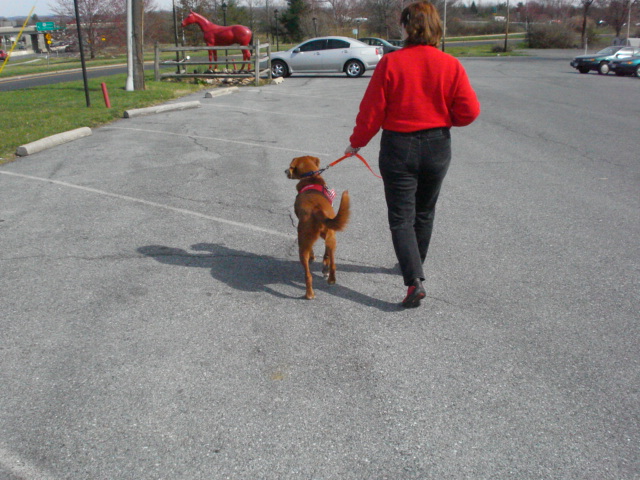
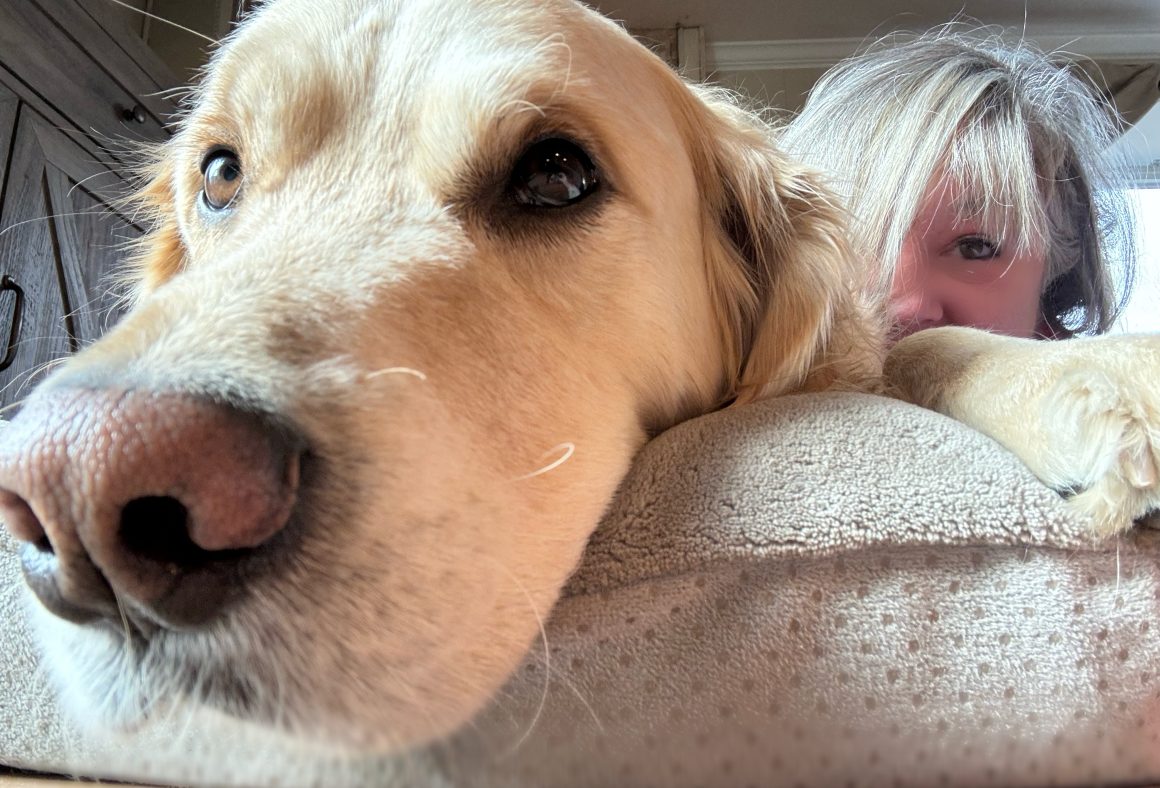
I wrote about a “red horse” that Chloe took a dis-liking too. The post can be accessed if you click here. As time has passed over the last couple of months, her discontent at seeing the red horse has become WORSE — not better! With a new driver in the van in the form of my 17-year-old son, Chris, I decided that perhaps a trip to the restaurant was in order so that she could see the horses up close – and personal. I wanted her to face her fears not only for her own good, but also so that my inexperienced new driver could continue to learn to drive safely!

There are three horses actually. One horse is in a tiny street level “corral”, the second one is on top of the restaurant sign, and a third is on top of the motel associated with the restaurant.

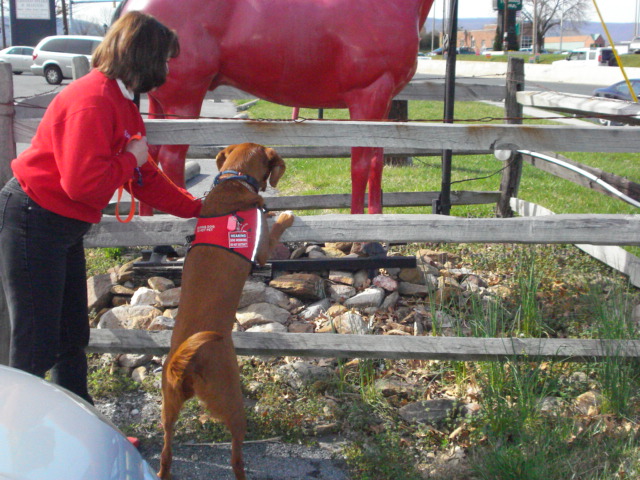
red-horse-005.jpg I was actually a “wee bit” nervous as I wasn’t sure how she would respond. Chloe understands commands and the tone of a voice. But I couldn’t exactly “reason” with her as we exited the van to face her fears. I was surprised that she practically drug me to the first red horse. I didn’t want her to “freak out” as I was in my Fidos For Freedom gear, having just returned from a DEMO to a brownie troupe. I certainly didn’t want Chloe and I to be poor representatives of my favorite organization!

I was a little bewildered that she didn’t even growl at the horse! She has such a fit in the van, I just knew the hair on her back would stand straight up as she barked her head off! As she doesn’t look nearly as cute without a head, I was glad to see her under such control. red-horse-008.jpg

Towards the end, she actually started wagging her tail. I was very glad to see her so calmly approach, study, and relax around something that has been upsetting her for months.

What made Chloe so calm around something she’s been so disturbed about for so long?

Perhaps facing her fears along side of someone she trusts helped.

I thought about how true this is of my own life as well.

Facing my fears, is much easier to do and much more successful when I have someone I trust beside me. Obviously, my biggest fear is that of my deafness. I am blessed to have a wonderful cochlear implant that maximizes my hearing, various technologies that improve how well I hear in different environments… yet I will always be a “deaf person”. I don’t hear “normally”, but I do hear. Having Chloe gives me confidence… but her partnership doesn’t give me my hearing back. I trust Chloe’s ears, and she is always beside me. So she helps me face my fears, just by her presence… which in my case is being able to hear the world around me in such a way that I stay “safe” and “aware”.

It’s also important to find people who can come along side you when you are fearful. I think that is why many people search out support when they acquire a disability. The internet is a GREAT thing. One can research, search, and FIND people who are facing the same thing they find themselves now living. There are numerous support groups, organizations, clubs and message boards for those with hearing loss.

Sharing your fears, worries and challenges with like-minded people, allow most individuals to face their fears with a little more determination, a little more courage, a little more optimism, and a little more success.

Denise Portis
©2008 Hearing Loss Diary
Update on Deaf for a Day

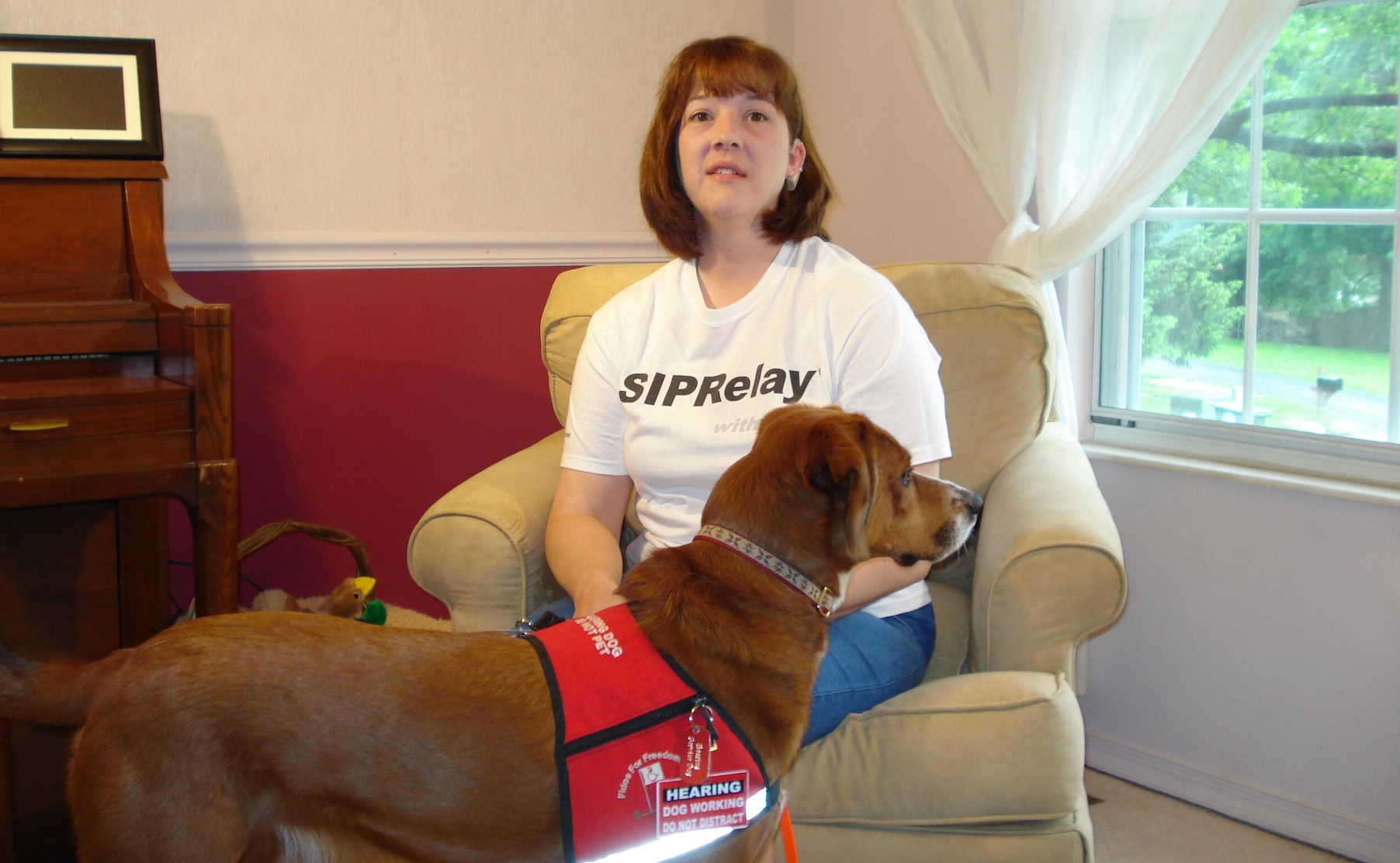
3-26-chloe-and-i-005.jpg
Things that make me go “hmmmm”? It’s curious as to why some years “Deaf for a Day” goes by without any ripple, with every goal I have for my students is met! Other years D4D seems to really flop! (grin)

I’ve not been able to pinpoint or “guess” how it will go, and so have not yet been able to accurately guess how my students may respond. This year I was contacted by a record number of teachers of sign (5 to be exact… usually it’s only 2-3 per year). It’s great to share ideas when teaching ASL to high school students, and “Deaf for a Day”, can be a very effective learning tool. One teacher that I have “met” online, actually has her students “Deaf for a week”! She teaches in a traditional school, however, so it’s easier to get updates from the students Monday through Friday.

I was in contact with a teacher from Texas this year who also teaches ASL to a large homeschool high school co-op like I do. He also teaches in another type of educational setting, and so sees “both sides” and can hypothesize about things that I cannot do. He believes that homeschool families are worse about “embracing” anything that will “mess with their schedule”, than others. I like to think that isn’t true.

This year was a “tough” year for me regarding my “Deaf for a Day” assignment. Again, I wish I knew what to look for ahead of time so that I can “brace myself” for the emotional negatives that come from students who “don’t get” the assignment. It was even suggested to me through a parent survey, that I give the students more time to prepare for the assignment. My personal opinion is that if a student has to much preparation, they aren’t really experiencing D4D. I’ve not ever met one person who planned when they’d go deaf. Not anyone who lost their hearing slowly, or overnight. So “preparing” themselves and their families is a little confusing to me. Families do not get to plan ahead for things that “hurt” when they are real.

I think that is why my daughter had such a strong reaction to what she was overhearing in the classroom. (Something I’m not able to do for obvious reasons). She was angry because some weren’t learning “anything… not even at the very beginning of the assignment”. ‘Course I also think it’s because my feelings were hurt so deeply, as well.

I believe I have more paperwork and written explanations, etc., about this assignment than most teachers of sign. And yet… it seems to be that this does not insure my students come away from D4D with new insights and having learned something valuable about their own hearing.

Certainly, the MAJORITY of my students do learn something, and the assignment is successful in giving them a glimpse of what it would be like should they become “late-deafened”… or adventitiously deaf. It allows their families to “realize” with a very sudden type of clarity, how they would react should their family member acquire a disability. The reality of the how successful this assignment may be, actually hinges on the hope that the students experience what to THEM is a NORMAL day… but doing so “deaf”. If you choose a day that is out of the ordinary, it’s not a day you can really experience D4D. I actually have had parents upset that their child wasn’t able to do anything all day long! Since when does being “deaf” keep you from school, your chores, your work, your church, your friends? Grin/grimace! The only thing I cannot do is HEAR. I worship, work, study, drive, “do chores”, love, laugh and learn. Sigh.

I currently teach 3 levels of ASL, and have taught students up to 5 levels. However, I offer the D4D assignment in ASL 1 class. I’ve always been very up front about what I teach… I do NOT only teach sign. It is important to me that my students realize that most people with hearing loss are not culturally Deaf. Deaf history, technology, advocacy and disability rights are also things we discuss and learn about in class. The D4D assignment seems to “naturally fit” into my ASL 1 class as I’m really trying to provide a good foundation about hearing loss. We don’t just learn a “few signs”. I am careful to explain my goals for the class in my “class description” and syllabus.

Each year I learn something new about D4D, and student reactions. Some years… I’m tempted to ditch the project. Some years… I yearn to change things to make it easier on the students to keep “some” (albeit a minority) from reacting so negatively.

However, each summer I come to the same realization. D4D does what it was designed to do! Not every individual who suddenly faces a disability or loss of a sense handles it well. Some react with shock, negative thinking, depression, etc. My students are people too… as are their families. I don’t have the statistics, but I imagine the percentage of those who handle it poorly, matches the percentage of folks who truly do handle real crisis poorly. It’s human nature.

Those who have negative reactions, often … eventually… recover. (The alternative is not good). Given more time… I’m sure even my students who handle the onset of “deafness” badly, will eventually turn it around. Maybe I should ask they be “Deaf for a Week”! (Naaaah! Just kidding!)

Denise Portis
©2008 Hearing Loss Diary
Back to Work

chloe-march-17th-002.jpg

Chloe was sick with a “tummy thing” Saturday through Sunday. Many people do not realize that a working dog is susceptible to occasional “tummy rumblings” and other “doggie colds” as they are exposed to so much more than a pet. At Fidos For Freedom, we are encouraged to take our working partners to the vet every 6 months for a “well check”. Chloe receives many vaccinations that are not even required by law, just to insure that her immune system has the very best defense against sickness. She gets sick about 3 times a year, and they are usually tummy things.

Early Saturday morning she woke me up with the same alert she uses to let me know my alarm was going off. At first I mumbled “good girl”, and reached for the alarm to turn it off. I think the fact that I was SO TIRED, I thought to look at the clock. 1:42 AM. Hmmm…

Chloe proceeded to show me why she got me up… poor sick girl! I put her on a hamburger/rice mixture for 48 hours. I fry and then strain (+ rinse with water) the very leanest hamburger, and boiled some white rice. Mixed together it seems to be the very best thing for an upset stomach. I keep these things on hand all the time.

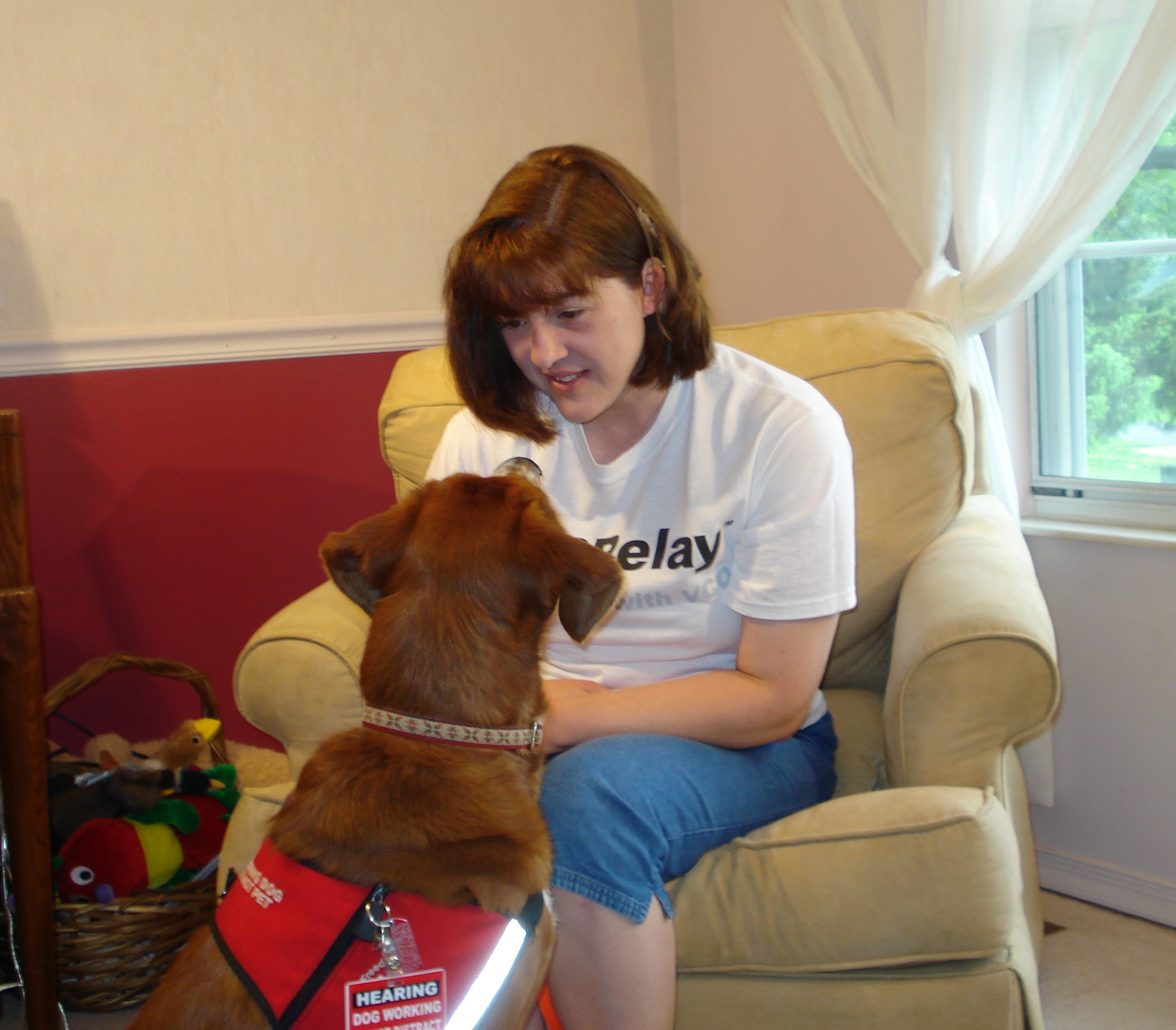
The picture above is Chloe right when I told her Monday morning that we were going to “go to work”! She was so excited! She ran to the window, and then stayed literally under my feet until I dressed her in her vest to go. One of the hardest things for she and I is for me to have to put her in her kennel. Sunday morning church, and a few errands had her resting and me? Well I felt practically naked without her. I kept looking around for my backpack (Chloe’s stuff) everywhere I went. chloe-march-17th-010.jpg

Many adjustments are made and even necessary when you have a working dog. You have to prepare in advance before going anywhere. Do I have water for Chloe and her collapsible bowl? Do I have her mat? Do I have treats, extra leash, ADA law book and “rights of access” brochures? It’s almost like carrying a diaper bag with me wherever I go. I remember those days when my kids were little and I had to “cart” their stuff around. Now I am doing it again. But Chloe does so much for me… the least I can do is carry some of her things!

The nice thing about saying, “Let’s go to work”? Chloe enjoys working so much! She practically jumps into her vest, and prances right out to the van! She loves being by my side and “showing” me sounds all day long. If Chloe had her way? She’d not ever take sick leave.

Denise Portis
©2008 Hearing Loss Diary
Sometimes? Sometimes it hurts…

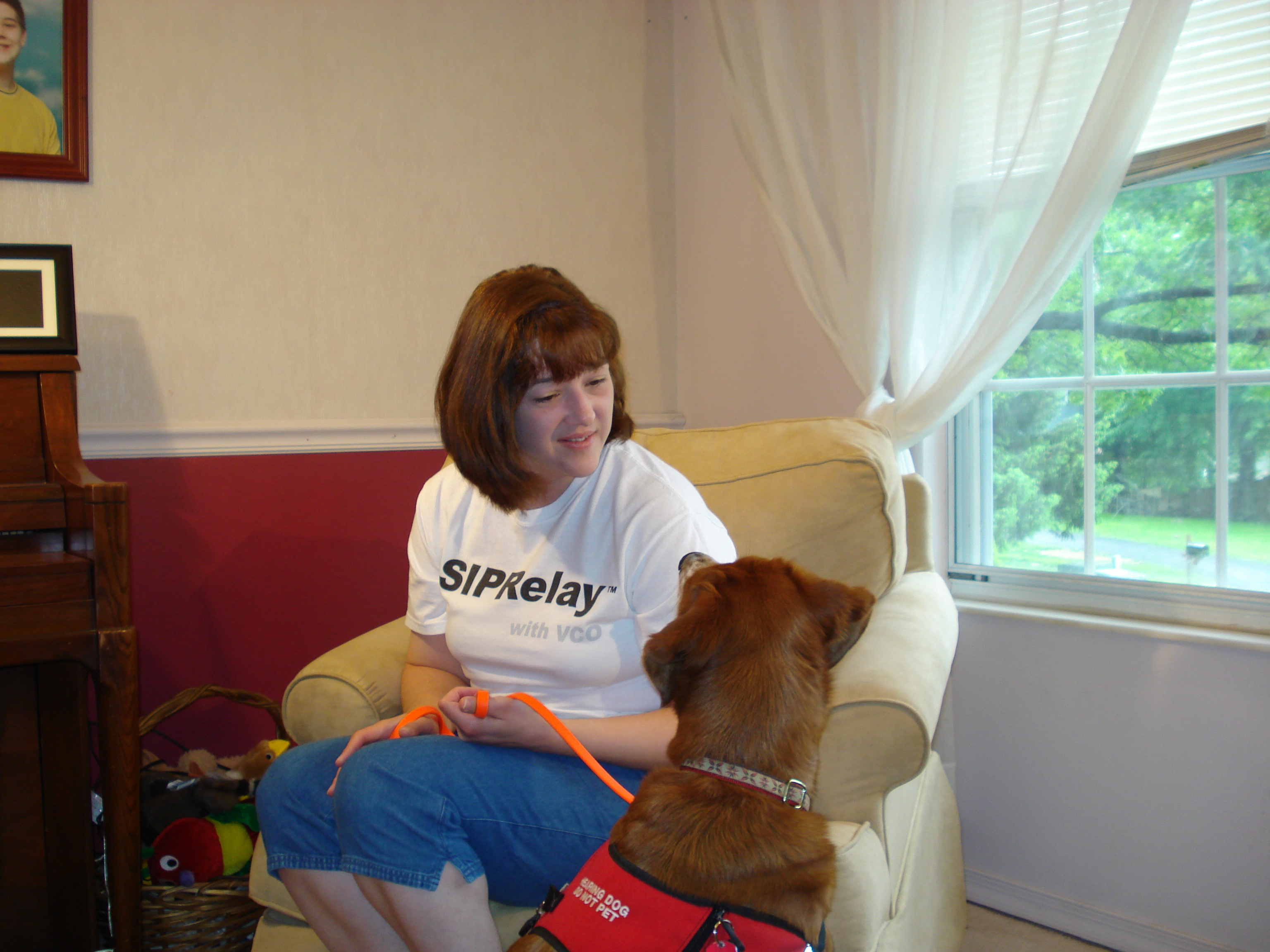
sometimes-its-hard.jpg

I like to think that I approach life with a really wonderful attitude. One of the biggest reasons that I am able to do so, is that I am really so incredibly blessed! I have the absolute greatest family, a wonderful husband, an assistance dog who loves me in the way God created dogs to love people (unconditionally), a super church, etc. Even my disability is one in which I can “handle” most days, and have been blessed by the friendships of others who really have a bigger burden to bear in their own disabilities.

Some people hate the word “disability”, as it lends one towards thinking they are NOT able – hence “dis” abled. I do like to focus on what I can do, instead of those things I cannot. However, I try very hard to balance that with reality. There ARE things I cannot do as a result of my disability. I think when one says that certain physical challenges (or emotional or mental) do not affect our everyday lives, one is really embracing a state of denial. I think we have to be honest with ourselves. It is only in this way we can then go out and be honest with others. I sit in my house alone as I write this, as my family has gone to participate in RESPITE… a ministry of our church. It is a ministry I cannot participate in, as I cannot allow my own deafness and balance problems place a child with disabilities in danger. I don’t care if I tumble down the stairs, or fail to hear something that ends up hurting me. I do care should I place another in danger. I accept that my disability will not allow me to do some things… things like RESPITE.

“Honestly”? (Grin), I think Christians make a mistake when they choose to go around acting as if life is always good all the time. GOD IS GOOD ALL THE TIME, but sometimes? Life isn’t! Sometimes? Sometimes it hurts…

Oswald Chambers wrote in My Utmost for His Highest, “A river is victoriously persistent, it overcomes all barriers. For awhile it goes steadily on its course, then it comes to an obstacle. For awhile it is balked, but it soon makes a pathway round the obstacle. You can see God using some lives, but into your life an obstacle has come and you do not seem to be of any use. Keep paying attention to the Source, and God will either take you round (it) or remove it. Never get your eyes on the obstacle or on the difficulty.”

I really do try to live that way. I consider myself a persistent little brat! I’ve had a few barriers disguised as boulders thrown into the course of my river! Sometimes, that boulder has acted like a dam. The water rising around me made me feel defeated and useless. There were times I wanted to stay in that stagnate pool so that I didn’t have to continue my journey down the riverbed. But after lessons learned, and a new desire to persevere, the “water” broke over the top of that barrier. And golly! The waterfall created after a necessary period of “standing water” was magnificent! Even in my deafness I could hear the roar of newfound power released, as I heard it from my heart! I know that God must have looked down and saw the water finally cascade over that barrier and thought, “Ah! Now that is why I created her! Look at her go now!”

My deafness has brought me a unique and valuable group of peers, many of whom have become very close friends. My deafness has definitely coerced me closer to my God; sometimes with a gentle push and other times with a giant shove. My deafness has helped me to really “listen” with other senses, as I’ve learned to see emotions play across people’s faces more clearly. People do not realize that their emotions can many times echo off of them like waves. These emotions of tension, happiness, sadness or anger, can almost knock a person over if they are really listening with something other than ears.

It reminds me of when I stood in the Atlantic ocean about 15 years ago. My family I were staying in a condo with my father-in-law on the Outer Banks of North Carolina. I stood in about 18 inches of salt water. Tears of shock poured down my face as I had been “sucker punched” with the knowledge that I could not hear the ocean. I could feel it, but I could not hear it. I grew up in Colorado – a completely landlocked state for those of you with geographical “issues”. (smile) So my very first time to stand in the ocean, trying to hear what I no longer had the hearing to do, wounded me deeply. (Now that I have a cochlear implant I have to get my ears to the ocean… well, the rest of me too! I’m fairly certain Maryland borders the ocean!) That week I did, however, learn how the ocean feels. Even in 18 inches of water, the current could be felt. My toddlers played around me in the surf and would squeal and run when they heard a big wave come crashing towards the shore. I soon learned that what I couldn’t hear, I could feel… and rarely was caught unaware by an incoming whitecap!

I think people with hearing loss can learn to hear better than those with normal hearing… if only we determine to do so.

But you know? Just when I think I’ve got a “handle” on my hearing loss and balance issues, something happens to remind me that hearing loss can still hurt. Sometimes? Sometimes it hurts…

I slammed the door of our van on my son’s hand yesterday. It was only by seeing my daughter’s horrified expression as she faced me and saw the commotion outside my door that I even knew it had happened. My first response was, “Why didn’t you holler?” Both assured me that everyone within a square mile DID hear him holler. Being able to hear, wouldn’t have meant his hand would not have been “in the wrong place at the wrong time”, but I certainly would have opened my door quicker had I heard him!

I’ve also learned that even though I tend to “read someone’s emotions well”, if that person decides to deliberately hide their feelings then I am truly “deaf”. As a mother, I find myself tagging along behind a child who is hurting, trying desperately to sense what is wrong. I feel like Sherlock Holmes sometimes, trying to deduce what might be the problem from analyzing evidence that is clear… about a problem that is NOT. If my children need their “space” and choose to not discuss certain things, it is their choice. I can sense a problem, but not be able to identify it. It can be rather annoying for a mother to shadow your every step and try to find out what is wrong! My children are growing up, and needing me less. My brain knows that, but my heart refuses to let go just yet.

I worry about how I’ll know if something is wrong, when they eventually move out… get married… and have families of their own. If I’m not within arms reach, how can I feel that something is wrong… that something is hurting them? I know and trust that God will always be that “within arm’s reach” source of comfort. Knowing it, trusting it, and being able to truly come to terms with it is something else though!

I suppose that is why my “river” will always have barriers to work around. Sometimes those barriers are big things; things that cause my river to surge to a halt. Other times, those barriers are a series of small things. Ultimately, I must press on. My river has a course to run.

Phil. 3: 13(b)-14 “but this one thing I do, forgetting those things which are behind, and reaching forth unto those things which are before. I press toward the mark for the prize of the high calling of God in Christ Jesus. “

Denise Portis
©2008 Hearing Loss Diary

Loving Someone with Hearing Loss, Part 2

One of my readers reminded me of a video I taped last summer of my kids explaining what it was like having a mom with hearing loss. I shared it in a workshop at a convention in both Texas and North Carolina. I thought I’d post it here as well to share with all of you.

The Kids

My hearing loss has definitely been a “hidden blessing” and I have much more to be thankful for than things in which to “whine about”!

Denise Portis
©2008 Hearing Loss Diary